Non-serviceable CPU water coolers allow their buyers to kill two birds with one stone: use their favorite "chip" in a non-standard mode and expel the heated air from the PC as quickly as possible. And if you're lucky, the cooler will also operate quietly.

I wonder what to expect from a water cooler named "Typhoon"? Super-efficient heat dissipation, terrible noise, or a combination of both? Or maybe deadly consequences for the "hardware"? We hope you're as curious to find the answer as we are. So, in the current review, we'll talk about the senior, more productive AIO from a brand already well-known to our readers – Vinga Typhoon.
Specification
|
Manufacturer and model |
Vinga Typhoon |
|
|
Supported CPU sockets |
AMD Socket AM2 / AM2+ / AM3 / AM3+ / AM4 / FM1 / FM2 / FM2+ Intel Socket LGA1156 / LGA1155 / LGA1150 / LGA1151 / LGA1366 / LGA2011 / LGA2011-v3 / LGA2066 |
|
|
Declared TDP of supported CPUs, W |
150 (Intel) / 140 (AMD) |
|
|
Base material |
Nickel-plated copper |
|
|
Weight of assembled cooler, kg |
1.095 |
|
|
Thermal interface |
Thermal paste in syringe |
|
|
Radiator |
||
|
Material |
Aluminum |
|
|
Dimensions, mm (in brackets – own measurements) |
275 x 120 x 27 (272 x 118 x 27) |
|
|
Radiator dimensions with installed fans, mm |
275 x 120 x 52 |
|
|
Water block |
||
|
Pump speed, RPM |
2200 ± 10% |
|
|
Current, A |
0.25 ± 10% |
|
|
Nominal voltage, V |
12 |
|
|
Operating voltage, V |
10.8 – 13.2 |
|
|
Power, W |
3 |
|
|
Power connector |
3-pin |
|
|
Tubing length, mm |
328 |
|
|
Fans |
||
|
Number of fans |
2 |
|
|
Bearing type |
Hydrodynamic |
|
|
MTBF, hours |
50,000 |
|
|
Fan voltage, V |
up to 12 |
|
|
Current consumption, A |
0.26 ± 10% |
|
|
Power, W |
3.12 |
|
|
Fan speed, RPM |
1600 |
|
|
Noise level at different speeds, dB |
17.8 – 34.1 |
|
|
Maximum airflow, m3/h (CFM) |
142.2 (83.64) |
|
|
Static pressure, mm H2O |
4.08 |
|
|
Power connector |
4-pin |
|
|
Fan dimensions, mm |
120 x 120 x 25 |
|
|
Cable length, mm |
440 |
|
|
Manufacturer's website |
||




|
Processors |
AMD Phenom II X6 1100T @ 4.0 GHz, 1.4 V (Socket AM3+, 3.3 GHz, L3 6 MB) Intel Core i5-2500K @ 4.5 GHz, 1.44 V (Socket LGA1155, 3.3 GHz, L3 6 MB) |
|
Motherboards |
ASUS SABERTOOTH 990FX (AMD 990FX, Socket AM3+, DDR3, ATX) ASUS P8P67 (Intel P67, Socket LGA1155, DDR3, ATX) |
|
RAM |
2 x 1024 MB DDR3-1333 TwinMOS 9DRTBKZ8-TATP |
|
Video Card |
AMD Radeon HD 6950 (2 GB GDDR5) |
|
Hard Drive |
Samsung HD080HJ (80 GB, 7200 rpm, 8 MB, SATA 3 Gbps) |
|
Power Supply |
Seasonic X-760 (SS-760KM), 120 mm fan |
|
Case |
Enermax Hoplite ECA 3220 (2 x 120 mm fans) |
|
Thermal Paste |
akasa AK-460 pro-grade (3.3 W/m·K, -45…+200°C) |


The efficiency of Vinga Typhoon in cooling test processors can be compared to very large tower solutions, but the novelty lags behind top air coolers and a number of previously tested AIO coolers. The reason lies in the slower operation of the propellers at a speed of 1600 rpm compared to over 2000 rpm in other water coolers.
Reducing the blade rotation speed to 1200 rpm increases the lag by another 2-3°C, but this mode still allows effective cooling of overclocked high-performance processors of previous generations. This means that more energy-efficient modern models will also be within the new product's capabilities, even at reduced rotation speeds.
Remember that the full load mode (Full load) implies maximum utilization of all processor cores. Therefore, in real conditions where the load is variable (for example, in games), you can safely expect lower temperature readings.

Testing Vinga Typhoon on a 300-W heating stand shows a dependence close to linear. Thus, using fans even at low frequencies will allow effective heat dissipation from processors.
|
Fan supply voltage, V |
Blade rotation speed, rpm |
Noise level |
|
6 |
1010 |
Silent |
|
7 |
1130 |
Almost silent |
|
8 |
1240 |
Very quiet |
|
9 |
1330 |
Quiet |
|
10 |
1410 |
Quiet |
|
11 |
1480 |
Below average, slightly noticeable |
|
12 |
1540 |
Below average |
The pump, operating at a frequency of 2300 RPM, turned out to be almost silent, so the overall background in most cases will depend on the propellers. In the mentioned moderate mode (1200 RPM), the novelty operates almost silently, and when increasing the frequency to almost nominal value (1540 RPM), acoustic comfort is not disturbed. This allows us to call this water cooler one of the quietest among those we have tested.
For the sake of experiment, instead of the bundled fans, we tried to install faster solutions, which allowed us to achieve efficiency on par with competitors. However, in practice, such a replacement will be expensive, so we recommend buying the Vinga Typhoon for those who prioritize a comfortable noise level.
Conclusions

For its slightly more than $60 (1708 UAH), Vinga Typhoon is a very attractive device, both externally and in terms of technical specifications.
Although it is an average representative of non-serviceable water coolers, once you turn on the computer, the soft blue LED lighting of the propellers and water block radically changes the appearance of the system unit. If the side of the case is equipped with a transparent window, then the owner of the "typhoon" will definitely have something to admire.
The second point worth mentioning is the installation process. It will not cause any difficulties. Even the most inexperienced user, who can hold a Phillips screwdriver, will be able to perform it.
And, of course, performance. The bundled propellers, operating at a frequency of 1600 RPM, create a comfortable acoustic background that will not interfere with thinking at the PC. It is quite logical that with such a parameter, the novelty slightly lags behind more agile solutions. However, for cooling a modern AMD Ryzen or Intel Core processor, it will be quite suitable, and good results can be achieved even when reducing the speed to 1200 RPM.
Overall, Vinga Typhoon can become a kind of compromise in a modern system, allowing experimentation with overclocking at very comfortable noise levels. However, for those who want to embark on the challenging path of overclocking, we still recommend looking for either a water cooler with faster propellers or a large air cooler.
Advantages:
- pleasant appearance;
- efficient operation at low fan speeds;
- compatibility with most current and some outdated platforms;
- use of fans based on hydrodynamic bearings with a wide range of operating speeds and blue lighting;
- quiet operation;
- ease of installation;
- affordable price.
Features:
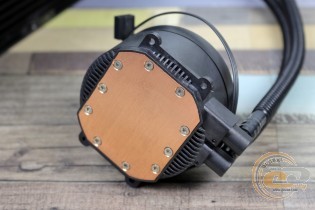
- compact size of the water block does not interfere with the installation of memory modules of any height;
- cooler is not compatible with AMD Socket TR4 platform.
Author: Oles Paholok
Translation: Yuriy Koval
We express our gratitude to the companies AMD, ASUS, Enermax, Intel, Sea Sonic and TwinMOS for providing the equipment for the test bench.