For enthusiasts and geeks, a system unit is not just a faceless box filled with components, but a faithful assistant with which you spend the lion's share of your time. It is quite logical that this category of users prefers to assemble computers themselves, carefully selecting each component to achieve the necessary functionality and give it individuality - something you can't buy in a store. Of course, if the budget is very limited, most of it is directed towards the "hardware" to get the maximum FPS in games or for comfortable execution of certain tasks, while the appearance takes a back seat. But, agree, in the modern world, the aesthetic component is also very important, and the same PC can be assembled in several ways - from ordinary Tower cases to compact Slim solutions and more exotic open stands or showcase cases. It is a representative of the latter class of devices that visited our test lab. Meet - Vinga Limpid.
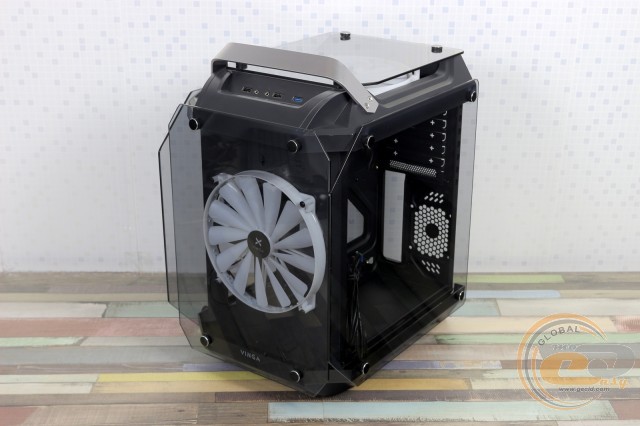
The name of the novelty can be translated as "transparent," which best reflects the main feature of the case - a large number of glass panels, thanks to which all system components are visible as if in the palm of your hand. But how are things in practice, and what else interesting can this model offer? Let's try to find out.
Specification
|
Model |
Vinga Limpid |
|
|
Case Size |
Mini Tower (Cube Case) |
|
|
Motherboard Form Factor Support |
ATX / microATX / Mini-ITX |
|
|
Color |
Black |
|
|
Bays |
2 x 3.5” (internal) 2 x 2.5” (internal) |
|
|
Expansion Slots |
7 |
|
|
Maximum GPU Length (in brackets - own measurements) |
290 mm (280 mm) |
|
|
Maximum CPU Cooler Height (in brackets - own measurements) |
160 mm (146 mm) |
|
|
Ports |
1 x USB 3.0 2 x USB 2.0 2 x audio ports |
|
|
Pre-installed Fans |
Front Panel |
1 x 200 mm |
|
Top Panel |
1 x 200 mm |
|
|
Fan Installation Options |
Front Panel |
1 x 200 mm / 2 x 120 mm |
|
Rear Panel |
1 x 80 mm |
|
|
Top Panel |
1 x 200 mm |
|
|
Liquid Cooling Installation Options |
Front Panel |
120 mm / 240 mm |
|
Power Supply |
None |
|
|
Materials |
Front, Side, and Top Panels |
Tempered Glass 3.87 mm |
|
Chassis |
Steel 0.62 mm thick |
|
|
Dimensions (in brackets - own measurements) |
460 x 280 x 370 mm (482 x 297 x 380 mm) |
|
|
Weight (net) |
7.3 kg |
|
|
Manufacturer's Website |
||
Packaging and Delivery Set
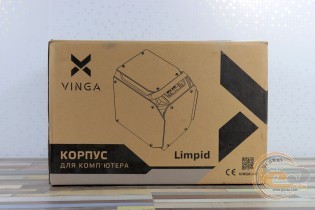
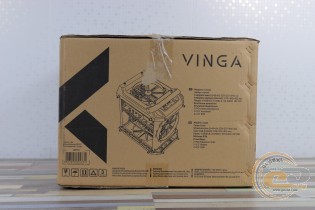
Vinga Limpid is sealed in a regular cardboard box with monochrome design. On its sides, you can see the model name and a schematic image of the case. The buyer can also familiarize themselves with the device's layout and specifications.
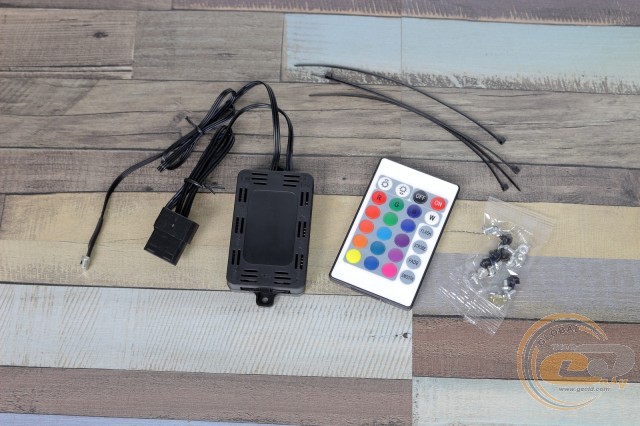
The delivery set includes the necessary accessories for assembling a computer: an additional stand and a set of screws for mounting the motherboard, fans, and drives. In addition, there is a set of disposable cable ties and an RGB LED controller with a remote control.
Appearance
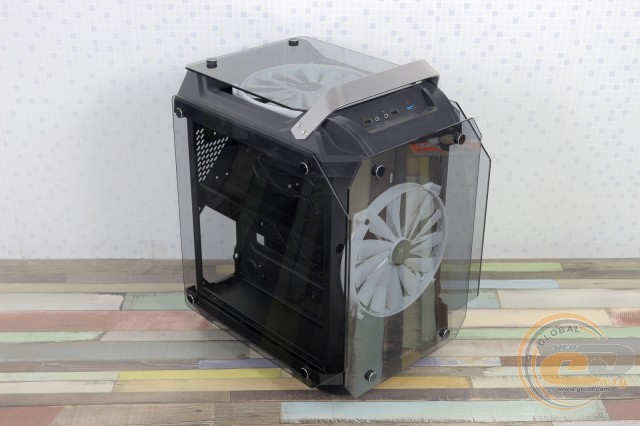
We have a rather interesting and unusual case. Structurally, Vinga Limpid is represented by a steel chassis (0.62 mm) and a series of hinged panels made of plastic and tempered glass (3.87 mm). In all cases, simple geometric shapes prevail: it resembles a kind of crystal cube with a lightweight handle for carrying on the top edge. The chassis is covered with black matte paint, and fingerprints are barely visible on it, but the glass requires appropriate care to maintain a presentable appearance.
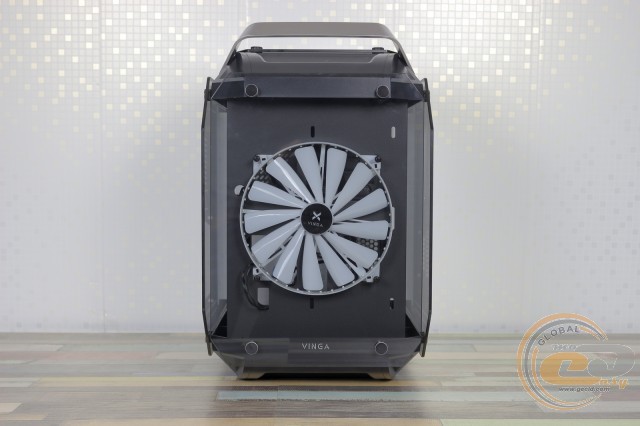
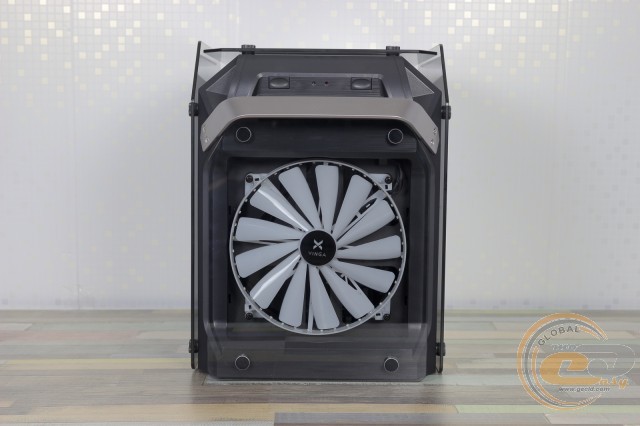
The front part is completely transparent, with beveled and rounded corners. The Vinga brand logo is painted at the bottom. Below it, a large 200-mm fan is clearly visible. By the way, for air circulation, the manufacturer has made fairly large gaps between the panels themselves and the edges of the case. On one hand, this will probably improve the temperature performance of the system components, but on the other hand, dust and small particles will accumulate quite quickly.
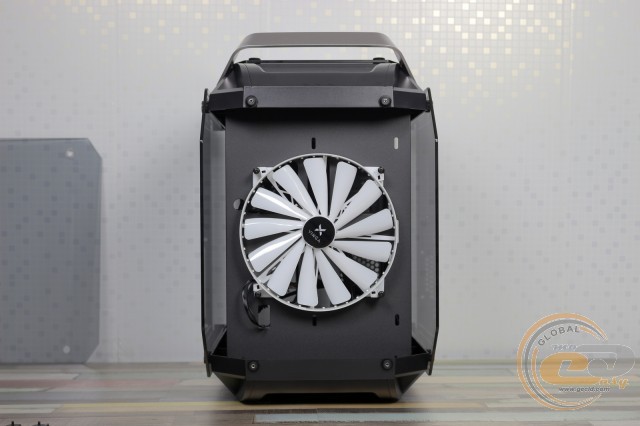
The facade is attached using two pairs of convenient screws with a patterned head, which look quite stylish, including thanks to the black coloring and shiny fascia around the perimeter. The contact points of the panels with the main part of the case have cushioning pads, and the inner side of the screws is equipped with rubber gaskets. All this is designed to protect the glass from mechanical damage. After dismantling, you can access the pre-installed fan. There are also a number of mounting holes offset to the right side for installing a pair of 120-mm fans.
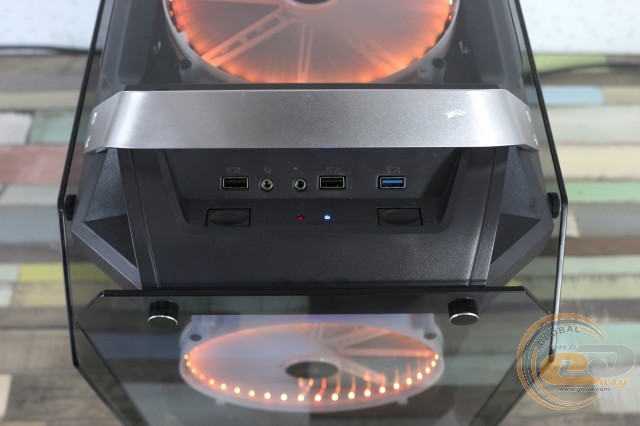
The Vinga Limpid external interface block is located in a recess in the plastic part of the top panel. It includes a pair of USB 2.0 ports and one USB 3.0 port, as well as a 3.5-mm jack for a microphone and headphones. Next to them are large power and reset buttons, and between them, there is space for the usual LED indicators.
Looking at the back of the case, it may seem that it is upside down, as the seven expansion slots are located at the top, and the cutout for the motherboard's interface panel, the place for the 80-mm exhaust fan, and the power supply unit are at the bottom. But in fact, this is a feature of this model - a mirror reflection of the usual layout with the PSU located at the top.
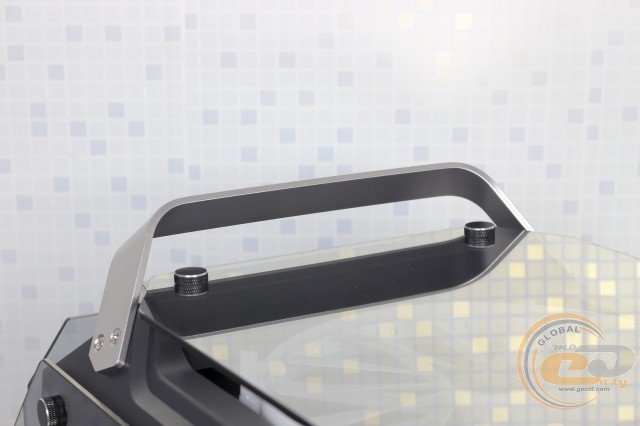
The top part consists of a sheet of glass mounted on a kind of plastic tray that is disguised as metal. The mounting is done using the same screws with a patterned head, and underneath hides another 200-mm "wind blower." It is also worth noting the aforementioned carrying handle.
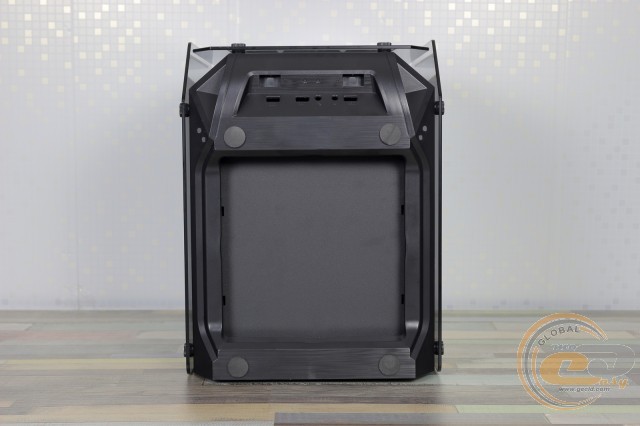
The bottom of the Vinga Limpid uses the same plastic construction as the top panel, but without the built-in interfaces, glass, and fan. The threaded holes are occupied by two pairs of rubber feet with a diameter of 23 mm, which provide good stability on different types of surfaces.
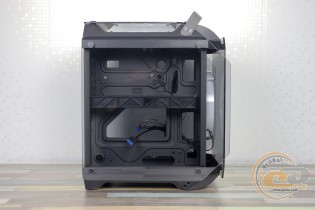
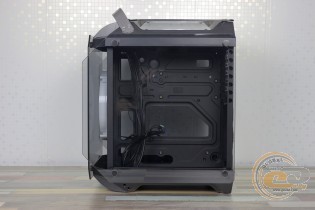
The sides of the case are made of transparent glass and secured with knurled screws. Dismantling is quite easy and effortless, and for convenience, the panels slightly protrude at the front and rear.
Internal Structure
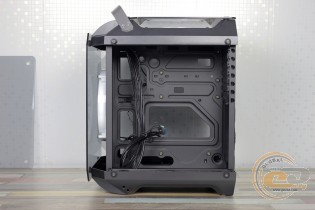
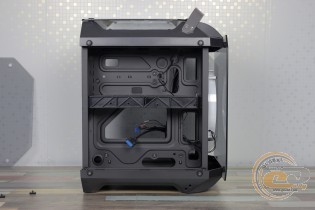
As already mentioned, the Vinga Limpid has a mirror-reflected internal structure. This means the motherboard is installed upside down, and the expansion slots are located at the top. The front part lacks racks, allowing for the installation of bulky components and improving the airflow of the system itself, thanks to the free circulation of air currents. In the motherboard tray, there is a cutout that allows for the installation of CPU cooling systems with a backplate without dismantling the board itself. The power supply and drives are located behind the motherboard tray.
There are a number of holes for cable management without silicone membranes but with tabs that secure these cables.
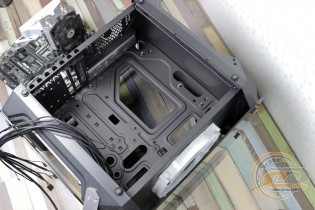
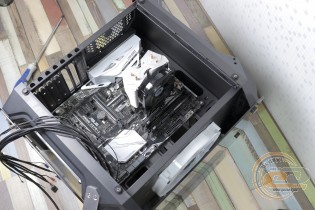
The motherboard is installed on standard 6-mm standoffs that the manufacturer has pre-installed according to the ATX specification. More compact solutions in the microATX and Mini-ITX formats will also fit here.
The power supply is installed vertically. Its mounting place is not equipped with anti-vibration pads, and the mounting is done with the included screws. Since all system elements are visible, it's worth considering a modular PSU right away to detach unnecessary cables.
In the Vinga Limpid, you can simultaneously install two 3.5- and 2.5-inch drives in a special plastic "shelf" behind the system board tray. The 3.5-inch models can be oriented both along and across the structure. They are secured with screws. Solid-state drives are inserted vertically and do not require a screwdriver.
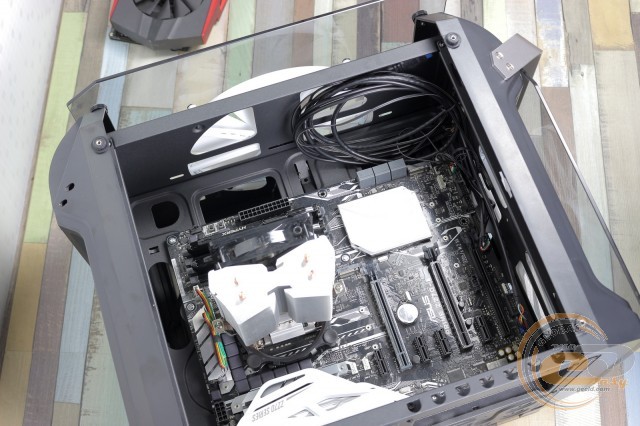
The width of the case is sufficient for installing CPU coolers up to 146 mm in height. For this reason, we could not use our usual 158-mm cooler Scythe Mugen 3, and replaced it with a more compact AARDWOLF PERFORMA 3X.
There are seven expansion slot covers: the first is reusable, while the rest will have to be broken out. They are not equipped with a tool-less mounting system or knurled screws.
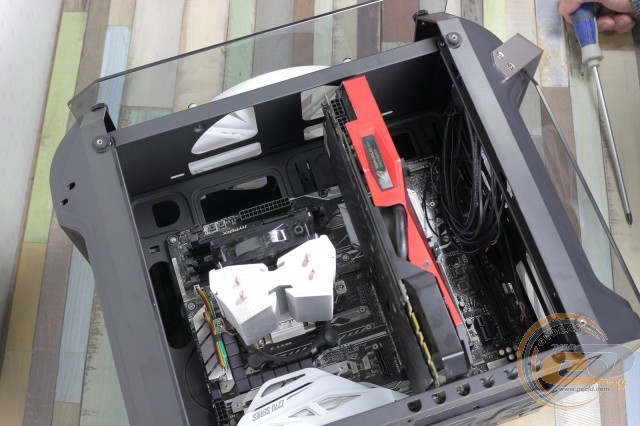
The case can easily accommodate a video adapter up to 280 mm in length (measured manually). Longer models can also be squeezed in: with our standard ASUS ROG Matrix Platinum GTX 980 with a length of 309 mm, we had to tinker, but it was still possible to install it.
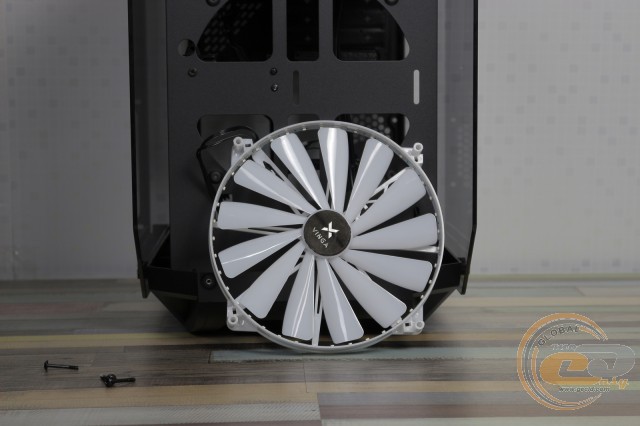
On the front side of the Vinga Limpid's front panel, there is a large 200-mm fan with RGB lighting and a 6-pin connector for connection. According to monitoring data, it operates at a speed of 560-590 RPM. Unfortunately, the manufacturer does not specify the type of bearing used or its lifespan. Instead of the standard fan, two 120-mm solutions can be installed, but only with a side offset, which is unlikely to be used due to the not very aesthetic appearance. Most likely, these holes will be used for mounting a radiator (120 or 240 mm) of a liquid cooling system on the inner side of the partition.
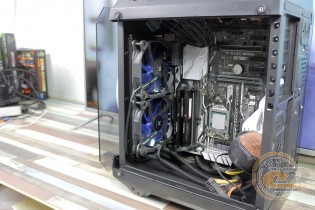
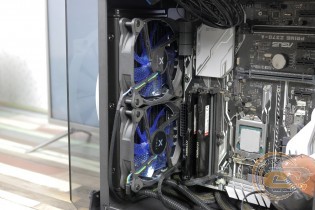
However, you will have to settle for shorter video cards, and there may also be conflicts with perpendicularly located SATA connectors, which should be taken into account.
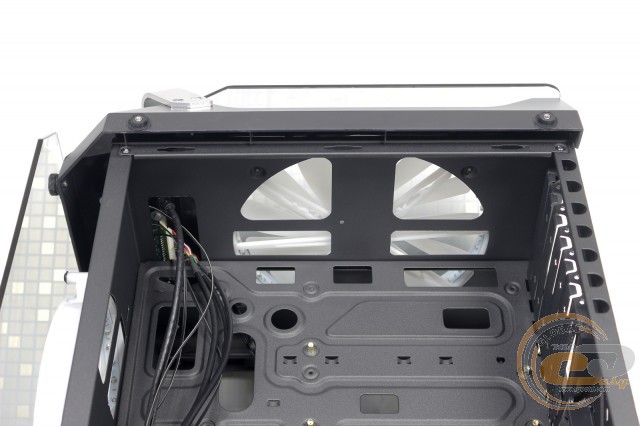
In the "attic" of the case, there is space for a similar 200-mm fan. And in the rear part, an 80-mm exhaust fan can be installed.
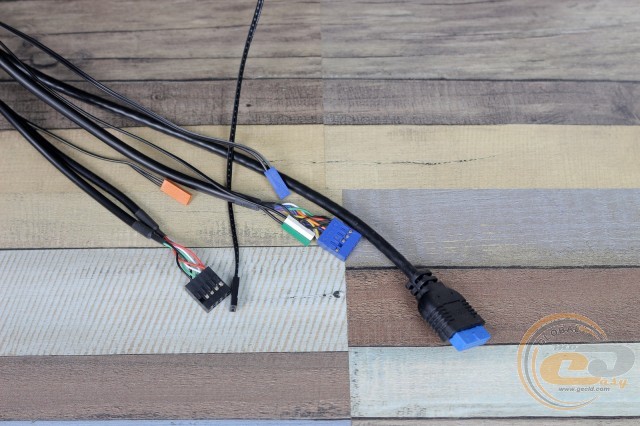
The set of connectors for connecting the front panel includes an HD Audio header, connectors for connecting power/reset buttons and LED indicators for power supply and hard drive operation, as well as connectors for connecting USB 3.0 and USB 2.0 ports, which have the following length:
|
Name |
Length, cm |
|
USB 3.0 |
70 |
|
HD Audio |
60 |
|
USB 2.0 |
60 |
|
Buttons and Indicators |
60 |
The included RGB LED controller deserves special attention. It's a small box to which you can connect 6 fans with RGB lighting, similar to the included ones, as well as two 4-pin LED strips. The controller is mounted behind the motherboard tray, and the optical sensor is brought to the front panel. Power is supplied via a Molex connector, and control is carried out via a remote.
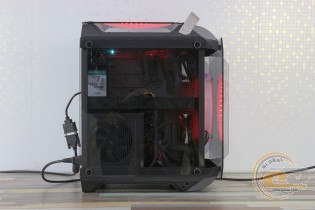
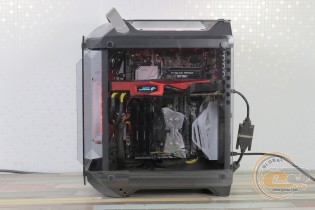
Overall, the process of assembling the system inside the Vinga Limpid is quite simple and only slightly complicated due to the compact dimensions. The construction is very solid, and there is no sense of cost-cutting on materials. All parts are well-processed and fitted: without gaps, distortions, or sharp edges.
Visually, everything is also fine. The unusual shape of the case, transparent panels that allow you to admire the components, and the lighting definitely attract attention and add a certain futurism. The user has access to 16 colors and 4 operating modes: "Flash" - flashing of all colors; "Strobe" - flashing white color; "Fade" - smooth color transitions; "Smooth" - fast color transitions. In addition to selecting the mode, you can adjust the time, speed, and brightness of the flashing. Naturally, if desired, all this riot of colors can be turned off. The installed sensor perfectly processes remote control signals at a distance of up to three meters even at sharp angles.
Testing
|
Processor |
Intel Core i7-7700K (Socket LGA1151, 4.2 GHz, L3 8 MB) |
|
Cooler |
AARDWOLF PERFORMA 3X |
|
Motherboard |
ASUS PRIME Z270-A (ATX, Socket LGA1151) |
|
RAM |
2 x 4 GB DDR4-2400 HyperX Fury (HX424C15FBK2/16) |
|
Video Card |
ASUS GeForce GTX 980 MATRIX PLATINUM 4GB GDDR5 |
|
SSD |
KINGMAX SME35 HYPERLINK |
|
Power Supply |
Seasonic X-560 Gold (SS-560KM Active PFC, ATX, 560W) |
|
Thermal Paste |
Noctua NT-H1 |
Testing the heating of the main components was conducted only with the pre-installed fans - two 200 mm models on the front and top panels, operating at standard speeds of 560-590 rpm. Also, remember that due to the compact dimensions of the case, a simpler AARDWOLF PERFORMA 3X cooler had to be used instead of the standard Scythe Mugen 3. Therefore, comparing CPU temperature graphs with previous test participants is not entirely correct. The air temperature in the test lab at the time of measurement was 25°C.
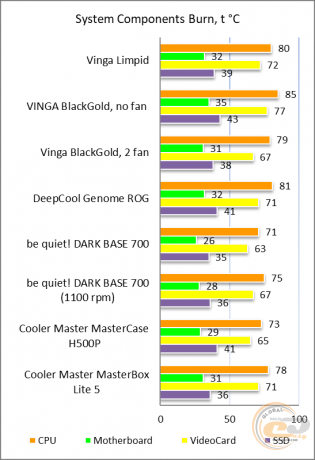
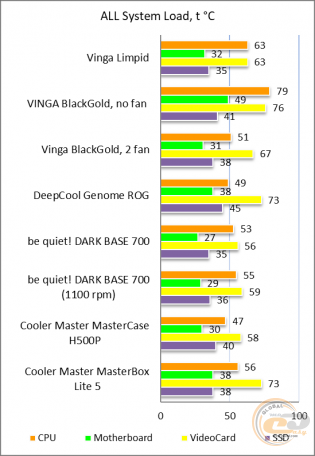
The "All System Load" chart shows component heating after 30 minutes of 3DMark Fire Strike in Ultra mode (4K resolution). And the "System Component Burn" mode shows temperatures under load with AIDA64 (Stress CPU and FPU) and MSI Kombustor applications for 15 minutes.
Even despite the compact dimensions, the novelty handles cooling quite powerful components well. Yes, it doesn't set any records, but the temperature indicators are not much higher than those of large tower solutions. All thanks to good ventilation of the structure and two large standard fans that operate very quietly, almost silently.
Conclusions
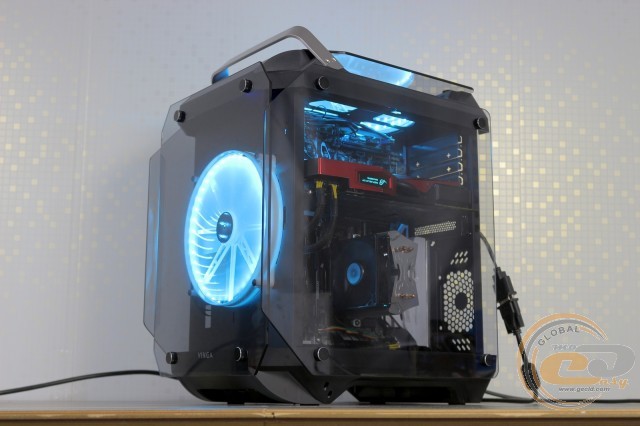
Perhaps the Vinga Limpid is the most unusual and interesting case that has passed through our hands recently. Visually, the novelty resembles a crystal cube. All thanks to the angular shape and transparent panels, allowing you to admire all the system components. Moreover, it uses not cheap plastic, but noble glass.
There is enough space to assemble a modern productive computer for work or gaming. It should only be noted that due to width limitations, low-profile tower coolers or water cooling will have to be used. In any case, the components inside the "cube" feel quite comfortable, showing good temperature indicators. All thanks to the decent ventilation of the structure and two quiet 200 mm fans with impressive lighting, for which a corresponding RGB LED controller and remote control are provided.
The downside of this beauty is the rapid accumulation of dust due to the openness of the structure and the smudging of the glass, so appropriate care will be needed to maintain its pristine appearance.
In any case, Vinga Limpid will definitely appeal to those users who are tired of the abundance of conventional Tower cases and want to assemble a non-standard PC and delight themselves with something original and beautiful.
Advantages:
- unusual design and compact dimensions;
- a large number of transparent glass panels;
- high-quality chassis assembly, edge panel finishing, and case painting;
- excellent rigidity and fitting of structural elements;
- ability to install graphics cards up to 280 mm in length and CPU coolers up to 146 mm in height;
- ability to install a pair of 3.5- and 2.5-mm drives;
- presence of two quiet pre-installed 200-mm fans with impressive lighting;
- included RGB LED controller with remote control;
- good temperature and noise performance.
Features:
- lack of vibration-damping elements in the mounting points of fans and power supply unit;
- possible obstruction of perpendicular SATA ports on ATX boards when installing a liquid cooling system on the front panel;
- open design and glass parts lead to quick accumulation of dust and fingerprints.
Author: Viktor Yefimenko
Translation: Yuriy Koval
We express our gratitude to BRAIN Computers, the official representative of Vinga, for providing the case for testing.
We express our gratitude to ASUS, Intel, Noctua, Sea Sonic Electronics and the brand HyperX for providing equipment for the test bench.