At the time of writing, for ₴2319 ($52), you can purchase a "bronze" power supply unit with a capacity of 750W and a PCIe 5.0 connector — agree, this looks like a very generous offer. But we understand that such a combination hints at noticeable savings in internal components.
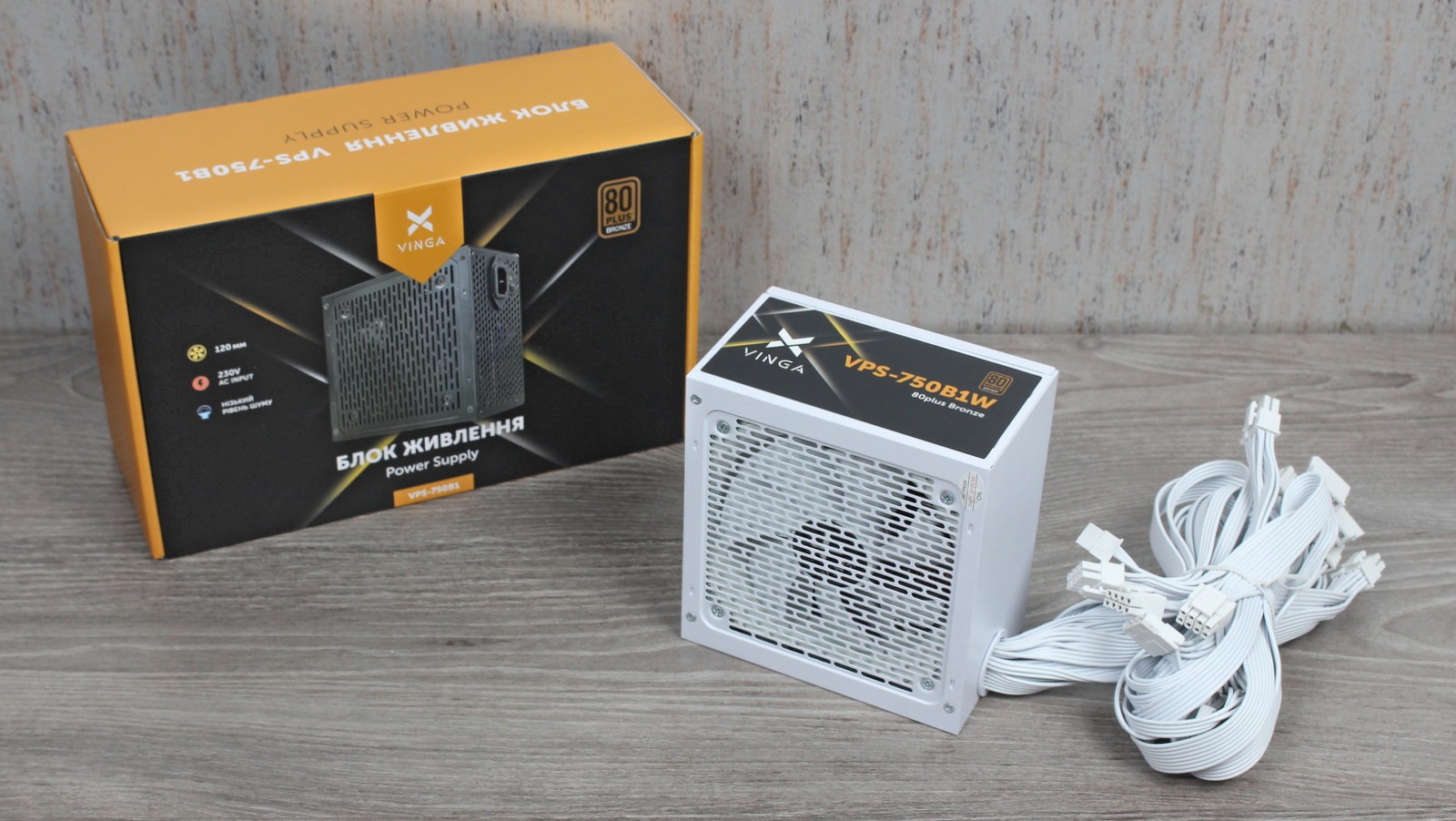
So in this material, we will test the affordable model Vinga 750W (VPS-750B1) and find out what's inside and how it performs in real-world usage conditions.
Specification
|
Model |
Vinga 750W (VPS-750B1) |
|
Type |
ATX12V 3.0 |
|
Maximum power, W |
750 |
|
Power on +12V rail, W |
744 |
|
Power on +3.3V and +5V rails, W |
100 |
|
Number of +12V rails |
1 |
|
Maximum current on +3.3V rail, A |
15 |
|
Maximum current on +5V rail, A |
15 |
|
Maximum current on +12V rail, A |
62 |
|
Maximum current on -12V rail, A |
0.3 |
|
Maximum current on +5Vsb (standby power) rail, A |
2.5 |
|
Input voltage, V |
230 |
|
Input current, A |
10 |
|
Efficiency, % |
≤86 |
|
80 PLUS Certification |
Bronze |
|
Power factor correction method |
Active |
|
Power factor (PF), % |
≤98 |
|
PCIe 5.0 |
Yes, 600 W |
|
PCIe connectors |
4 (6+2-pin) |
|
Modular |
No |
|
Fan dimensions, mm |
120 x 120 x 25 |
|
Protections |
OVP, UVP, OCP, OTP, OPP, SCP, SIP |
|
Dimensions (L x W x H), mm |
140 x 150 x 86 |
|
Warranty, years |
1 |
|
Device page |
|
|
Purchase page |
Packaging and Supply Kit
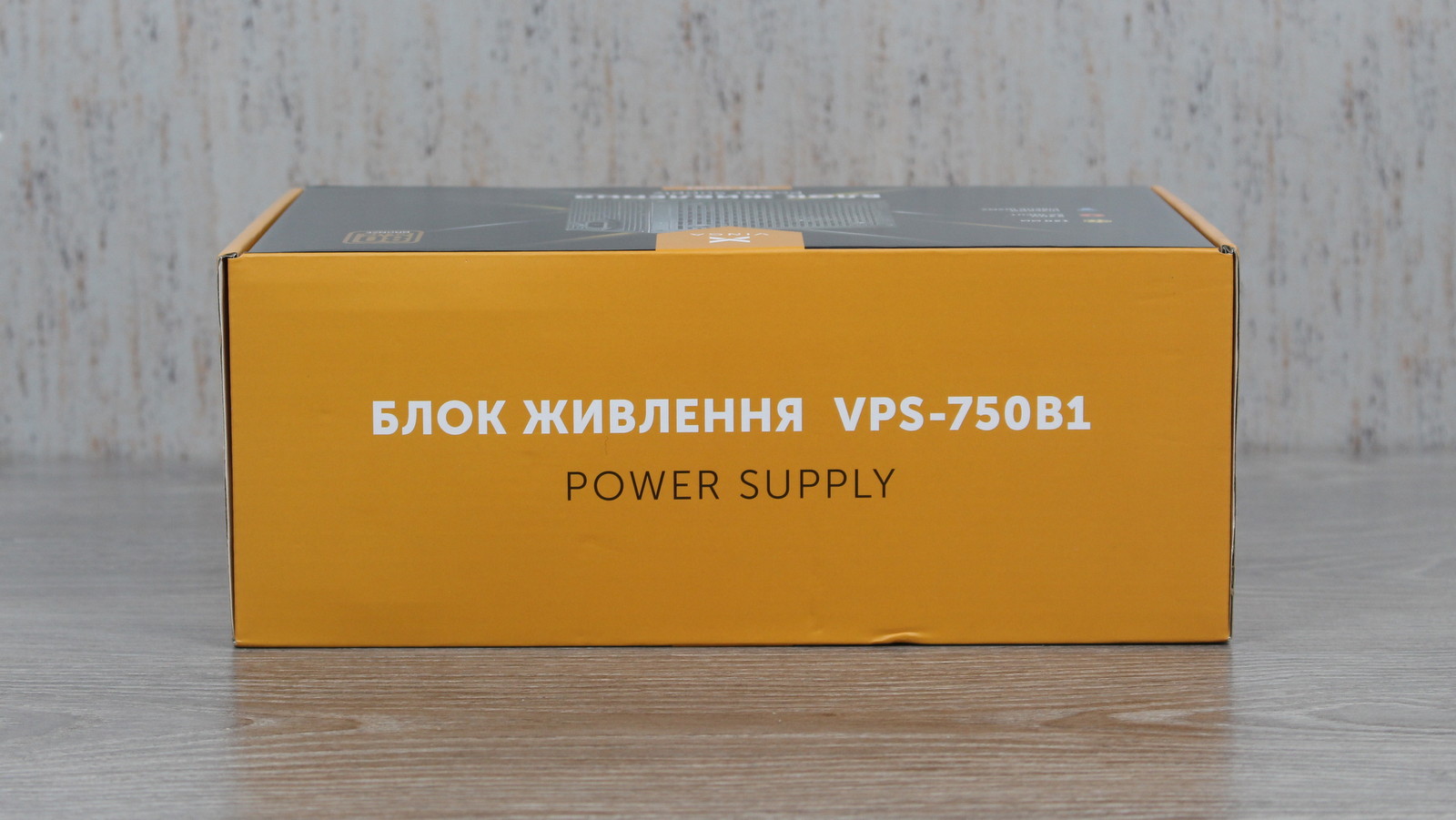
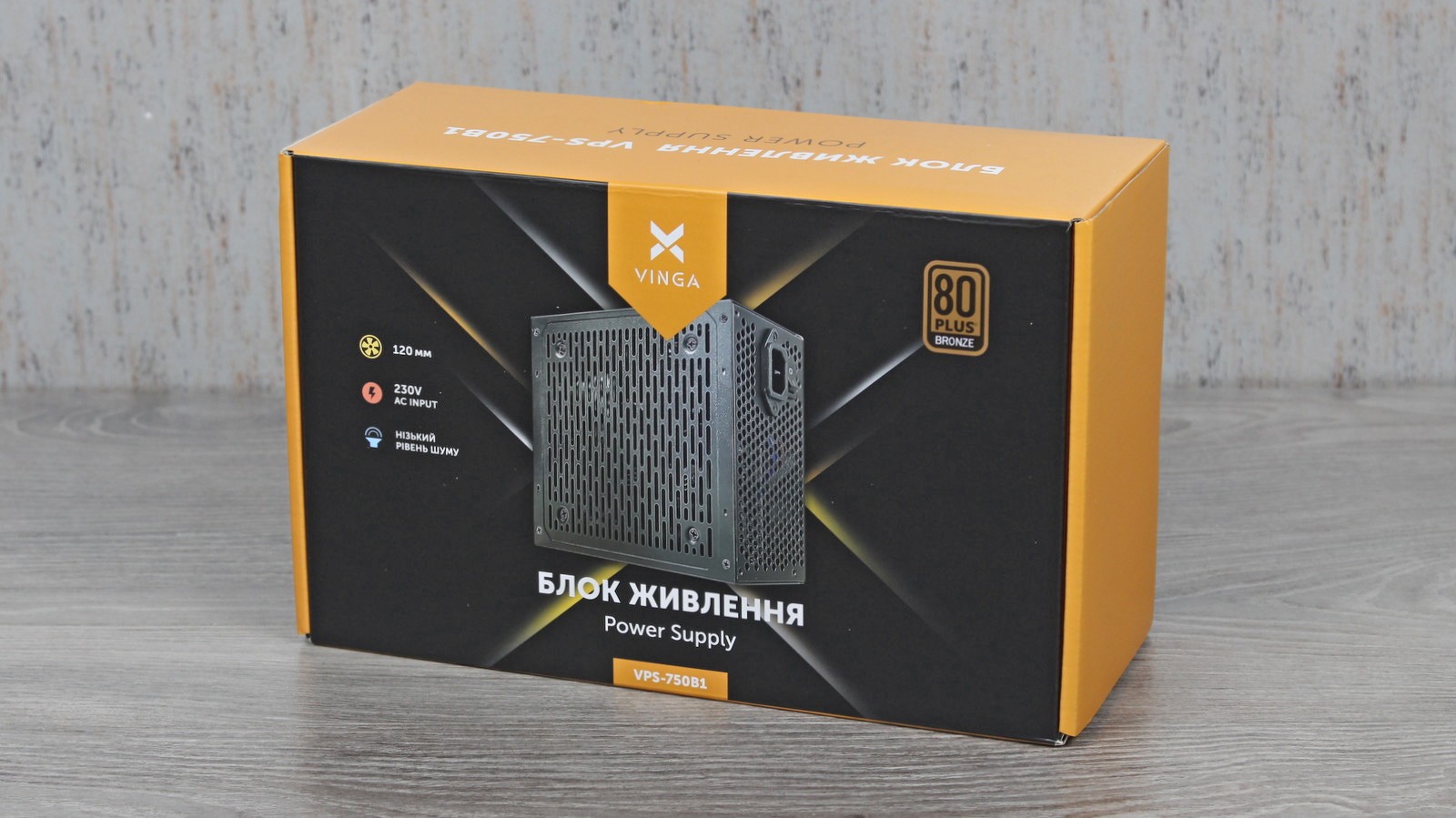
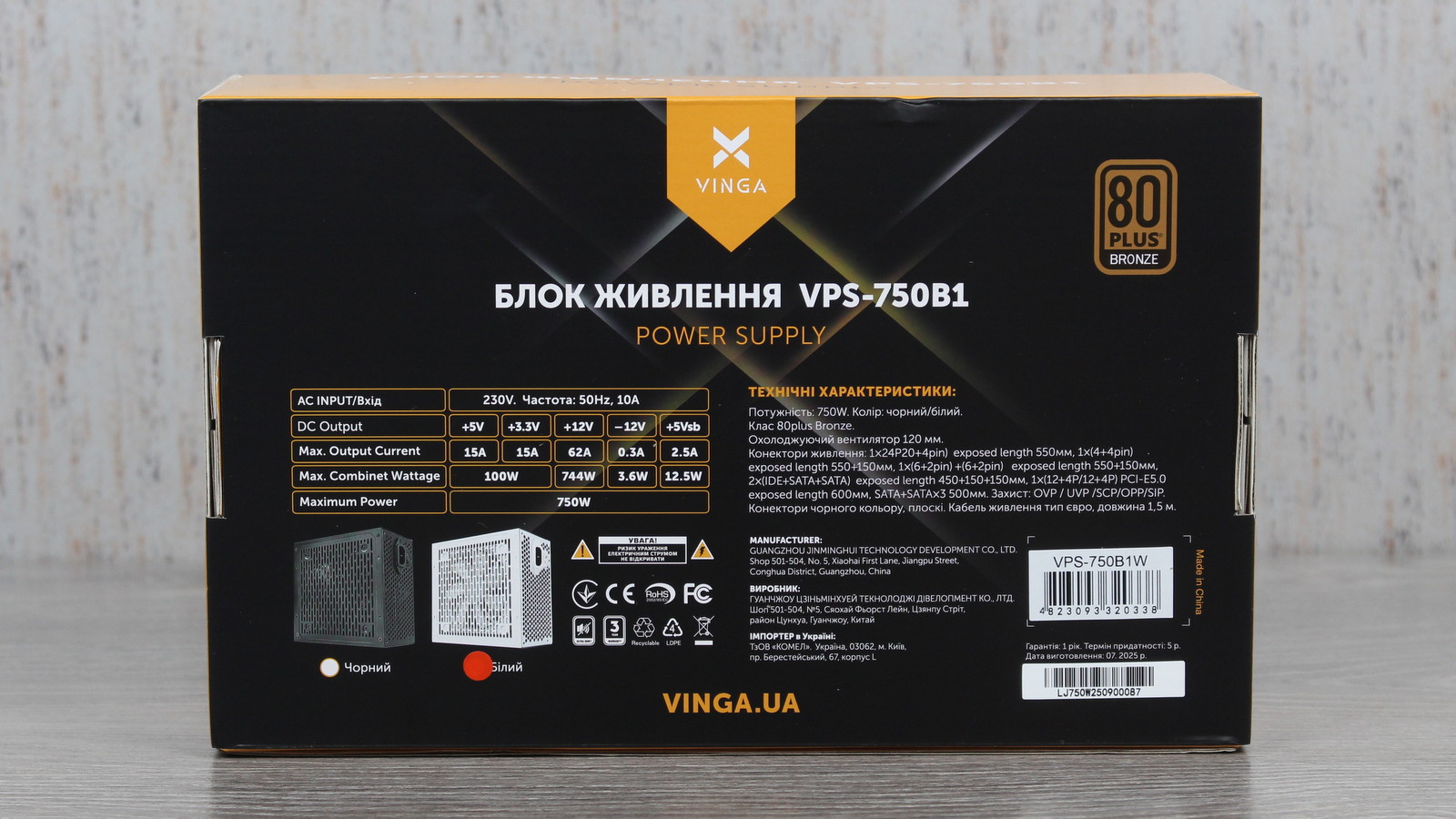
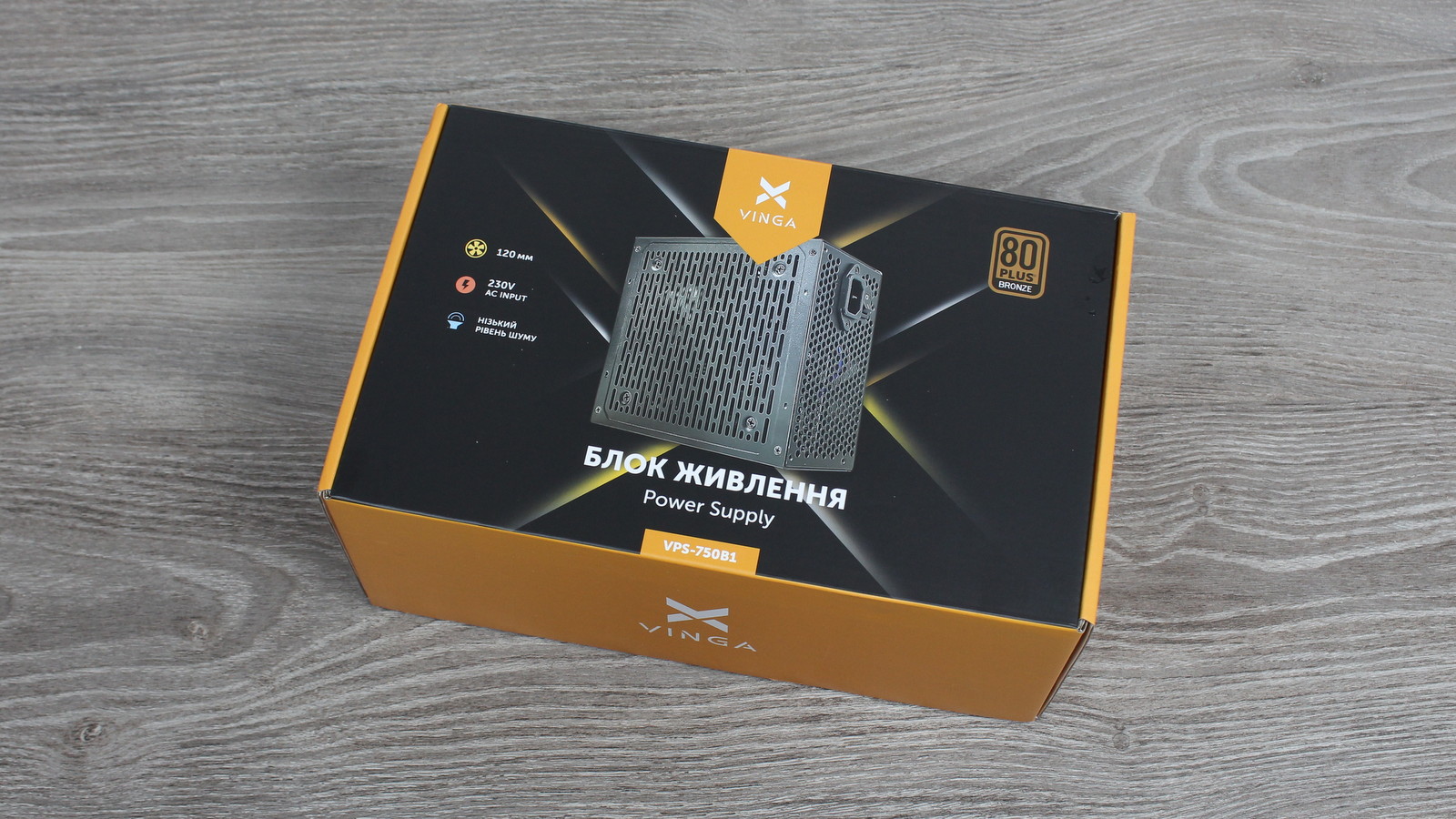
The box has been localized to Ukrainian, albeit selectively. It contains the electrical specifications of the device, a list of connectors, and a red circle indicates the color scheme — black or, as in our case, white.
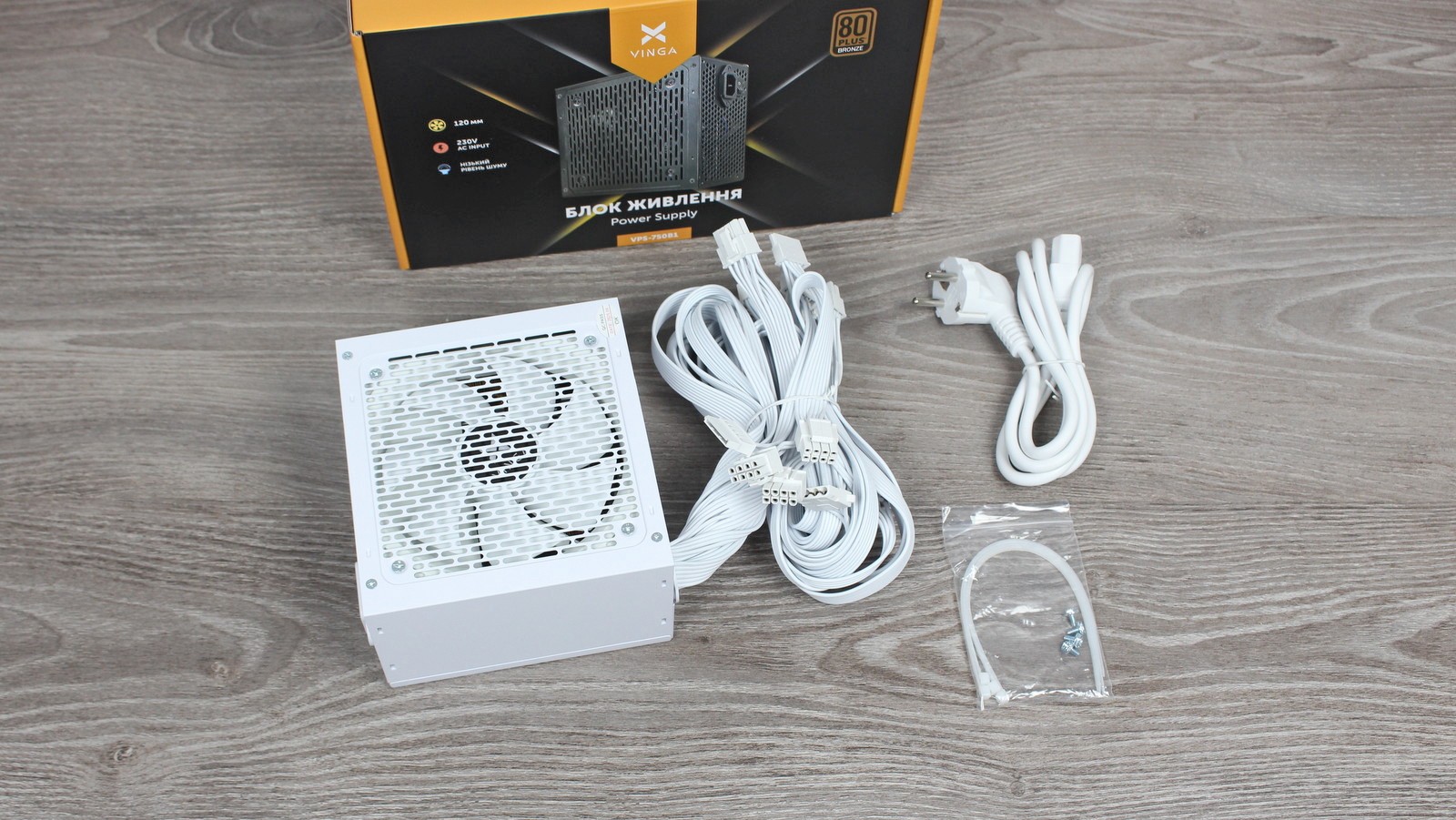
The package includes a power cable, a set of ties, and mounting screws — all in a light color to match the unit itself.
Appearance
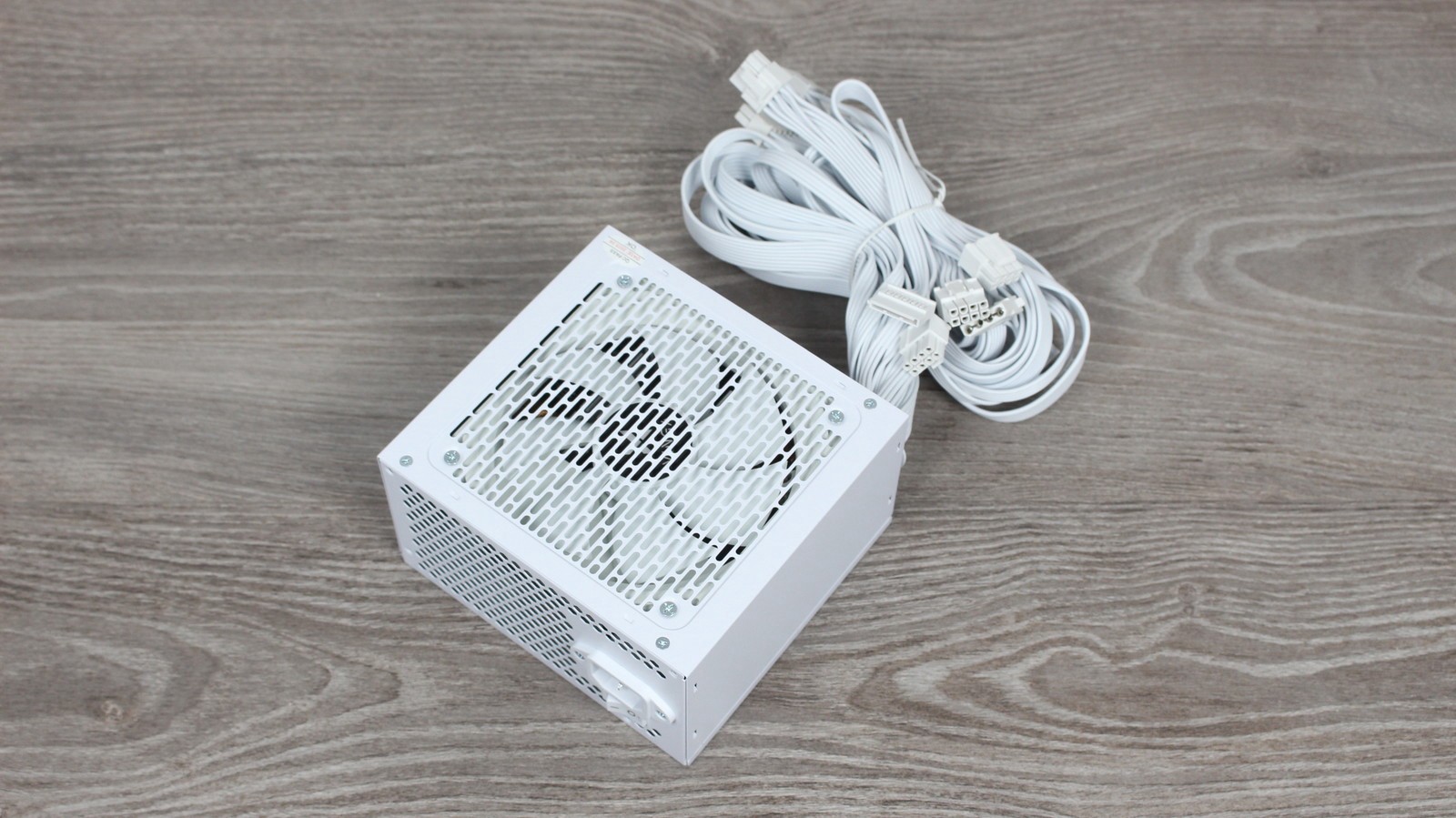
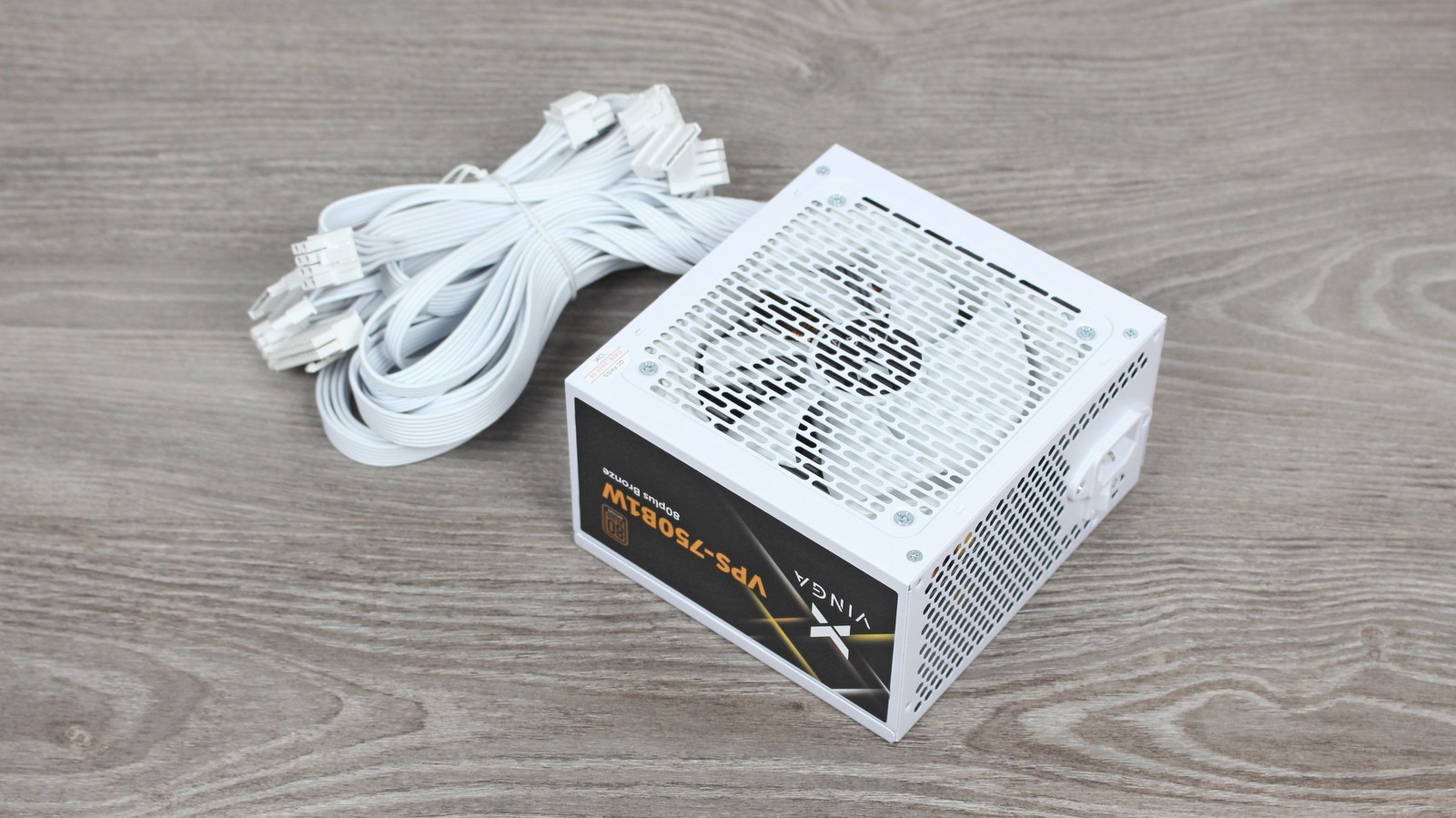
Vinga 750W (VPS-750B1) is adorned with elongated holes with rounded edges above the 120mm fan with the manufacturer's logo. The device's dimensions are standard — 140 × 150 × 86 mm.
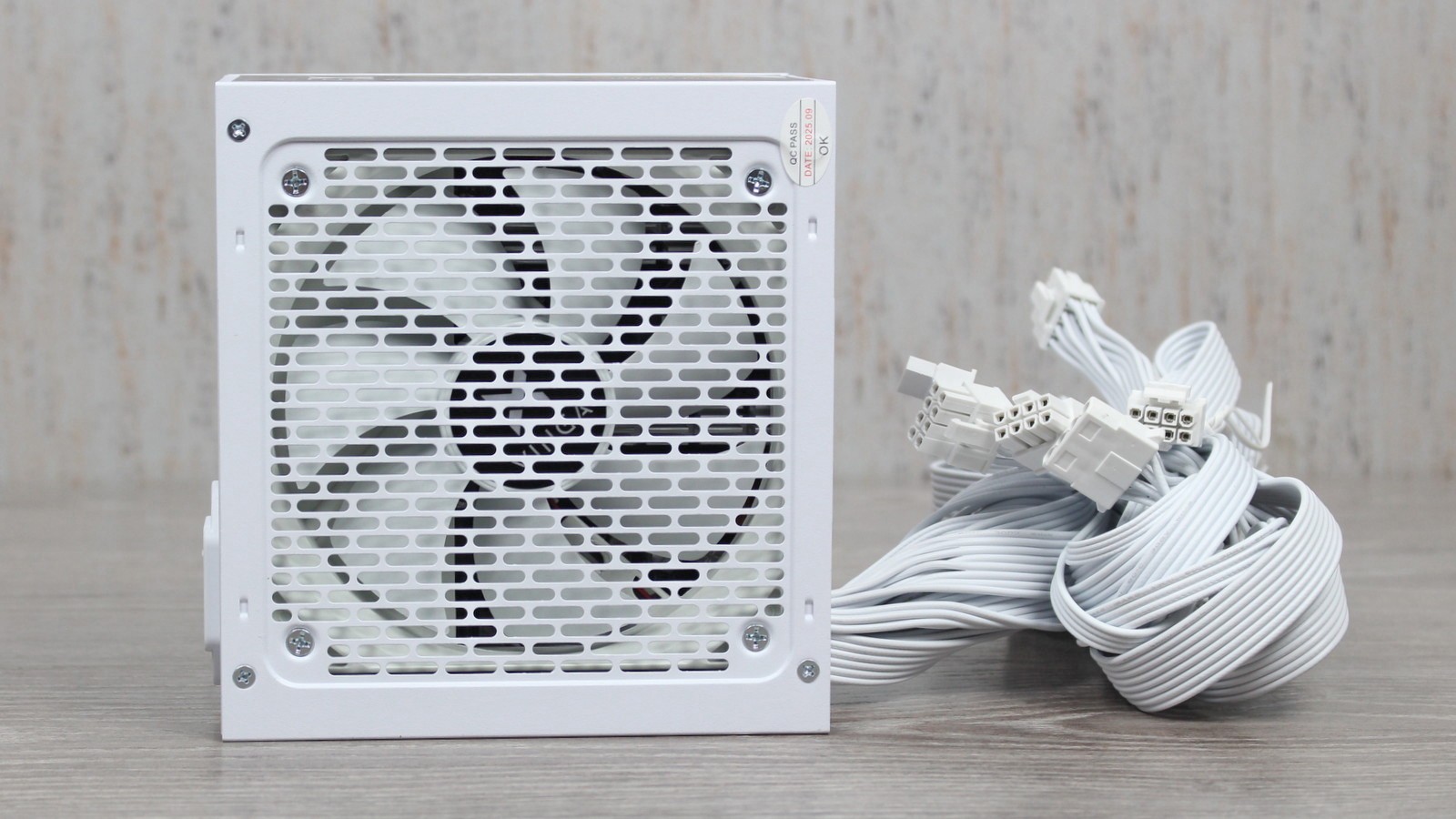
One of the case screws has a warranty seal valid for 1 year. For comparison, the "gold" models of this manufacturer have a warranty of 3 years.
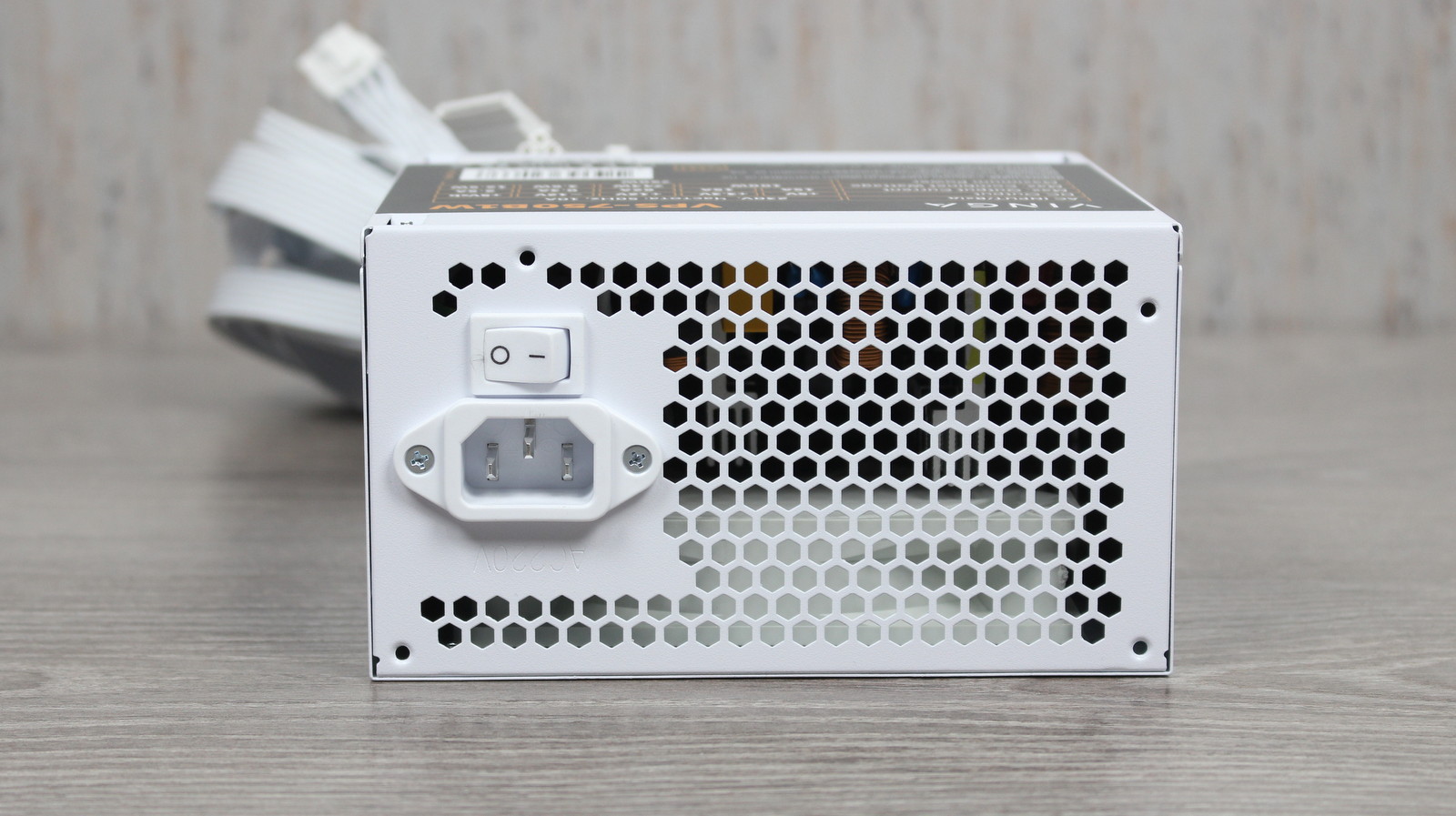
The rear panel features large honeycomb holes, a power connector, and a switch. Again, everything is in a pristine white finish.
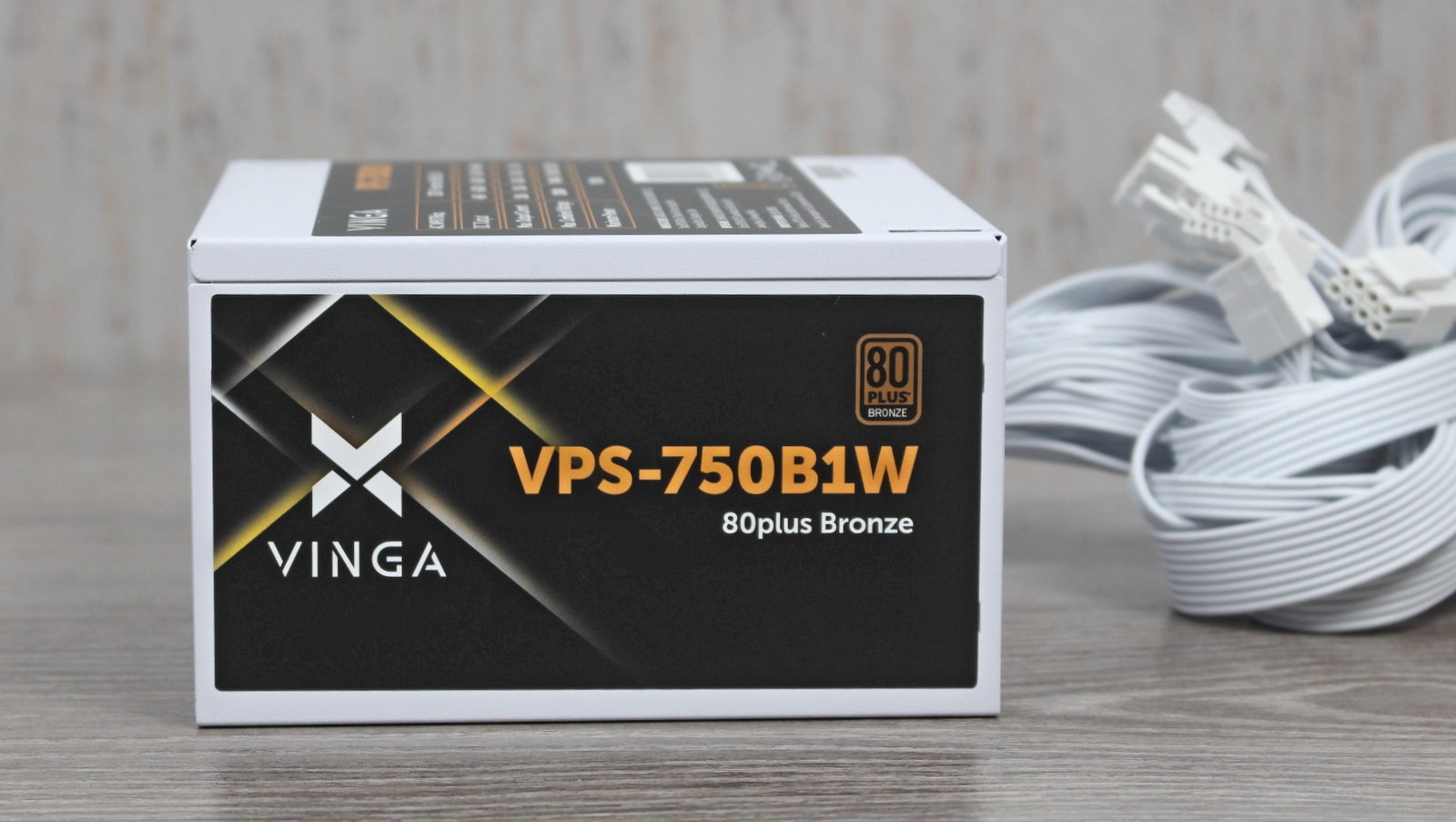
On one of the sides, there is a sticker indicating the model and 80 PLUS Bronze certification — subjectively, it should also have been made in light tones.
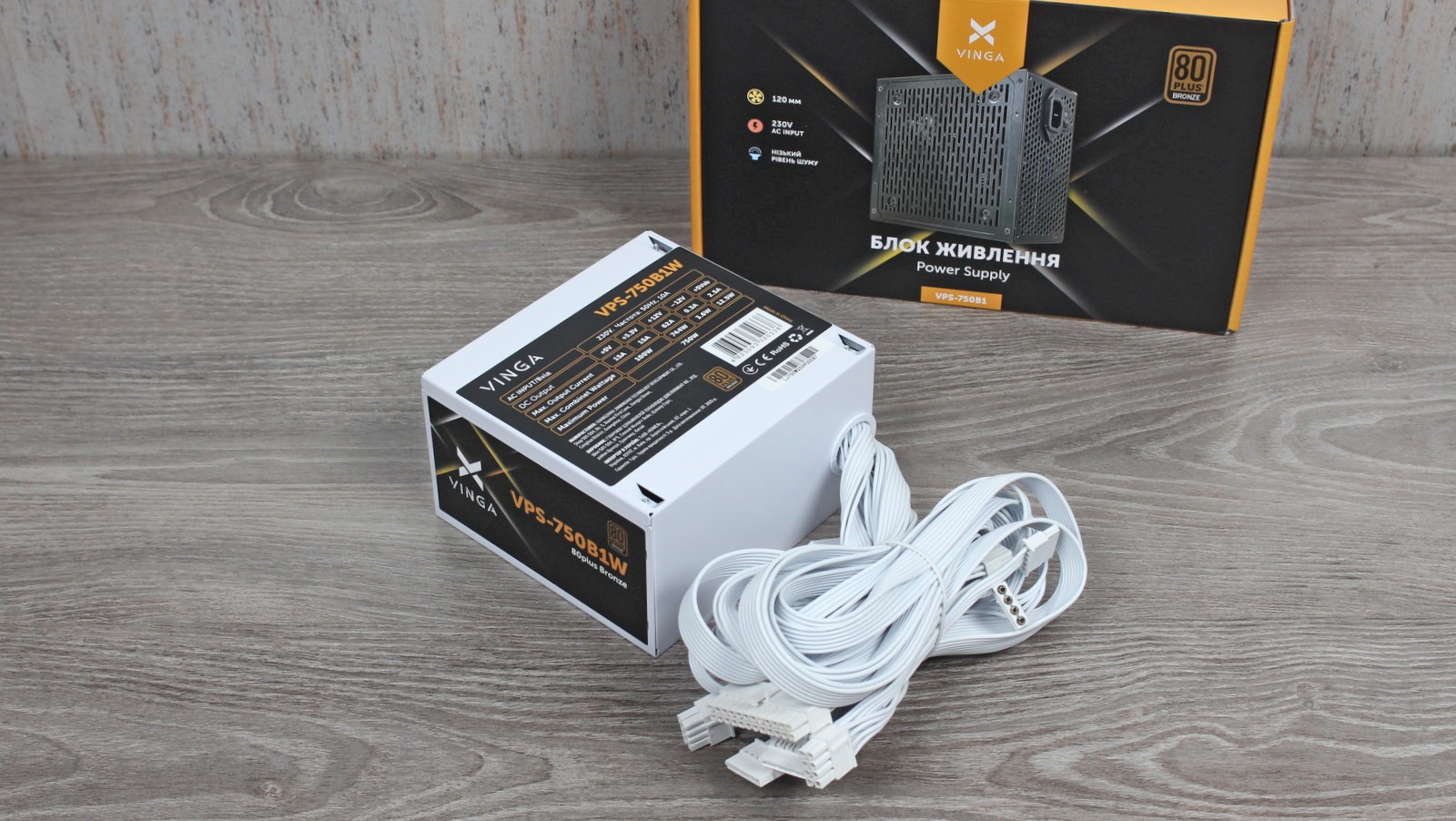
Another dark label provides the electrical specifications. It indicates the presence of a single +12V rail with a power of 744W — an excellent value for a 750W unit, but considering the use of group regulation, it seems overly optimistic. The +3.3V and +5V rails provide 100W or 15A each. Additionally, Vinga 750W (VPS-750B1) only supports operation in 230V networks.
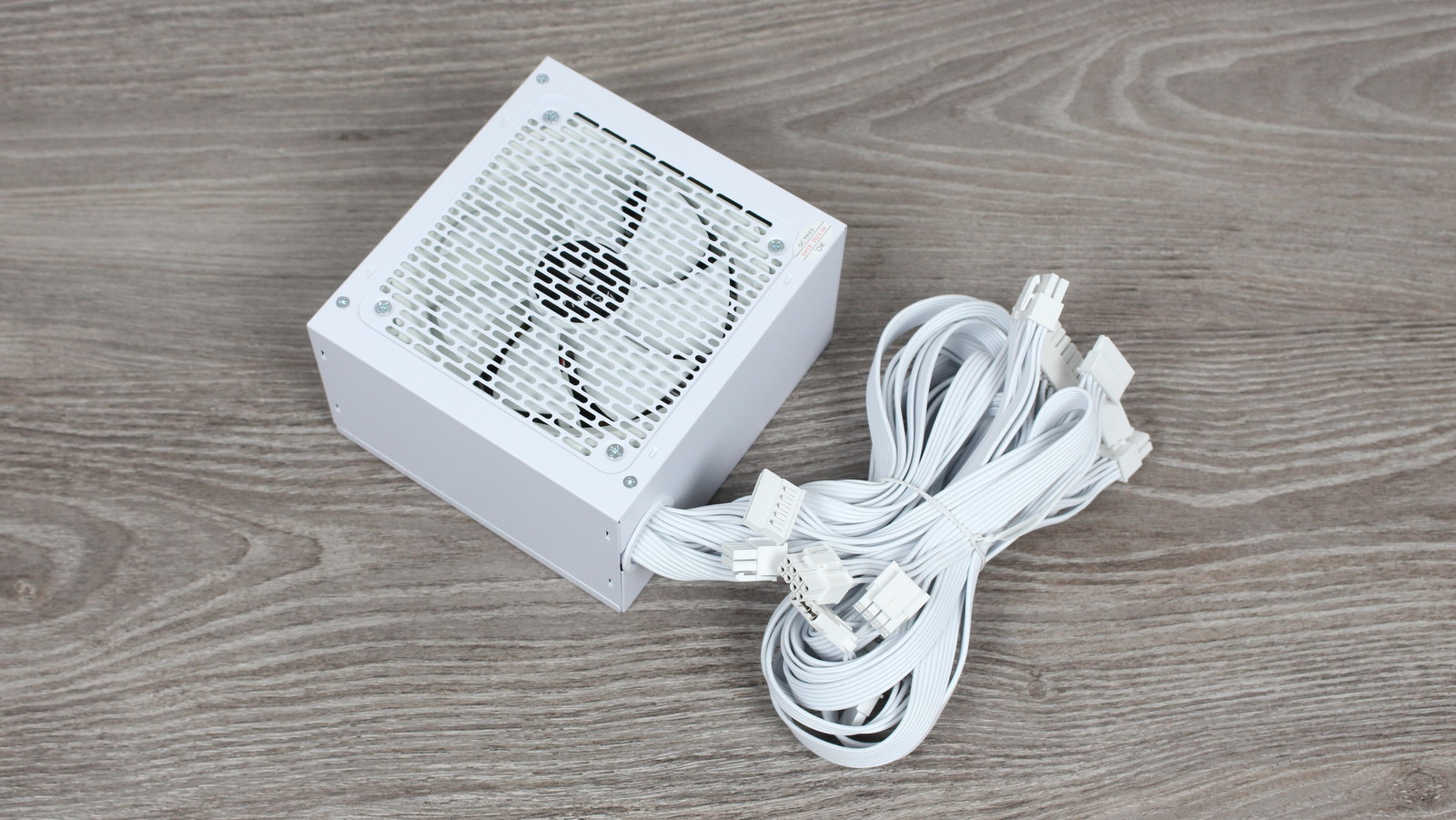
The ribbon cables come directly out of the unit's casing and are protected from abrasion by a plastic ring. The connector set looks like this:
|
Connectors |
Quantity |
Wire length, cm |
Gauge |
|
20+4-pin ATX |
1 |
55 |
18 AWG |
|
4+4-pin ATX12V |
1 |
67 |
18 AWG |
|
two 6+2-pin PCIe |
2 |
57-70 |
18 AWG |
|
PCIe 5.0 (600 W) |
1 |
65 |
16 AWG |
|
two SATA + one PATA |
2 |
45-60-75 |
18 AWG |
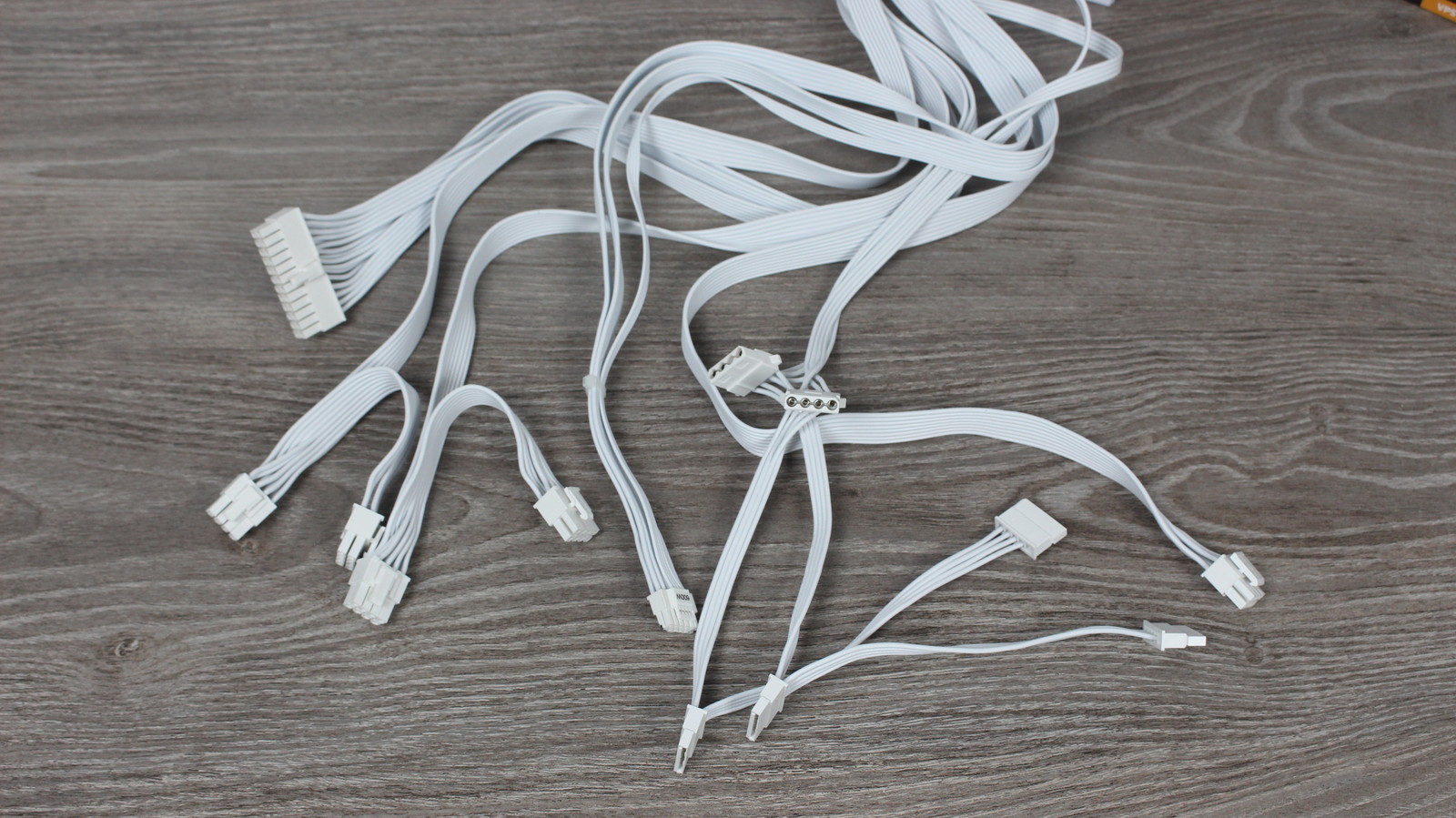
Available are 20+4-pin ATX, 4+4-pin ATX12V, as well as numerous connectors for connecting video cards: four classic 6+2-pin PCIe (on two separate wires) and a modern 600-watt PCIe 5.0 (12VHPWR). For storage and peripherals, there are four SATA and two PATA — not many, but sufficient for a modern build.
Internal Structure
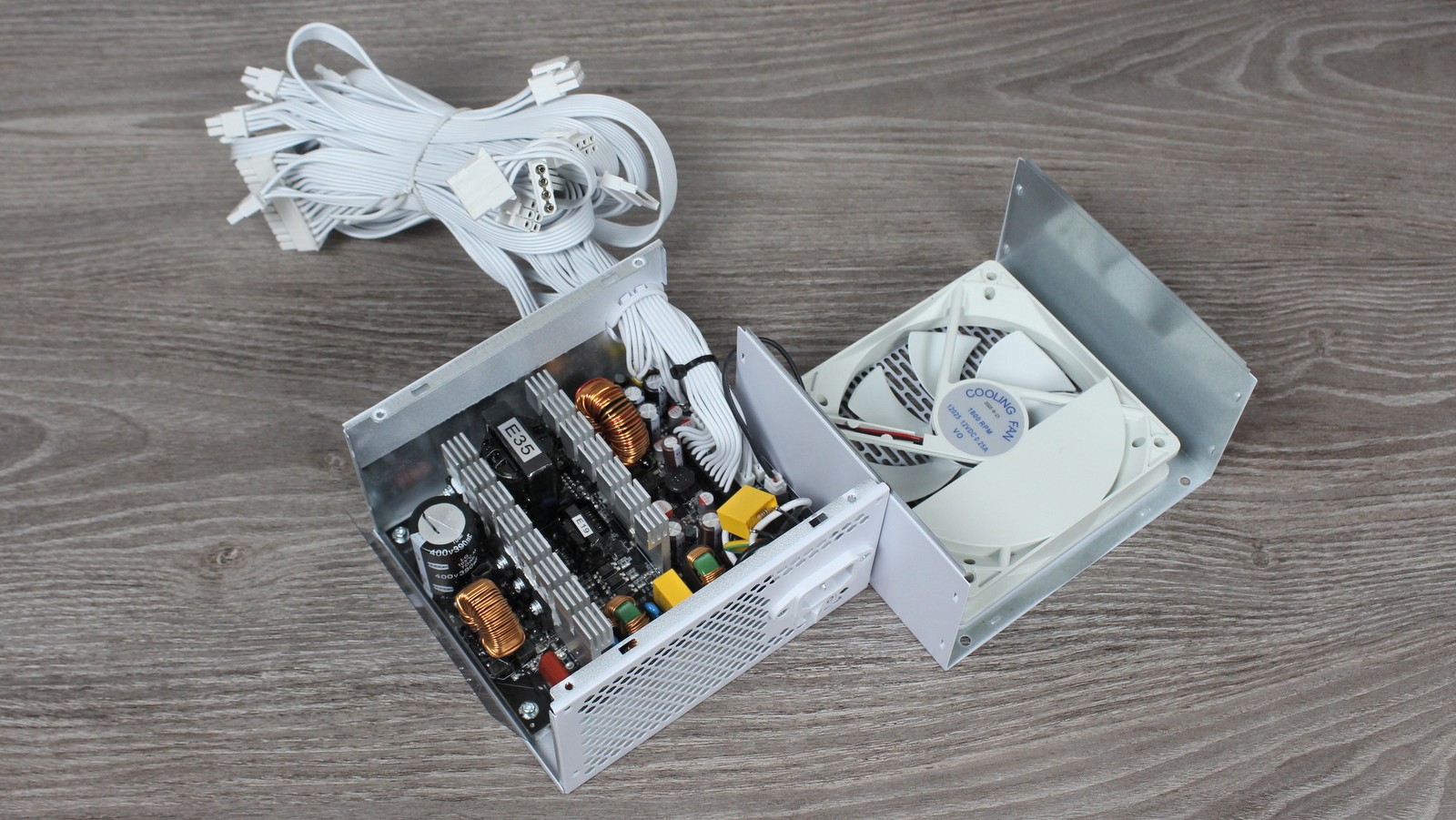
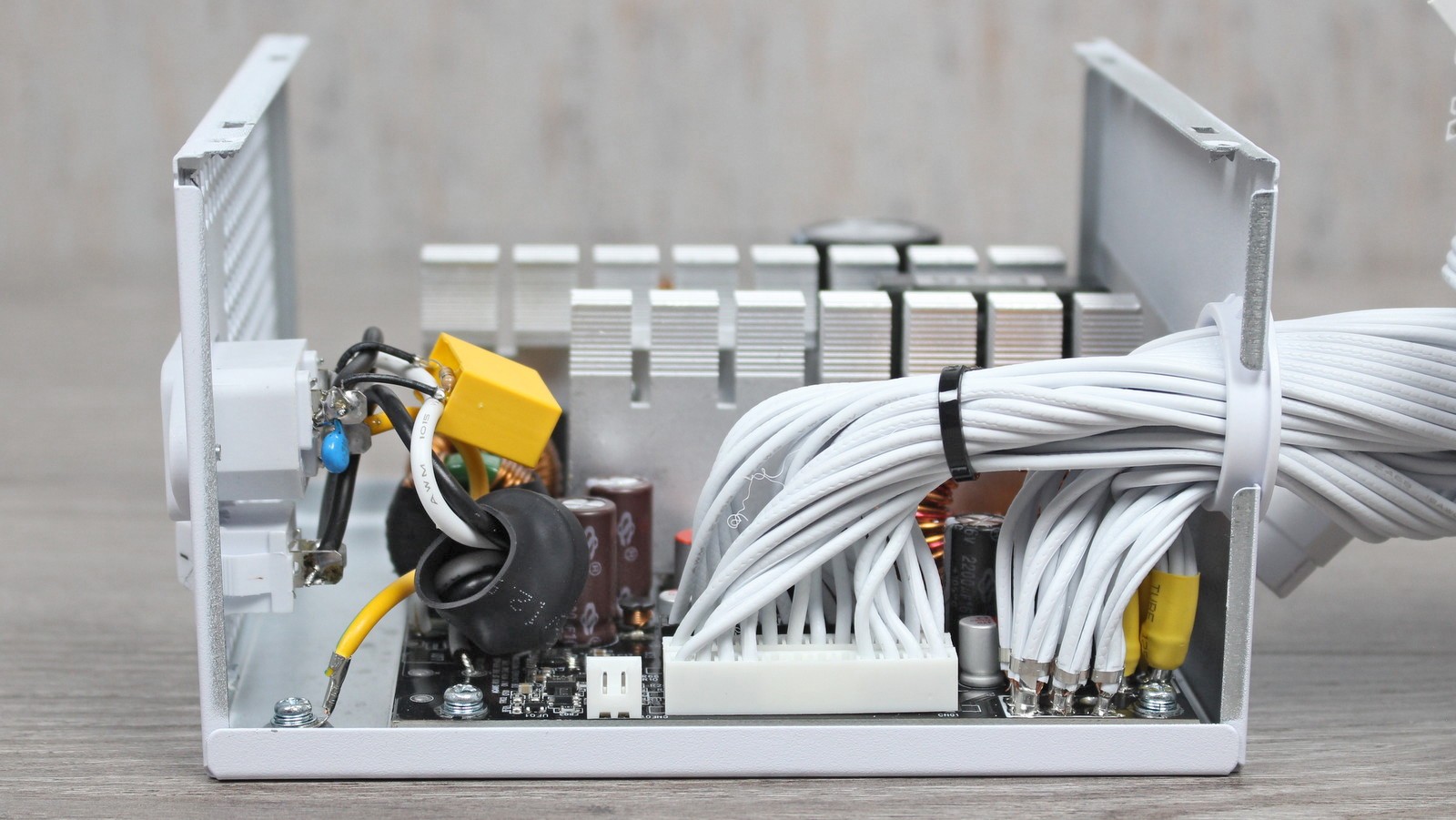
Well, we've acquainted ourselves with the exterior of Vinga 750W (VPS-750B1), now it's time to look inside.
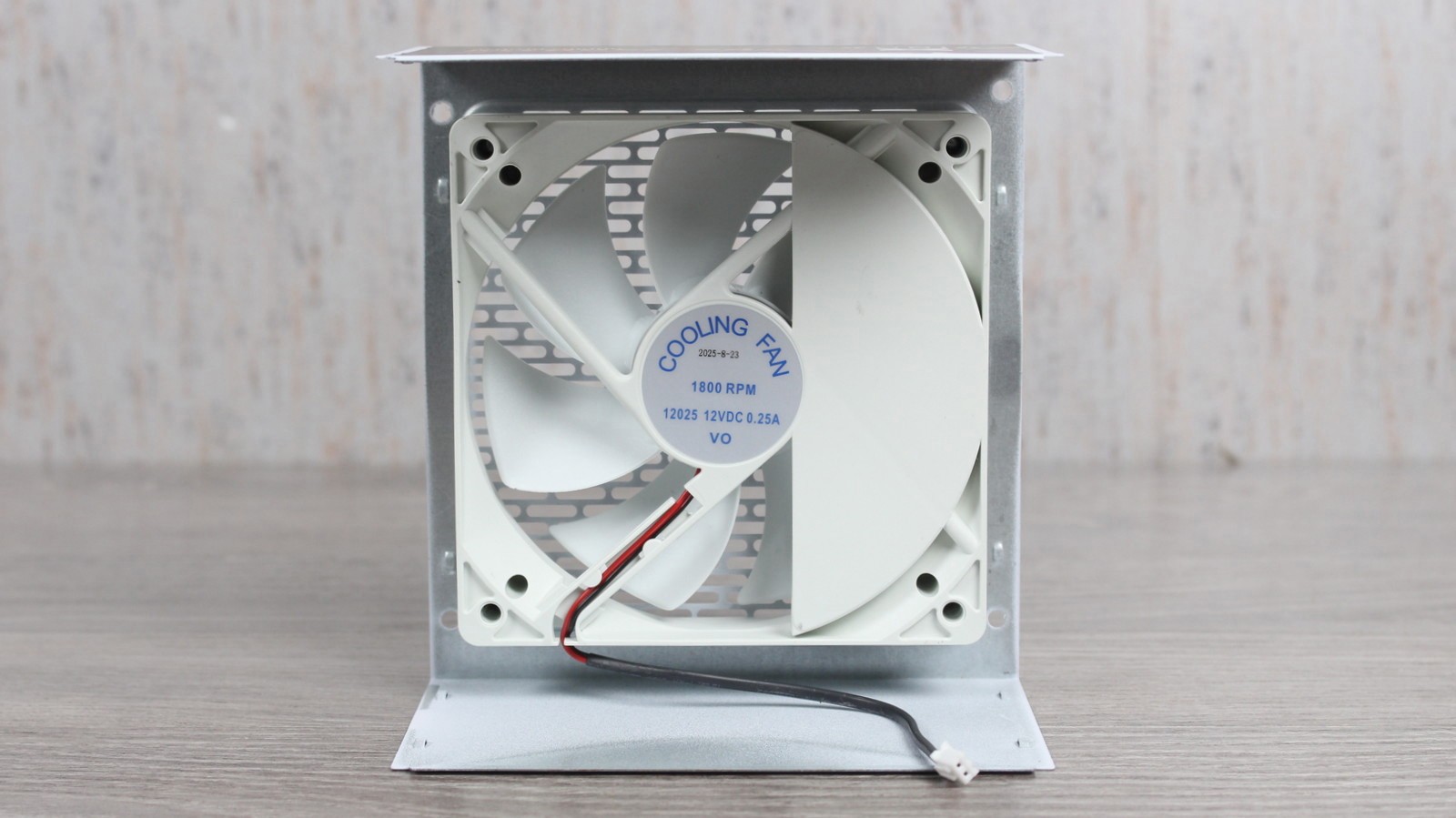
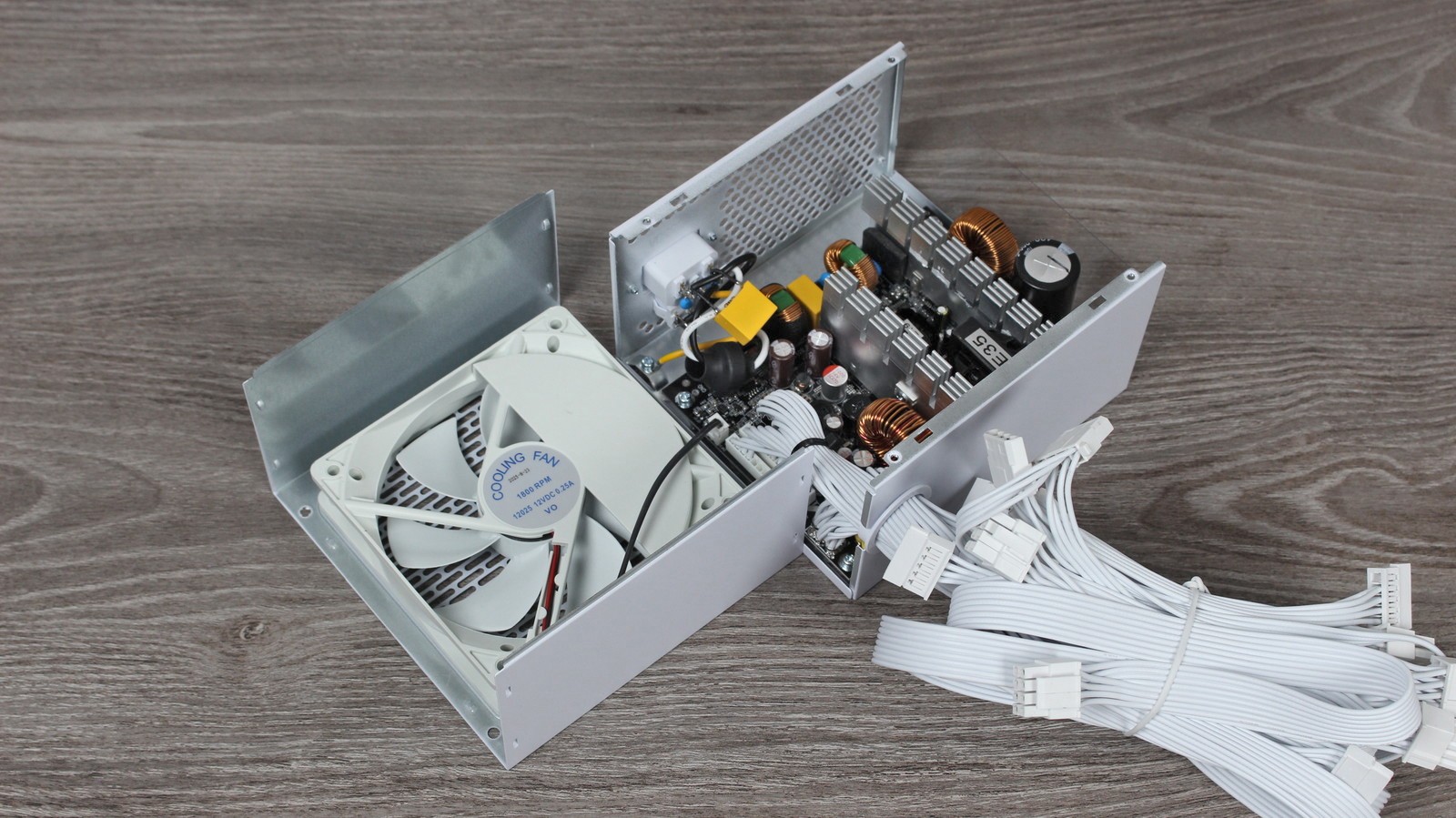
The 120mm fan casing, without a specified manufacturer, already contains a plate that directs air to the hottest elements. It has a typical 25mm profile, low power consumption of 4W (0.25A at 12V), and a maximum rotation speed of 1800 RPM. The fan is likely based on a budget sleeve bearing.
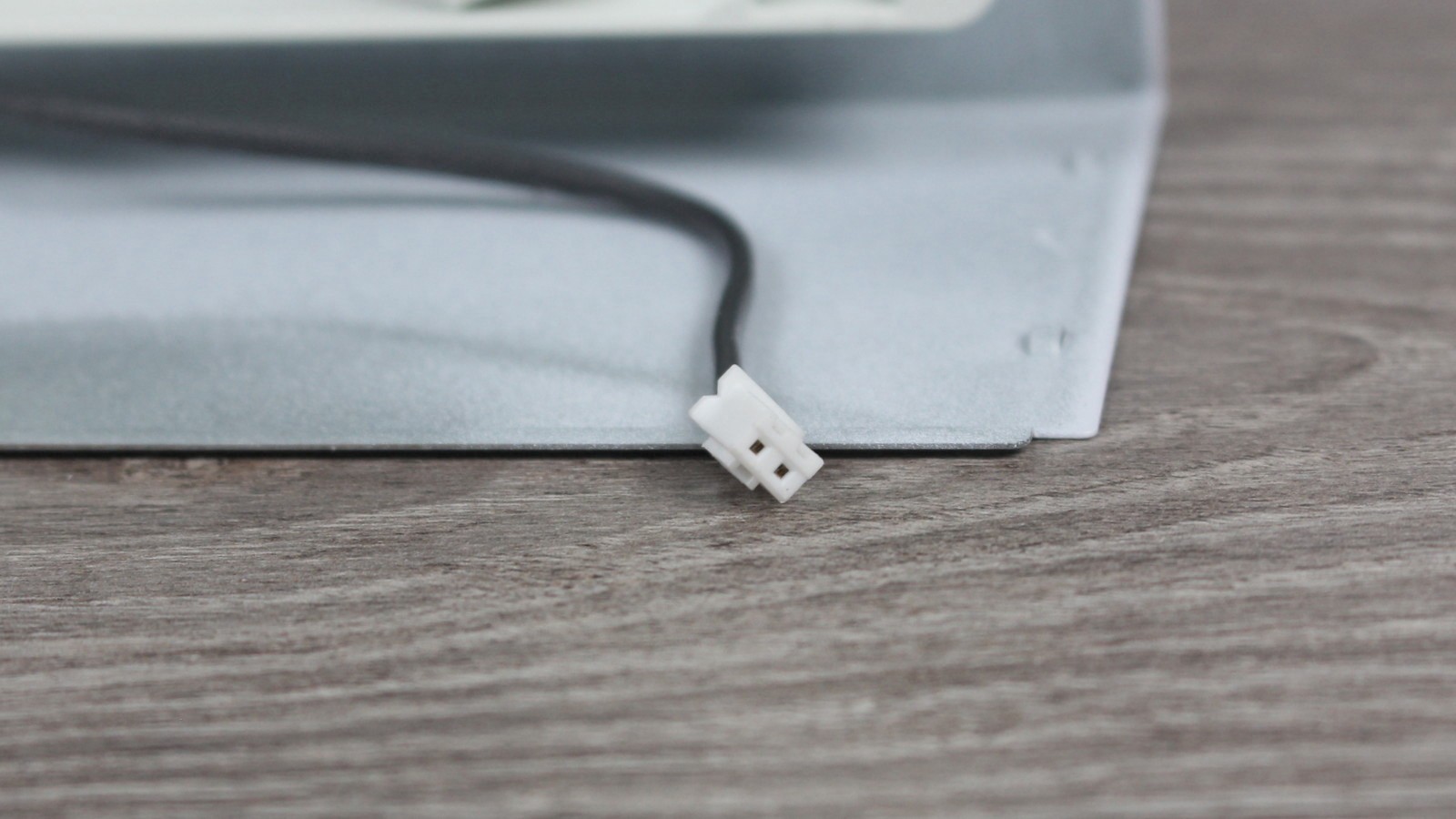
Power is supplied through a removable 2-pin connector.
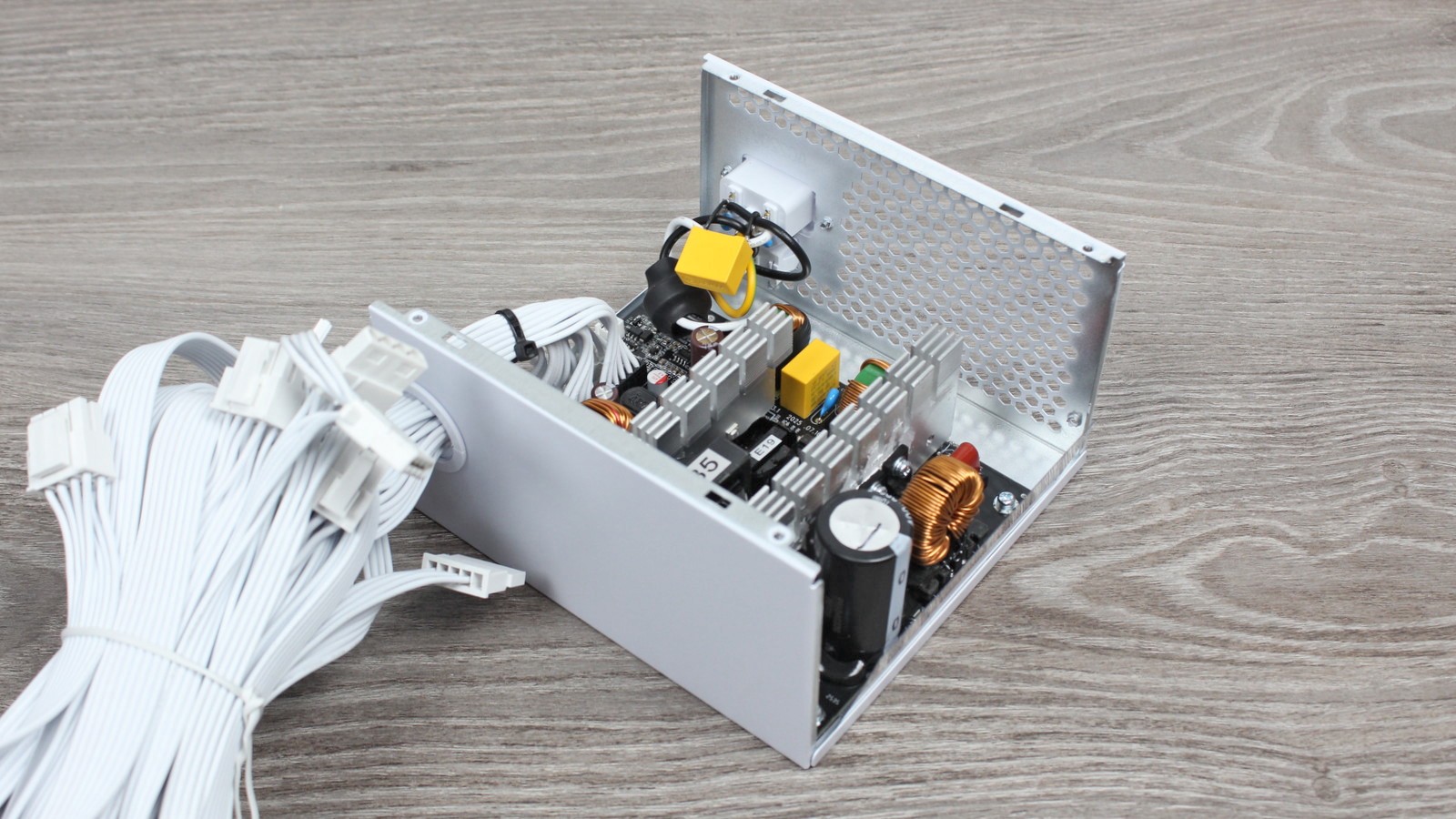
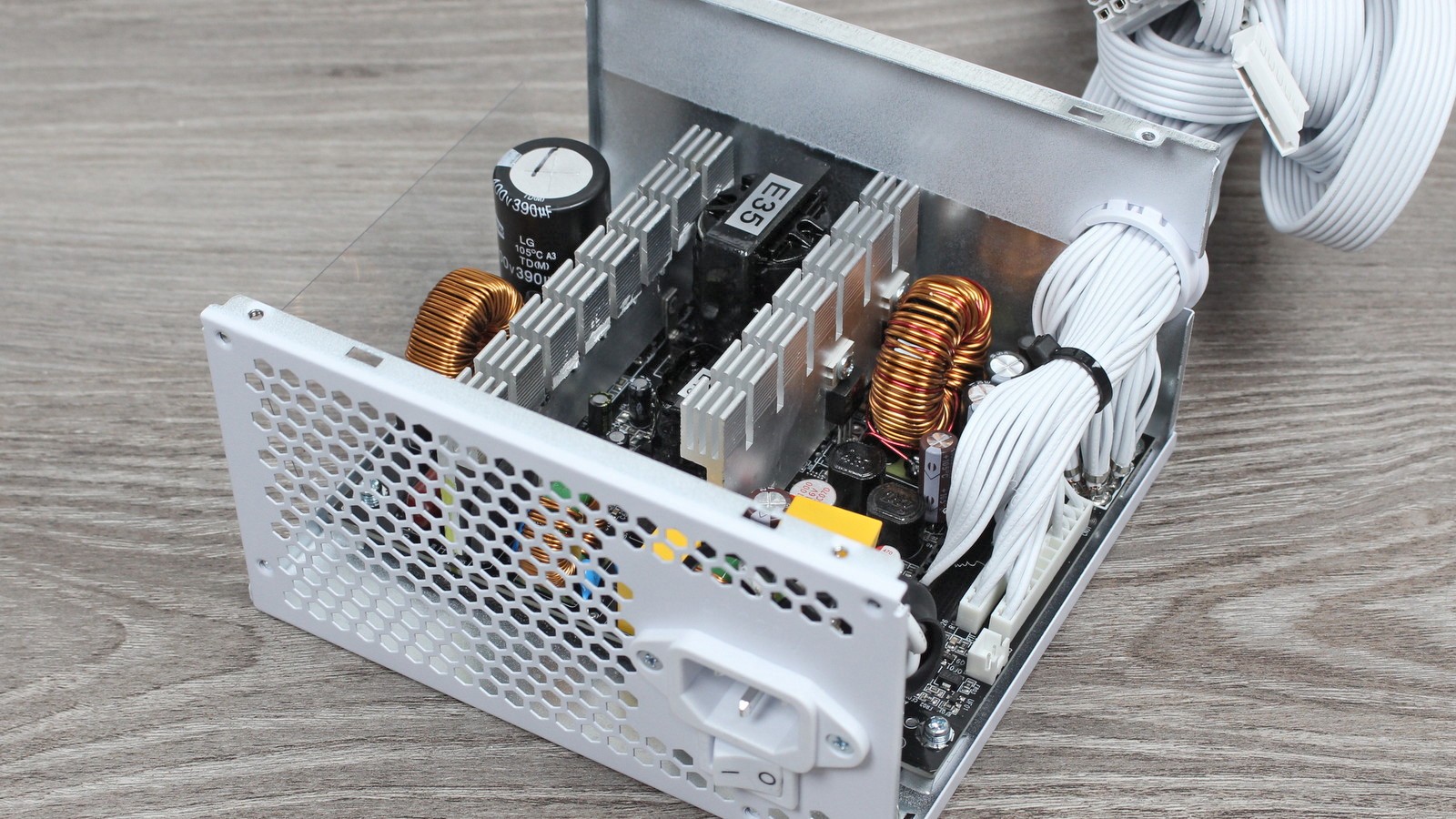
Moving on to the circuitry. The input EMI filter includes the necessary set of a pair of coils, X and Y capacitors, and a varistor.
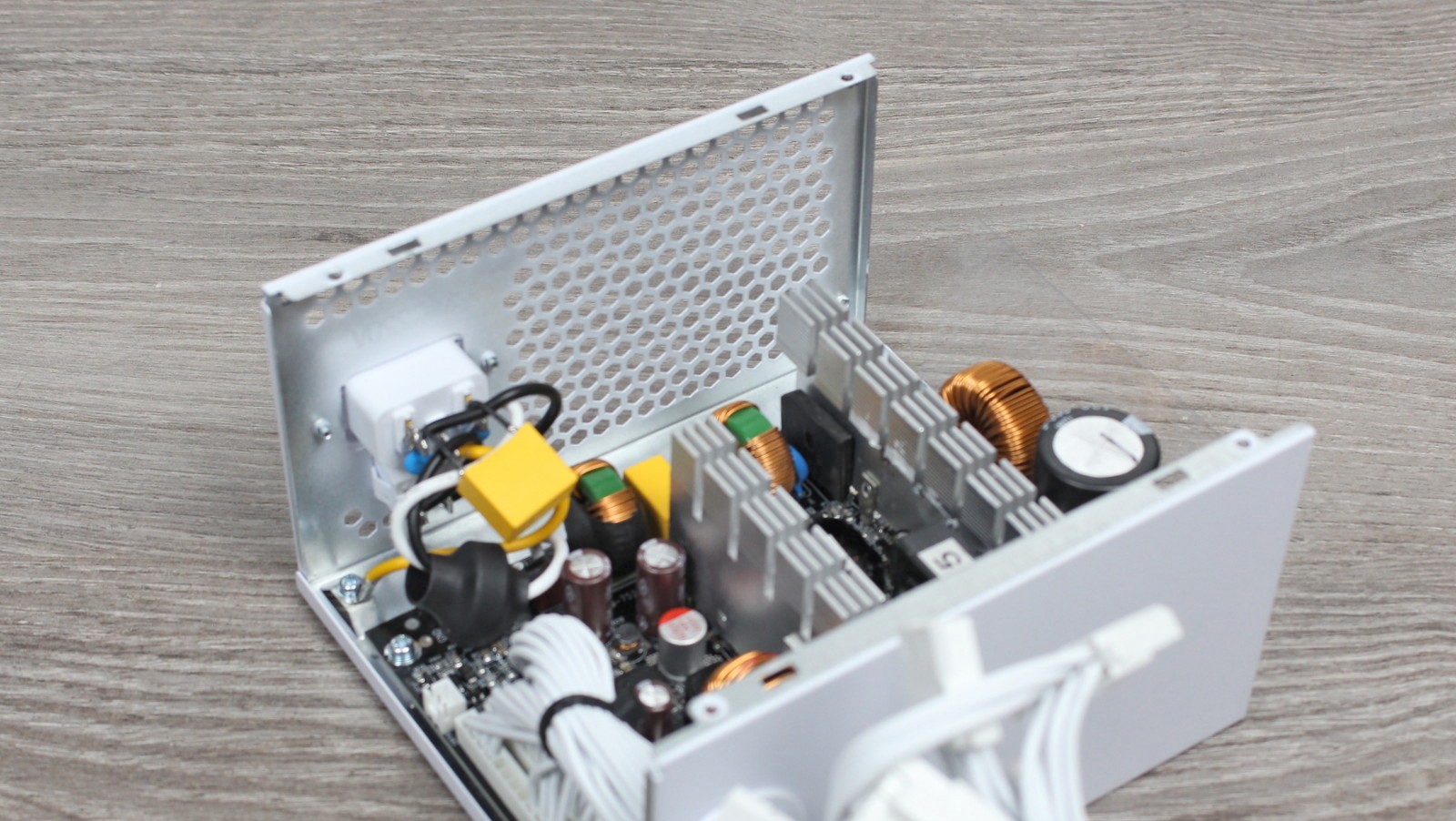
The diode assembly is located near the heatsink but does not contact it — for fairness, this is standard for devices without support for a wide range of input voltages.
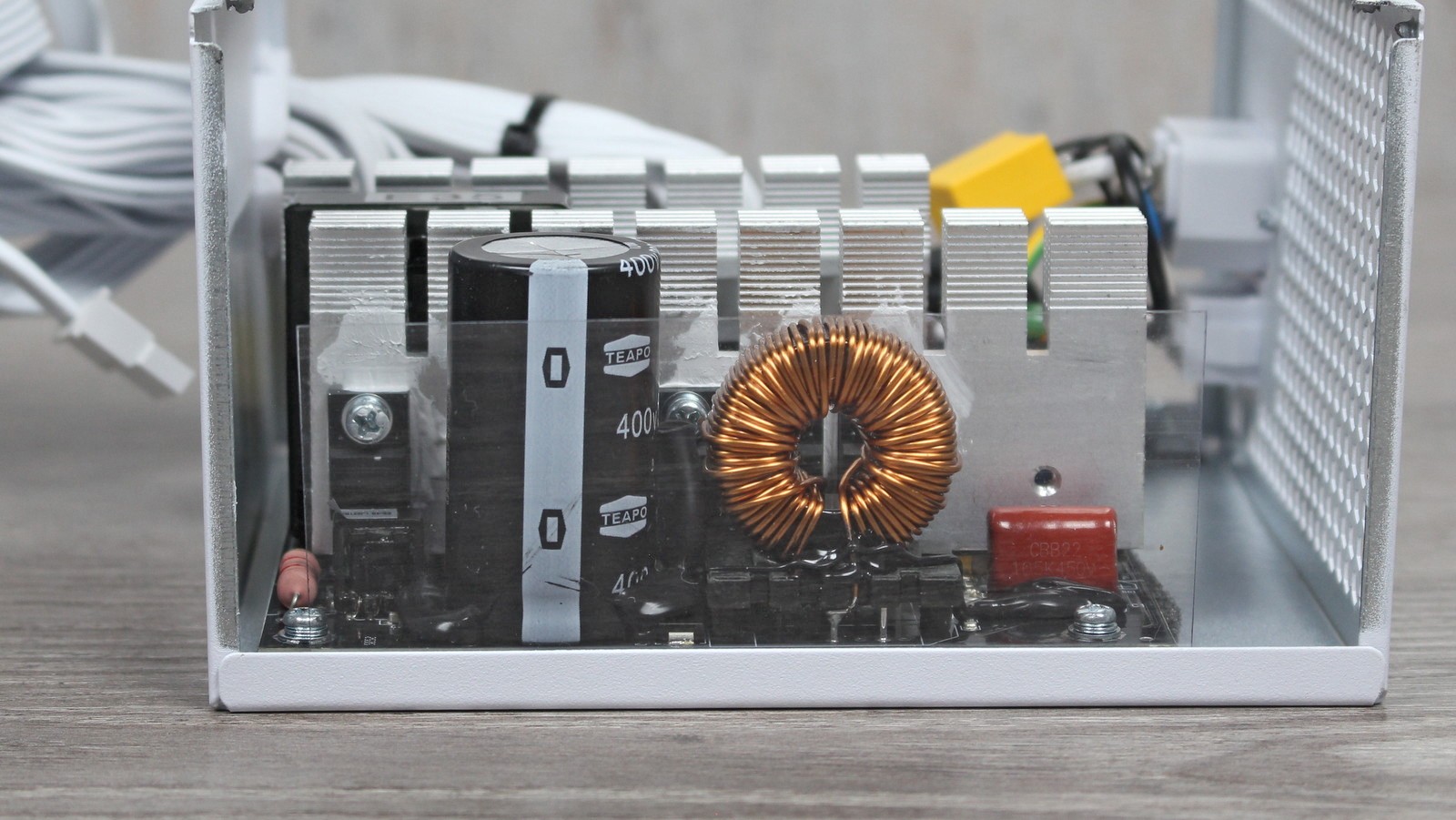
The APFC node elements are fully present, including a large choke. There is also a thermistor for protection against high inrush currents.
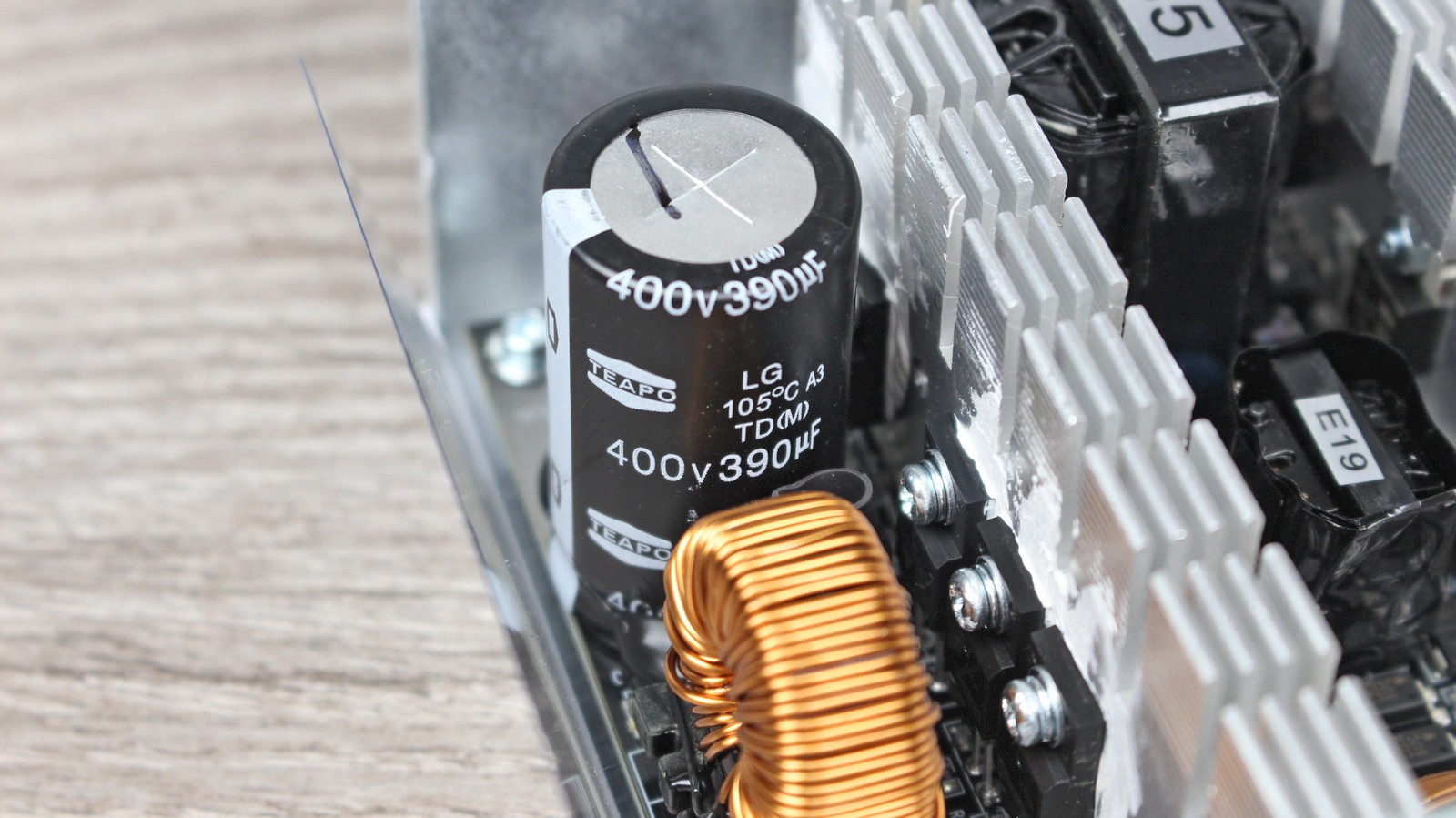
The input high-temperature capacitor from Taiwanese Teapo is of average quality and is a good option for such an inexpensive device. However, its capacity of 390 µF is low for a 750-watt unit.
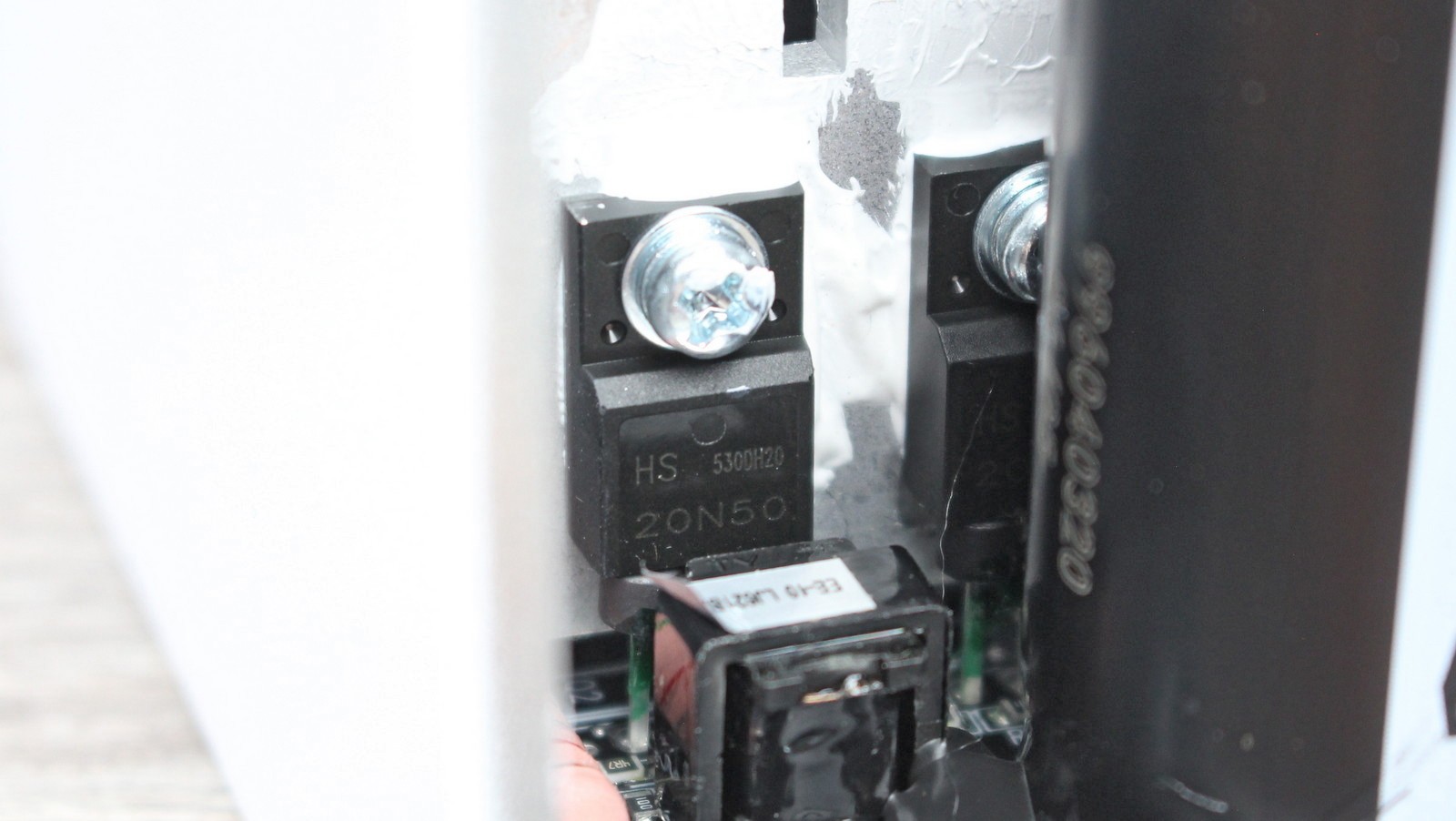
The primary converter keys are 20N50 transistors of Chinese origin — another compromise for the sake of price.
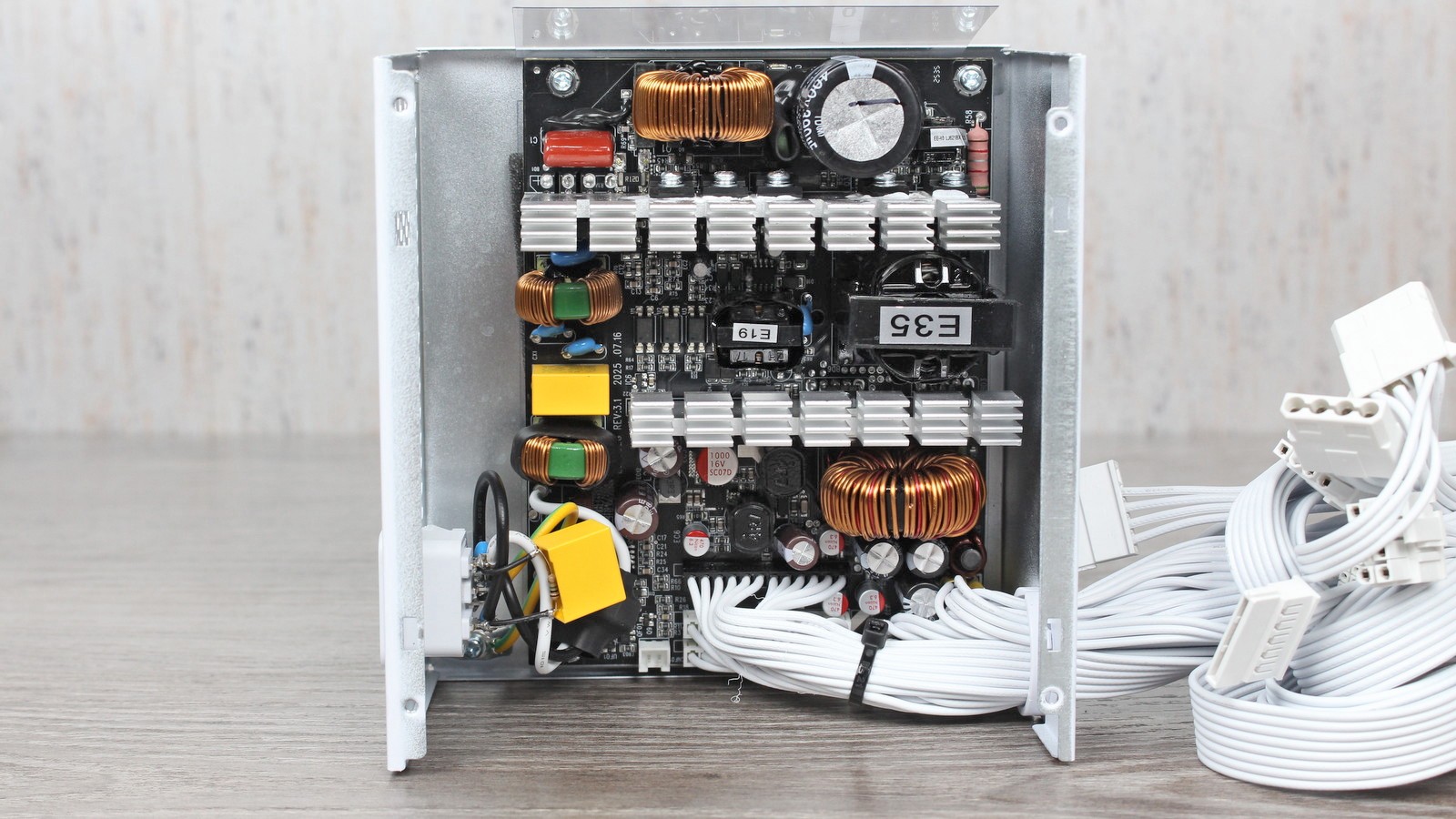
The power supply is based on a Double Forward Topology. This is a simple and inexpensive solution that is less efficient compared to more modern schemes.
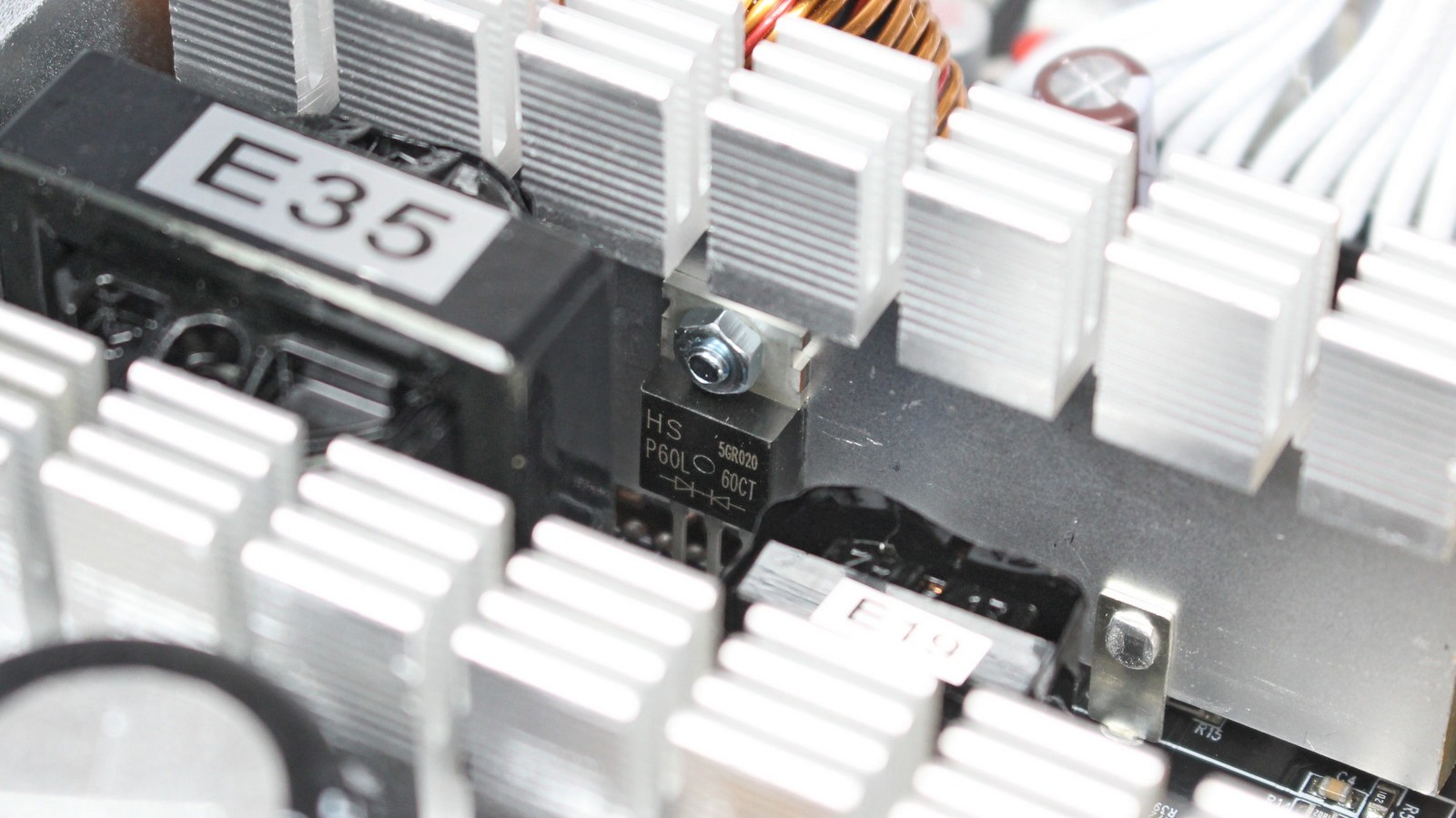
The secondary circuit uses a Schottky diode for voltage rectification. The manufacturer could not be identified, which also indicates savings on the component base.
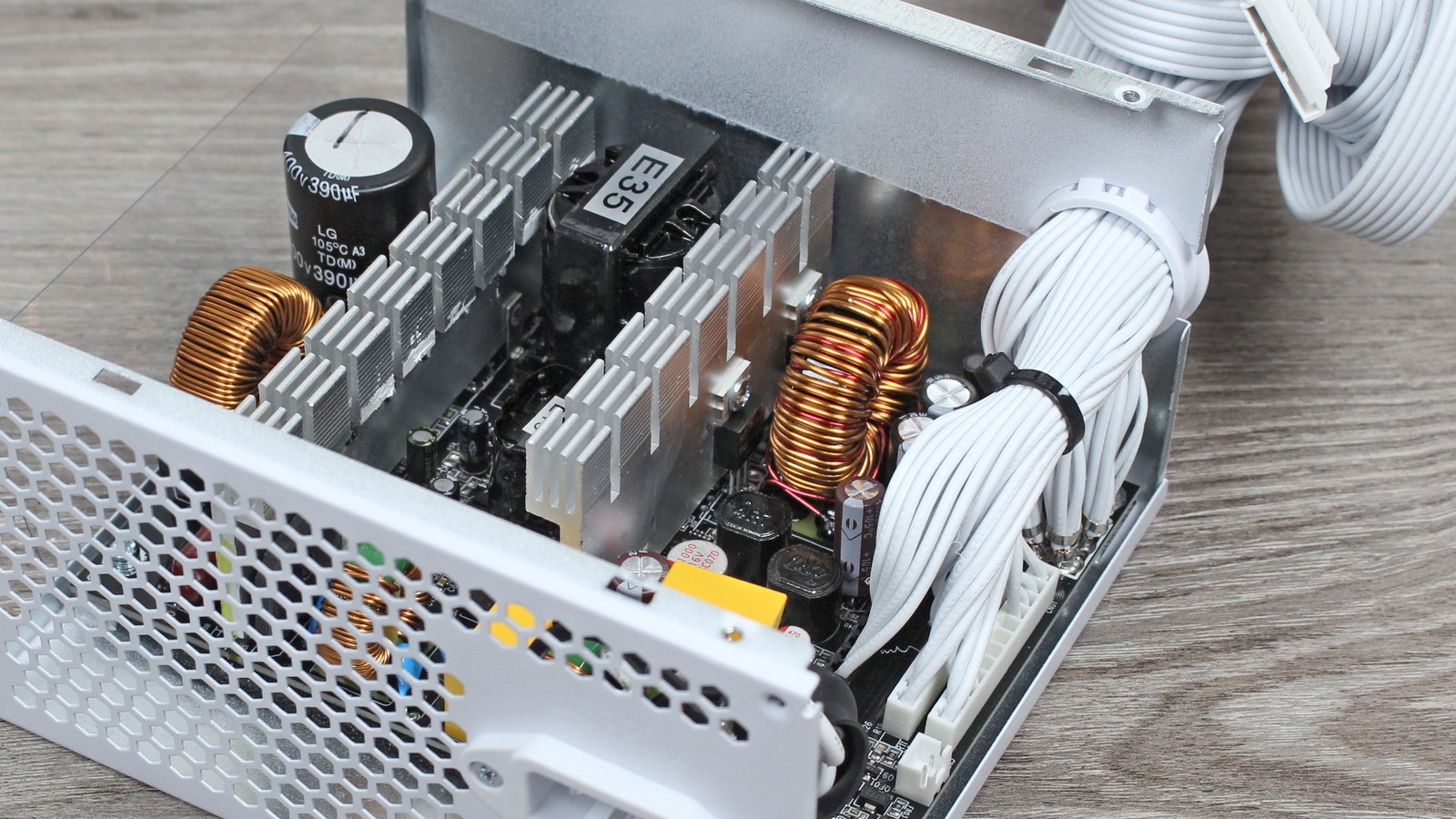
The power supply uses group voltage stabilization, indicated by a large choke with two windings — another sign of a budget approach.
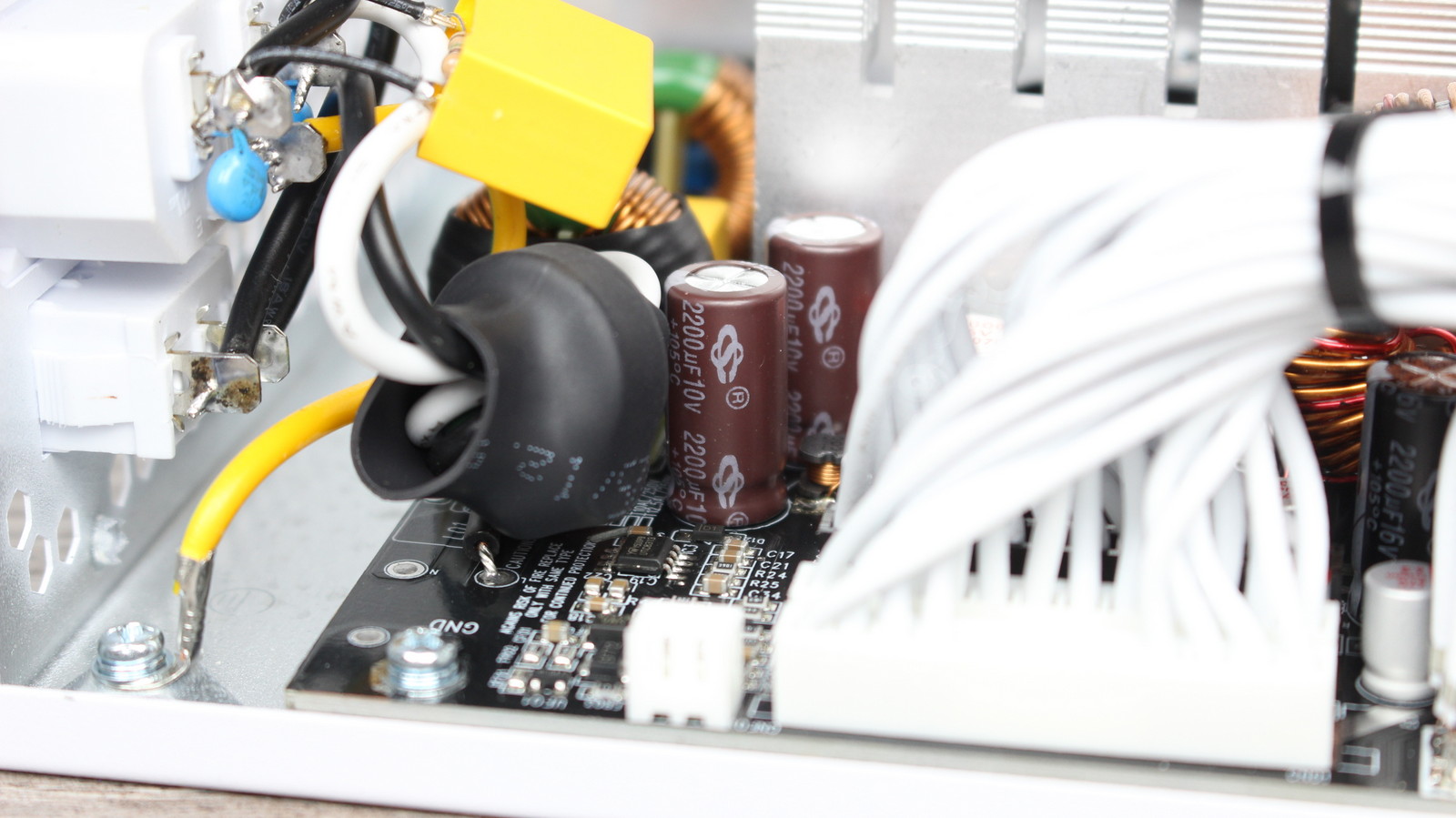
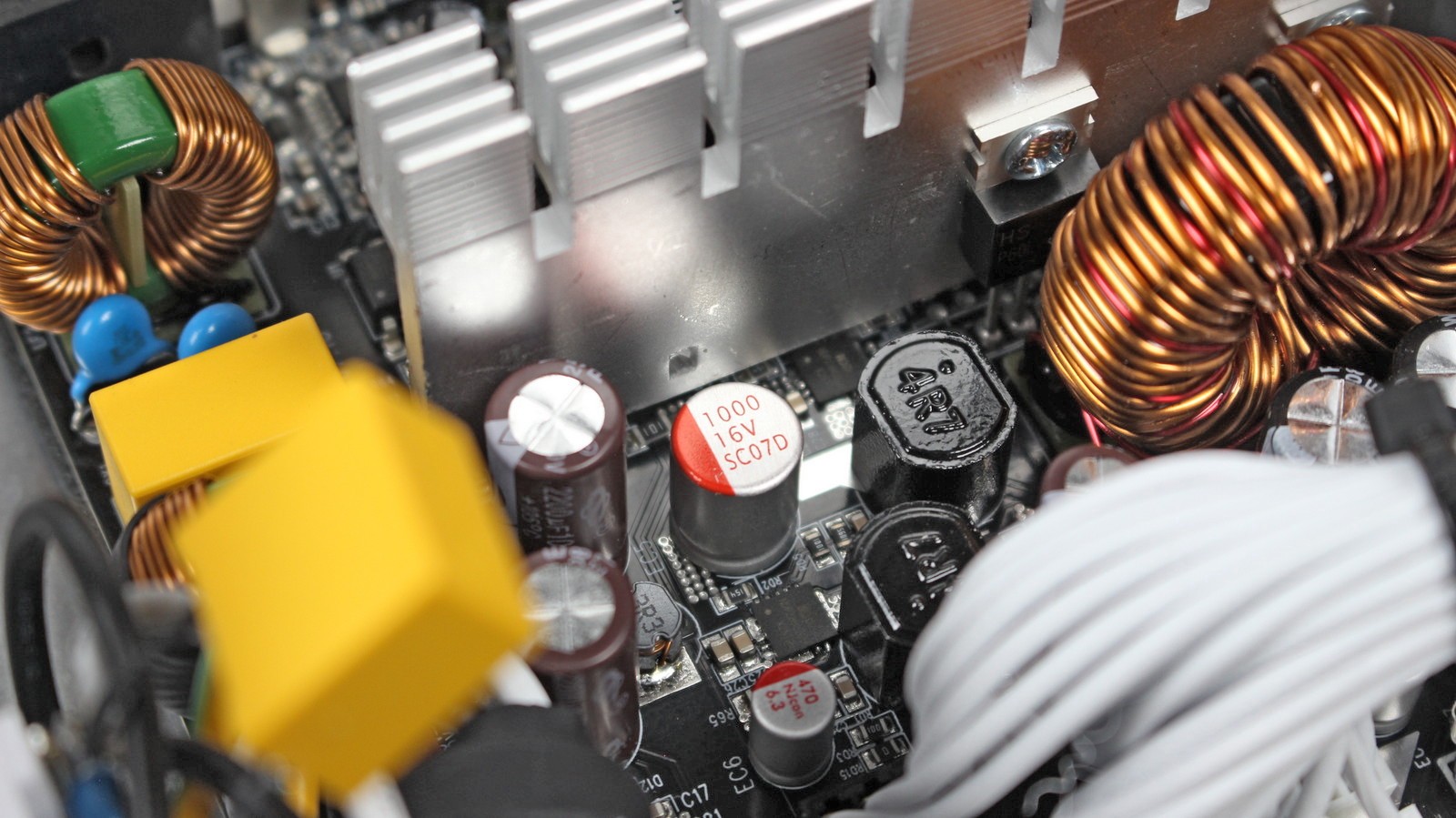
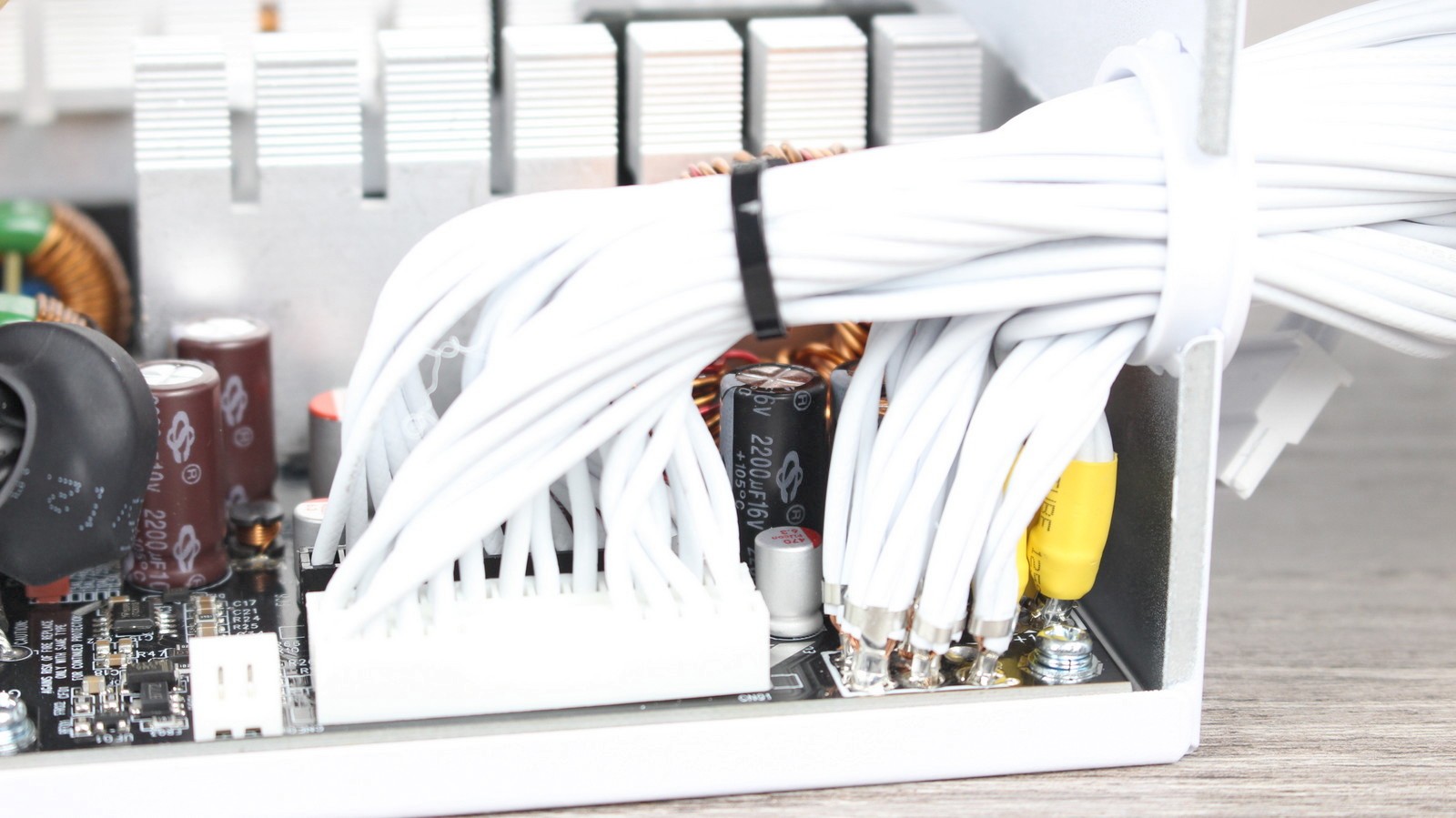
It is pleasing that the device includes a number of reliable solid-state capacitors. At the same time, we could not determine the manufacturer of the high-temperature electrolytes even with the presence of logos – such are encountered for the first time.
The power supply Vinga 750W (VPS-750B1) is equipped with a number of protections. They are listed on the manufacturer's website and on the box, and these lists differ slightly. Here is the compiled table:
- overvoltage protection (OVP);
- undervoltage protection (UVP);
- short circuit protection (SCP);
- overcurrent protection for each channel (OCP);
- overtemperature protection (OTP);
- overload protection (OPP);
- inrush current and surge protection (SIP).
Testing
Cross-load characteristics
Let's move on to practical tests. We'll start with cross-load tests of the main lines of Vinga 750W (VPS-750B1), where the allowable voltage deviation is ±5% from the nominal.
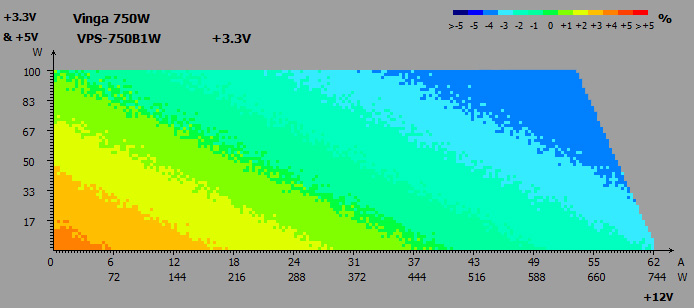
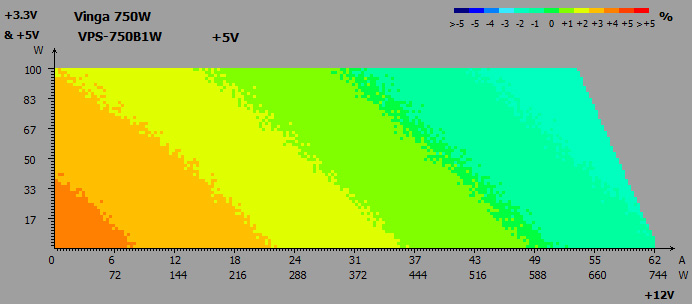
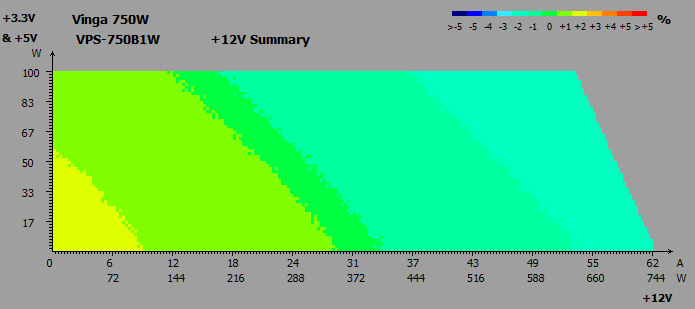
The following deviations were recorded during testing:
- +3.3V line: from -4% to +4%;
- +5V line: from -2% to +4%;
- +12V line: from -2% to +2%.
Group stabilization is noticeable with larger deviations than models with separate stabilization. However, all values remain within the norm, with a margin to the limit values.
Standby power line +5VSB
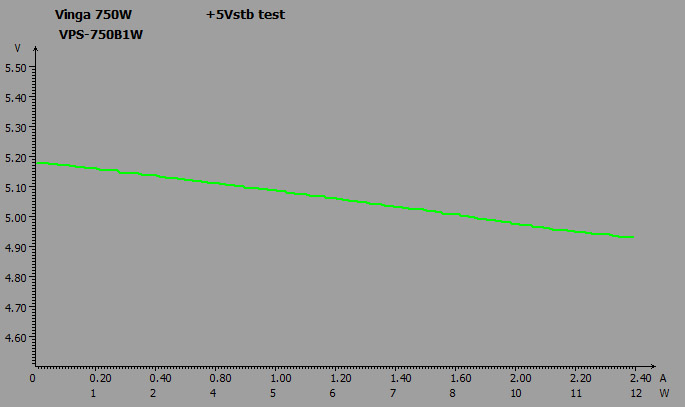
The deviations of the standby power line are very similar to the +5V channel: the voltage varies from 5.18 to 4.93 V, or from +3.6% to -1.4%.
Noise and Ripple
For the ATX12V standard, the following allowable ripple levels (peak-to-peak) are provided:
- +3.3V and +5V lines: 50 mV;
- +12V line: 120 mV.
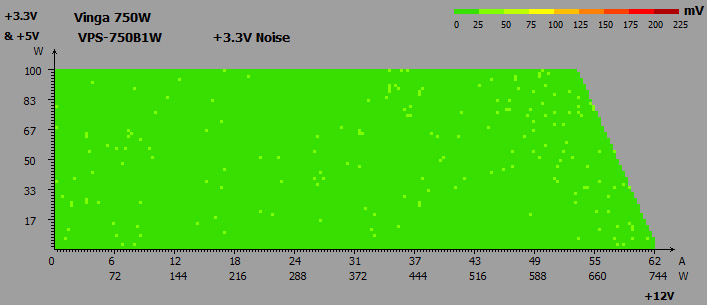
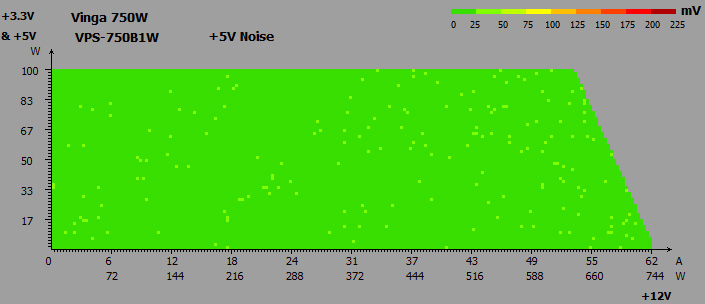
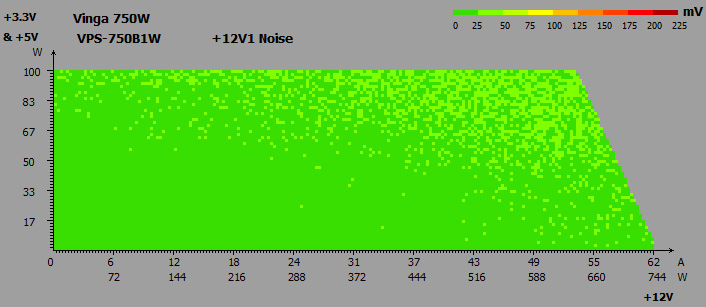
On the three main channels, the ripple did not exceed 50 mV, which is very good.
PF
Table showing the change in PF depending on the load of the power source:
|
Load, W |
70 |
150 |
250 |
325 |
400 |
500 |
600 |
700 |
750 |
|
Load*, % |
9 |
20 |
33 |
46 |
53 |
67 |
80 |
93 |
100 |
|
PF |
0,82 |
0,92 |
0,96 |
0,97 |
0,97 |
0,97 |
0,97 |
0,98 |
0,98 |
Load* – load as a percentage of the power supply's nominal power.
The APFC unit operates properly: at 20% load, the PF coefficient reaches 0.92, and the maximum value is 0.98.
Efficiency
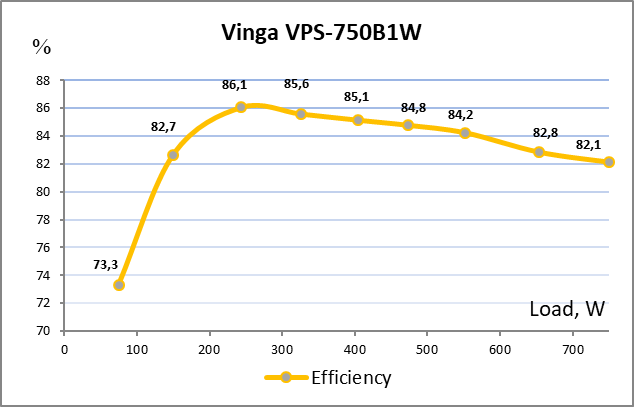
At loads of 20%, 50%, and 100% of the nominal, the efficiency of Vinga 750W (VPS-750B1) exceeded 82%, 85%, and 82% respectively – a level corresponding to the 80 PLUS Bronze certificate.
Cooling System
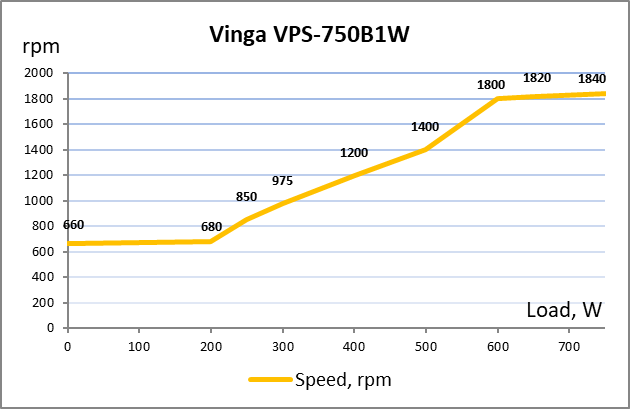
The fan starts at 680 RPM and operates very quietly up to a load of 250 W. It remains quiet up to 450 W, and then the noise increases to below average. The maximum speed is reached at 600 W and is 1800-1840 RPM.
Temperature Mode
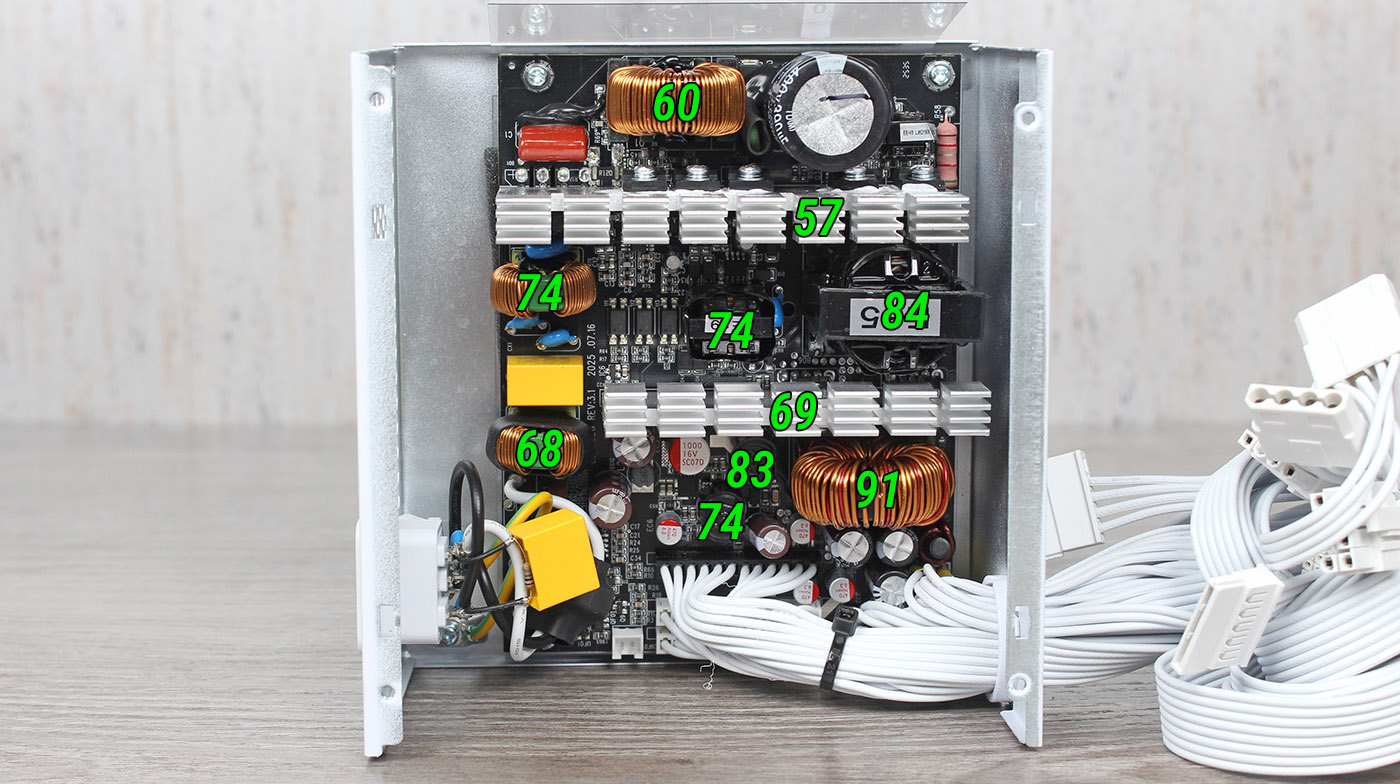
After 15 minutes of operation under a 650 W load, the main transformer reached a temperature of 84°C, which is an acceptable indicator. However, the group stabilization choke heated up to 91°C — this is already a high value that can accelerate the degradation of the winding insulation and heat the neighboring capacitors. Therefore, it is not advisable to load the unit over 600 W for a long time.
By the way, it was quite hot during testing — +28°C.
Testing on a Real Configuration
|
Component |
Model |
|
Processor |
AMD Ryzen 9 7900X (Socket AM5, 12 / 24 x 4.7 – 5.6 GHz, TDP 170 W) |
|
Cooler |
ASUS TUF Gaming LC II 360 ARGB |
|
Motherboard |
ASUS TUF GAMING X870-PRO WIFI7 W NEO (AMD X870, Socket AM5, ATX) |
|
RAM |
2 × DDR5-6000 16 GB Kingston FURY DDR5 (KF560C40BBAK2-32) |
|
Graphics Cards |
ASUS ROG Strix GeForce RTX 3090 Ti |
|
SSD |
Kingston KC600 512 GB (SKC600/512G) |
|
Wattmeter |
Seasonic PowerAngel |
|
Multimeter |
MASTECH MY64 |
The capabilities of Vinga 750W (VPS-750B1) were tested on a system with a 105-watt processor and a graphics card with a TDP of 450 W. Measurements were conducted in "Idle" and "Maximum Load" modes (using the FurMark Donut (GK) test in the MSI Kombuster utility). As a result, the following values were obtained:
|
Mode |
Value, V |
Deviation, % |
|
+12V |
||
|
Idle |
12.21 |
+1.8 |
|
Burn |
12.17 |
+1.4 |
|
+5V |
||
|
Idle |
5.13 |
+2.6 |
|
Burn |
5.10 |
+2.0 |
|
+3.3V |
||
|
Idle |
3.41 |
+3.3 |
|
Burn |
3.37 |
+2.1 |
|
Input Power Consumption, W |
||
|
Idle |
95 |
|
|
Burn |
703 |
|
The state of the output voltages turned out to be very good, and for a device with group stabilization — excellent. There are no drops below the nominal, and all values remain within the norm, deviating from the nominal by only 1.4-3.3%.
Power Consumption in Idle and Off State
Additionally, the tested device consumes only 3 W in the computer's off state and 5 W in sleep mode.
Conclusion
For its ₴2319 ($52) Vinga 750W (VPS-750B1) offers a lot: high nominal power, 80 PLUS Bronze certificate, flat cable ribbons, and a good set of connectors for connecting graphics cards. In particular, there is a modern PCIe 5.0 at 600 W and four 6+2-pin PCIe connectors. It also includes a set of necessary protections, a Taiwanese input capacitor, and several polymer elements. Moreover, the tested white version will fit well into a light build.
However, the low price has its reasons: it uses a fan, power elements, and electrolytic capacitors (except for the input one) from unknown manufacturers. Another feature is group voltage stabilization. Despite this, the output indicators turned out to be very good even under significant load. However, the group stabilization choke heats up significantly, so for long-term operation, we recommend not exceeding a load of approximately 600 W.
All of the above may partially explain the short warranty period — only 1 year, while the manufacturer's "gold" models receive 3 years.
In conclusion, Vinga 750W (VPS-750B1) looks like an attractive solution in its price segment: it offers modern connectors and decent performance, but savings on the element base and cooling impose limitations. This is an option for those looking for an affordable power supply with good functionality but ready to compromise on durability.
Advantages:
- good efficiency level (80 PLUS Bronze);
- high-temperature Taiwanese input capacitor and several polymer elements;
- good voltage condition on the main power lines;
- no voltage drops even when connected to a powerful configuration;
- presence of protections;
- four 6+2-pin PCIe connectors and one 600-watt PCIe 5.0 (12VHPWR);
- convenient flat cable ribbons;
- attractive white design;
- affordable price.
Features:
- support for operation only in 230 V networks;
- use of a number of power elements, electrolytes, and a fan from unknown manufacturers;
- only 1 year warranty.