Power supplies under the Vinga brand have been present in the domestic market for several years — the first model entered our test lab more than 9 years ago. Over this time, they have significantly evolved, as we confirmed with the recently tested model Vinga 750W (VPS-750GV3). However, the good balance between cost and internal components remains stable.
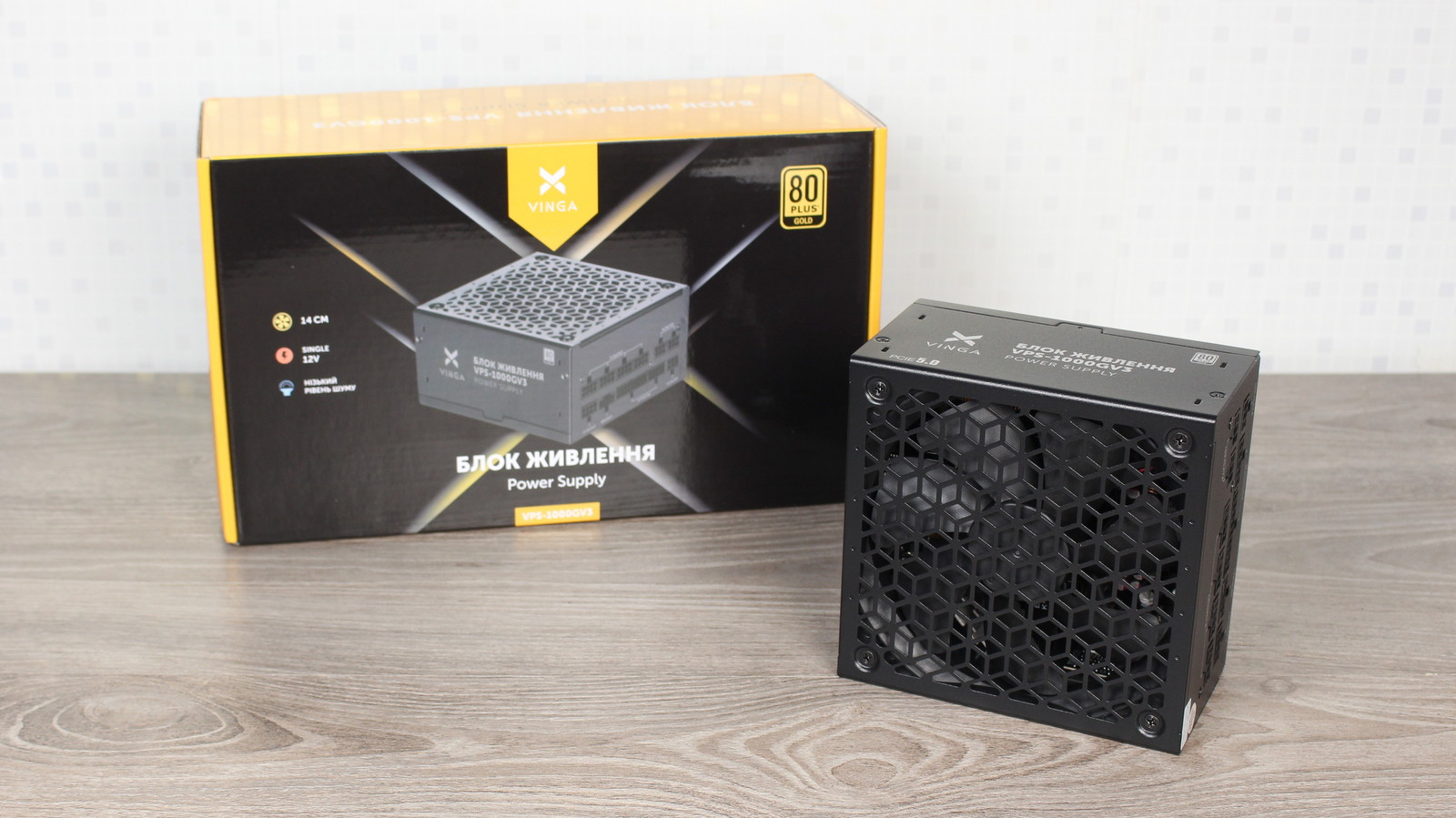
Another bright example of this is the Vinga 1000W (VPS-1000GV3). On one hand, it's one of the most affordable kilowatt units in the domestic market. On the other hand, it boasts several technical features, many of which are not immediately obvious. So we invite you to get acquainted with the new product together with us.
Specification
|
Model |
Vinga 1000W (VPS-1000GV3) |
|
Type |
ATX12V 3.0 |
|
Maximum power, W |
1000 |
|
Power on +12V channel, W |
999.6 |
|
Power on +3.3V and +5V lines, W |
100 |
|
Number of +12V lines |
1 |
|
Maximum current on +3.3V channel, A |
20 |
|
Maximum current on +5V channel, A |
20 |
|
Maximum current on +12V channel, A |
83.3 |
|
Maximum current on -12V channel, A |
0.4 |
|
Maximum current on +5Vsb (standby power line), A |
3.0 |
|
Input voltage, V |
100 − 240 |
|
Input current, A |
8 – 15 |
|
Efficiency, % |
≤92 |
|
80 PLUS Certification |
Gold |
|
Power factor correction method |
Active |
|
Power factor (PF), % |
≤99 |
|
PCIe connectors |
3 (6+2-pin) |
|
PCIe 5.0 connector (12VHPWR) |
1 (600 W) |
|
Modular |
Yes |
|
Fan dimensions, mm |
140 × 140 × 25 |
|
Fan bearing type |
Sleeve |
|
Dimensions (L × W × H), mm |
150 × 150 × 86 |
|
Warranty, years |
3 |
|
Device page |
|
|
Purchase page |
Packaging and Supply Kit
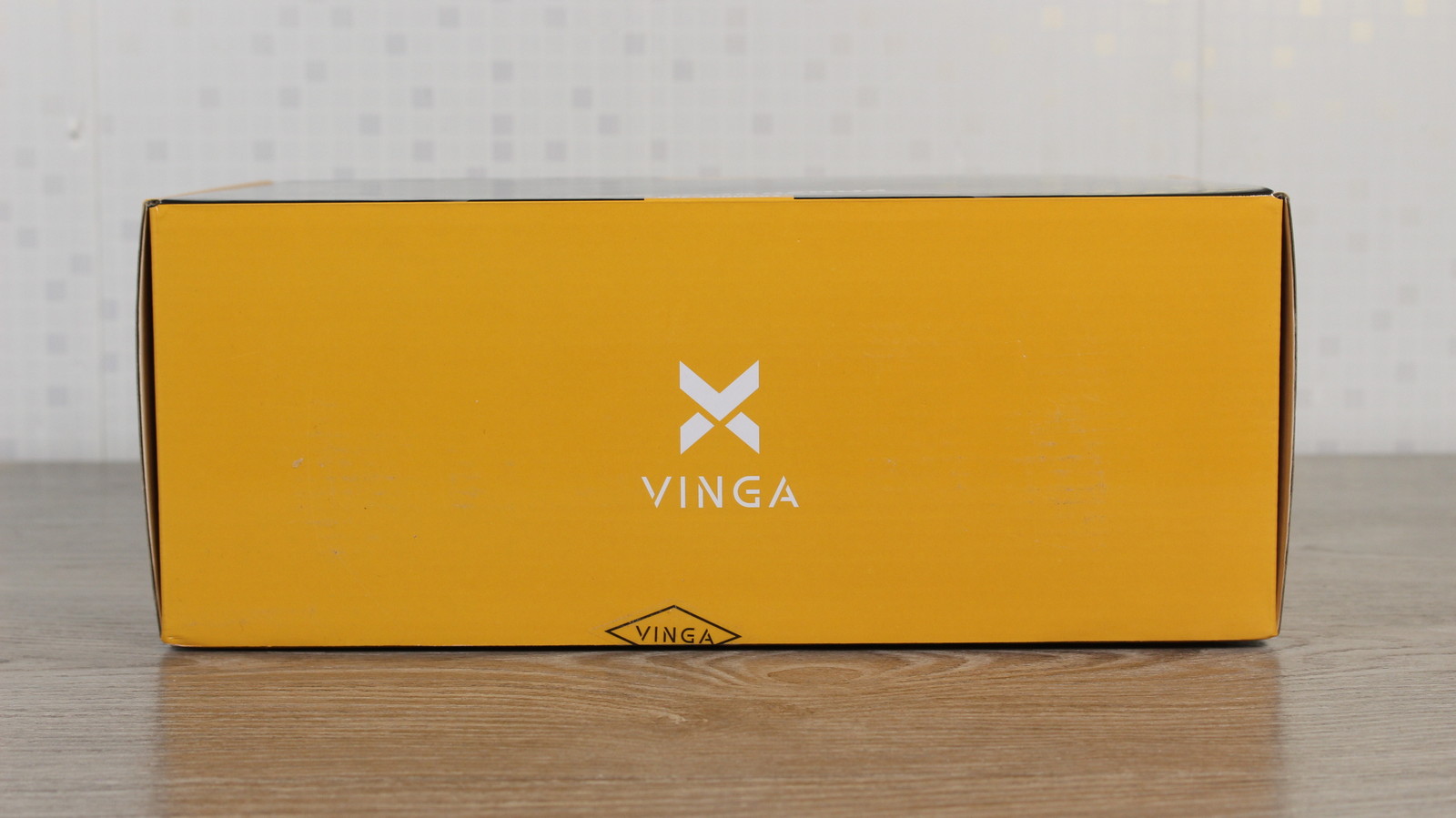
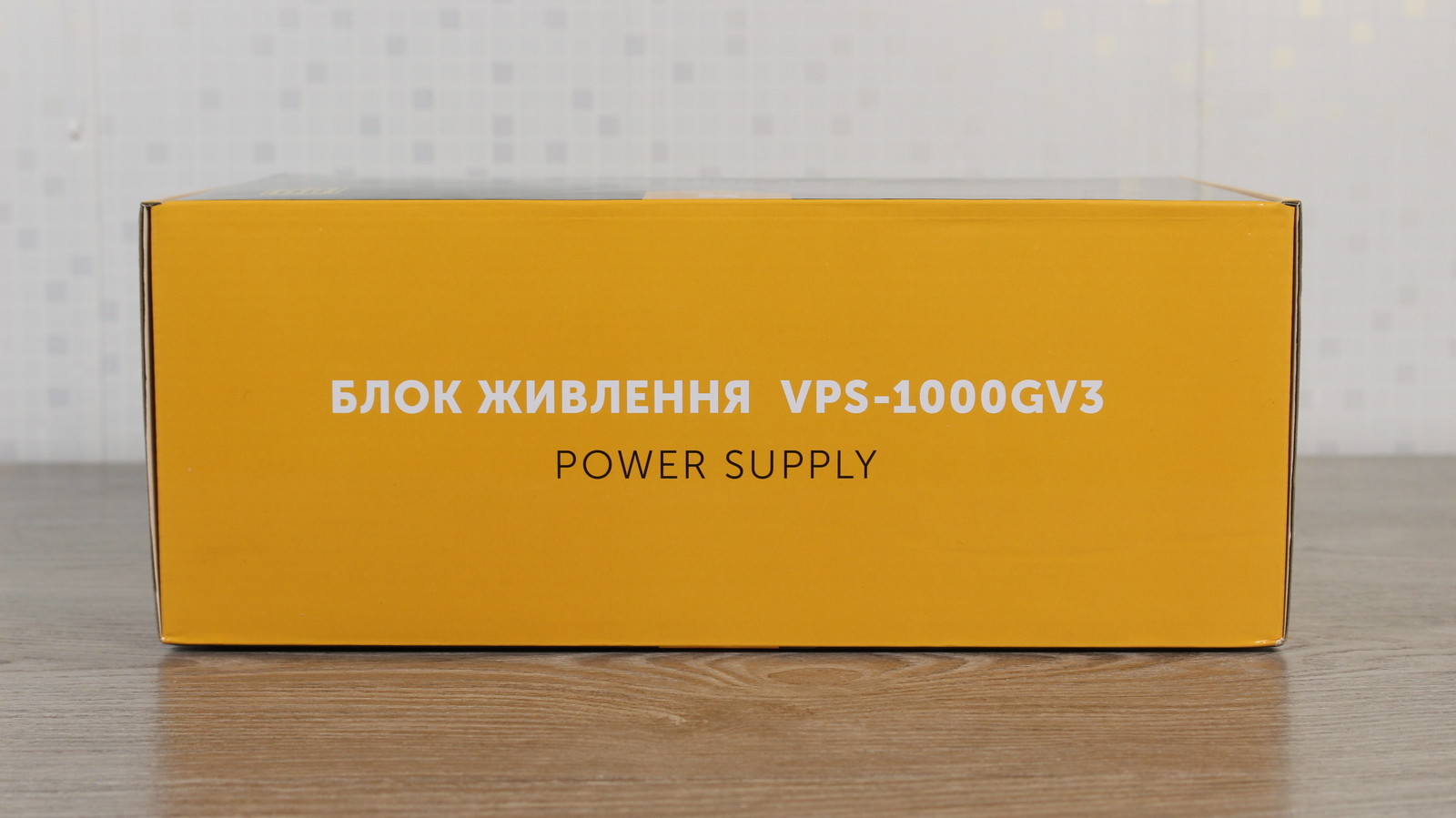
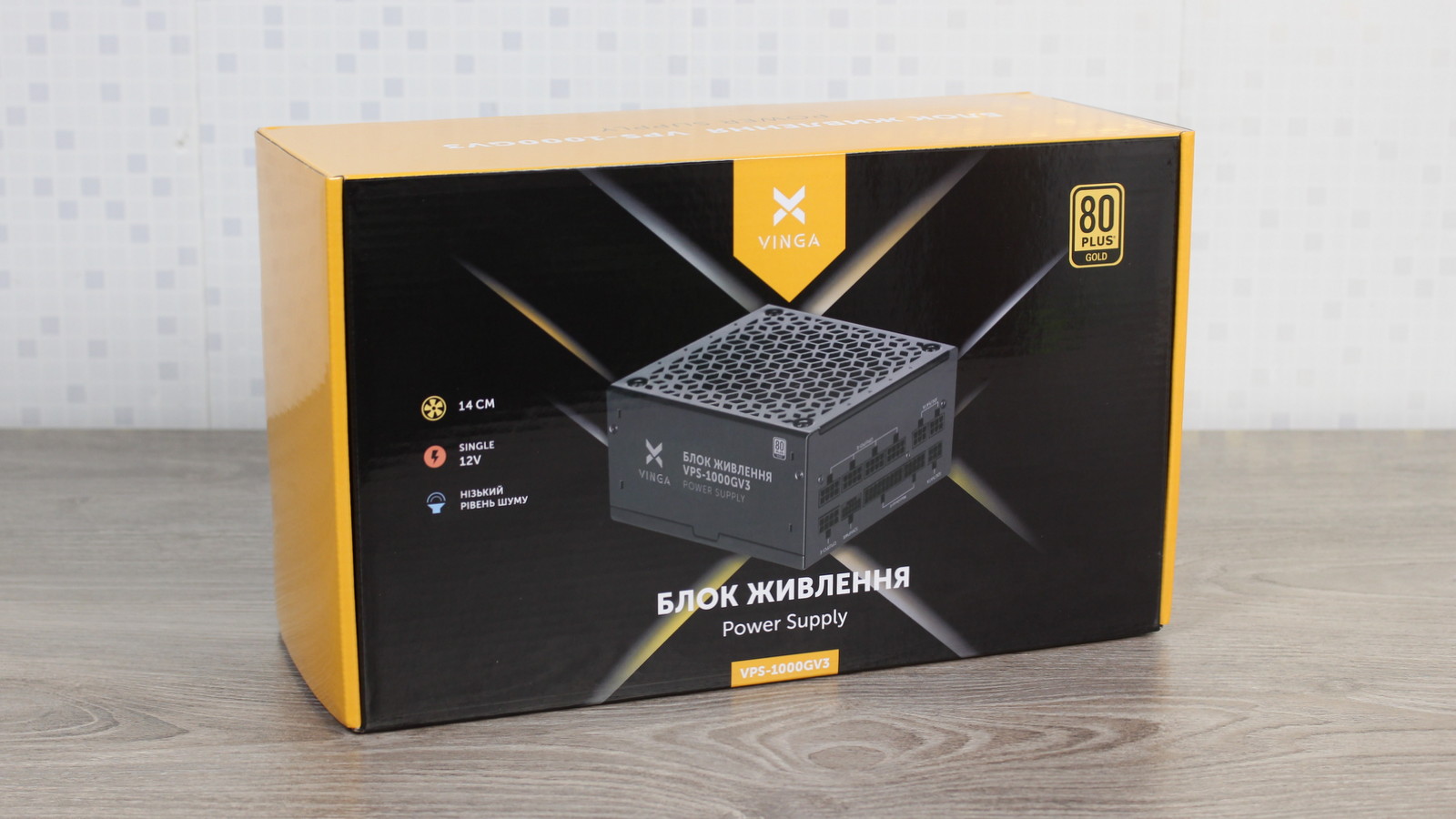
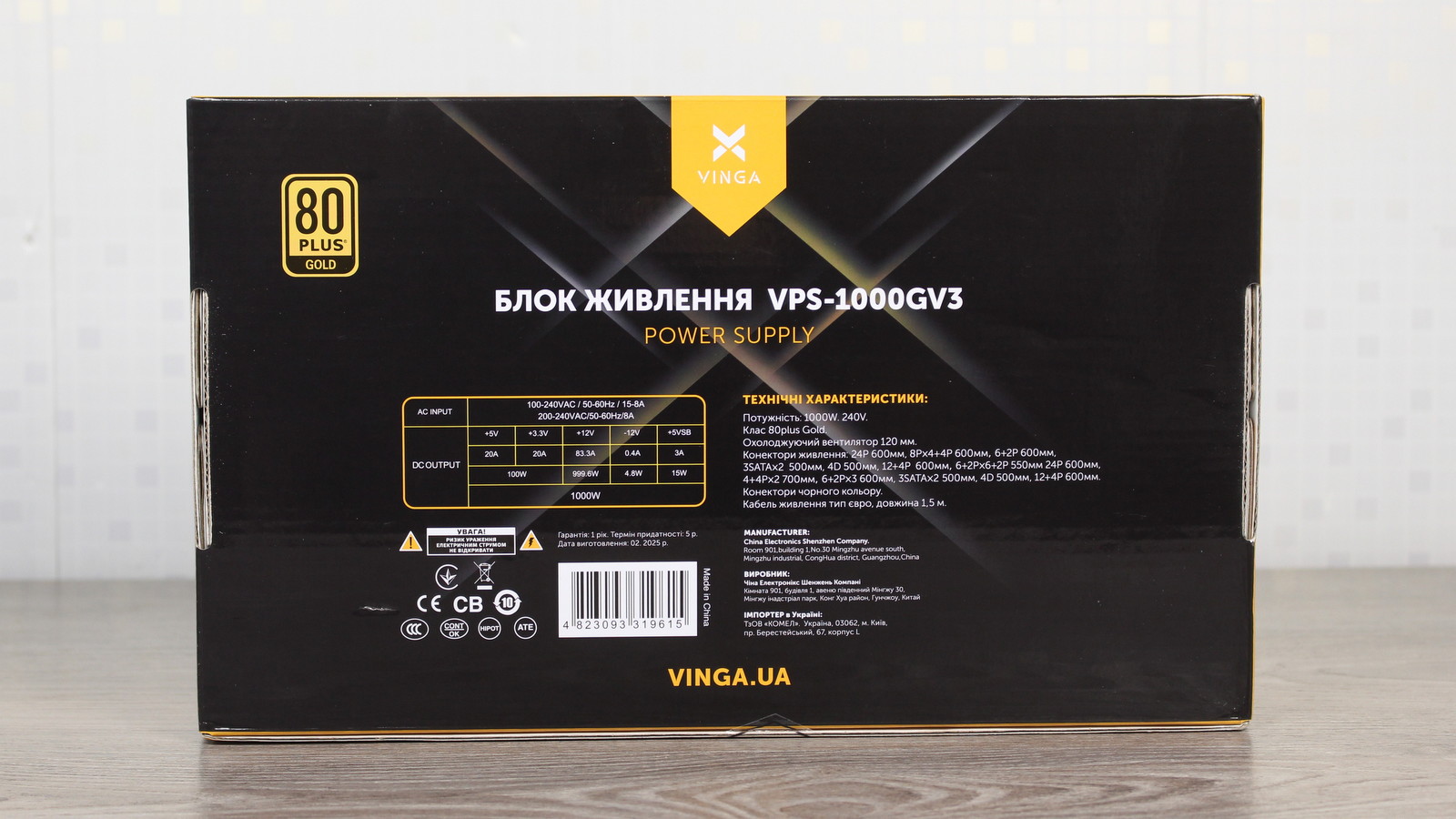
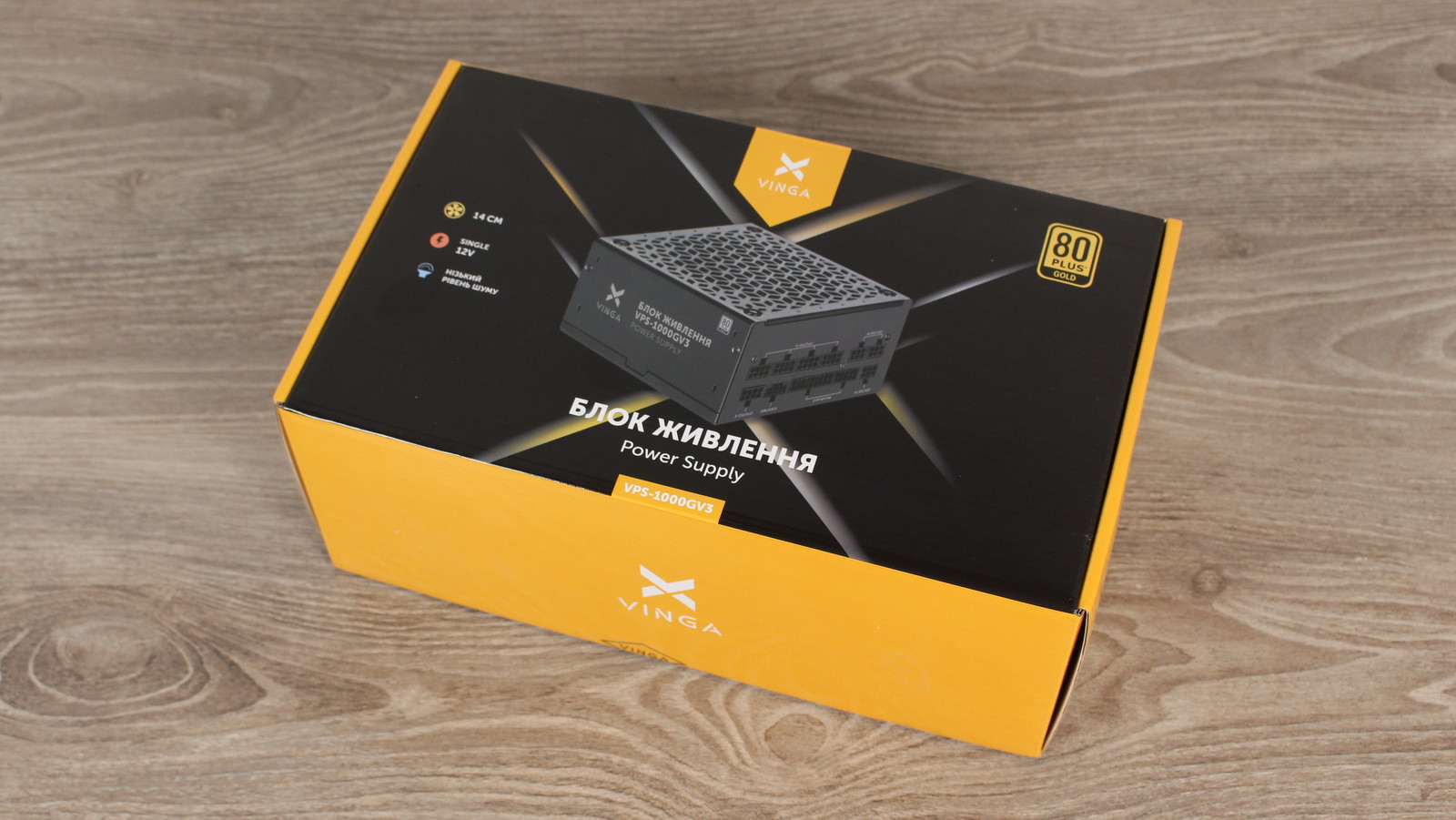
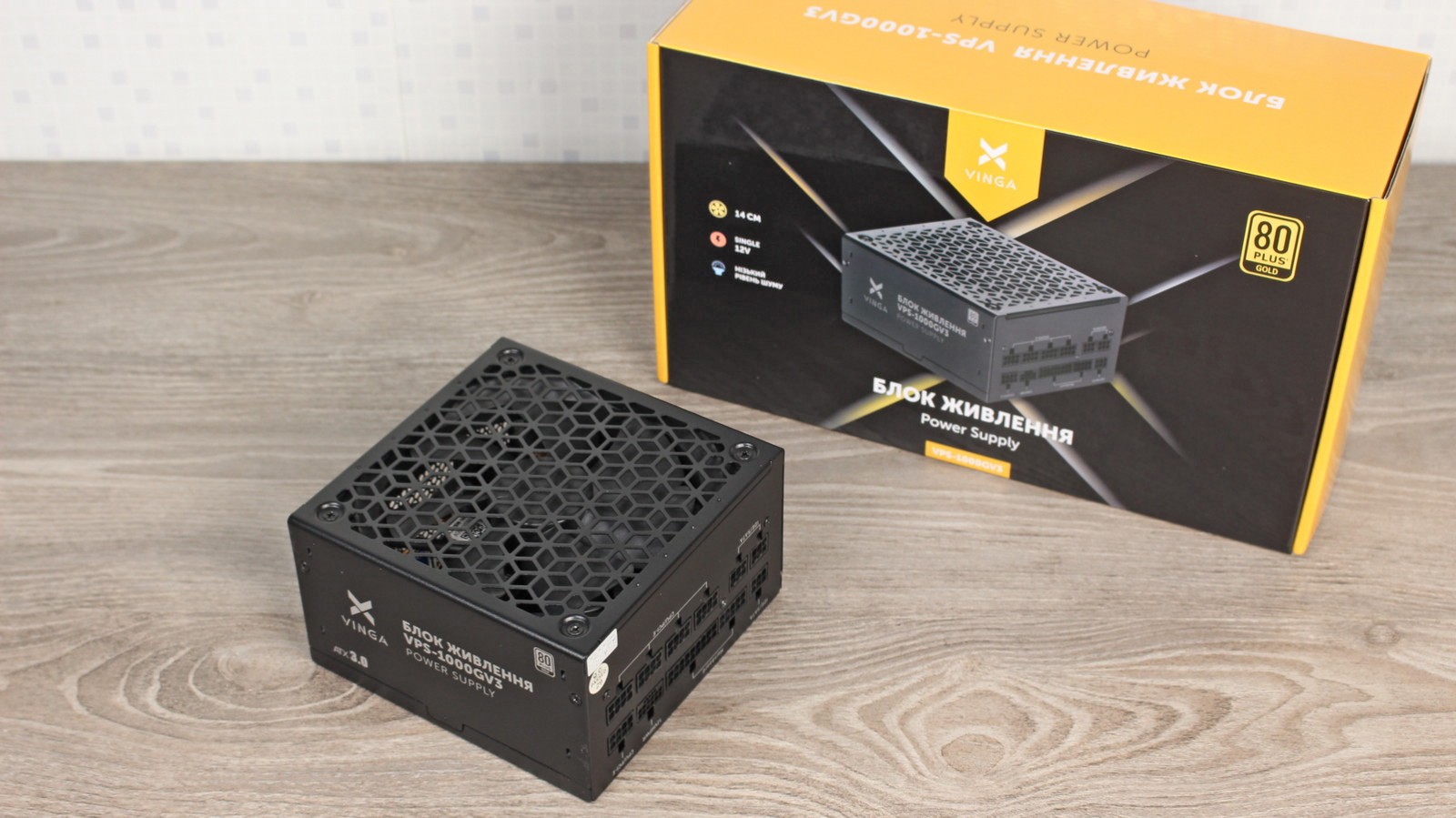
As with the 750W model, the box was designed to be reasonably informative, although some information here contradicts reality.
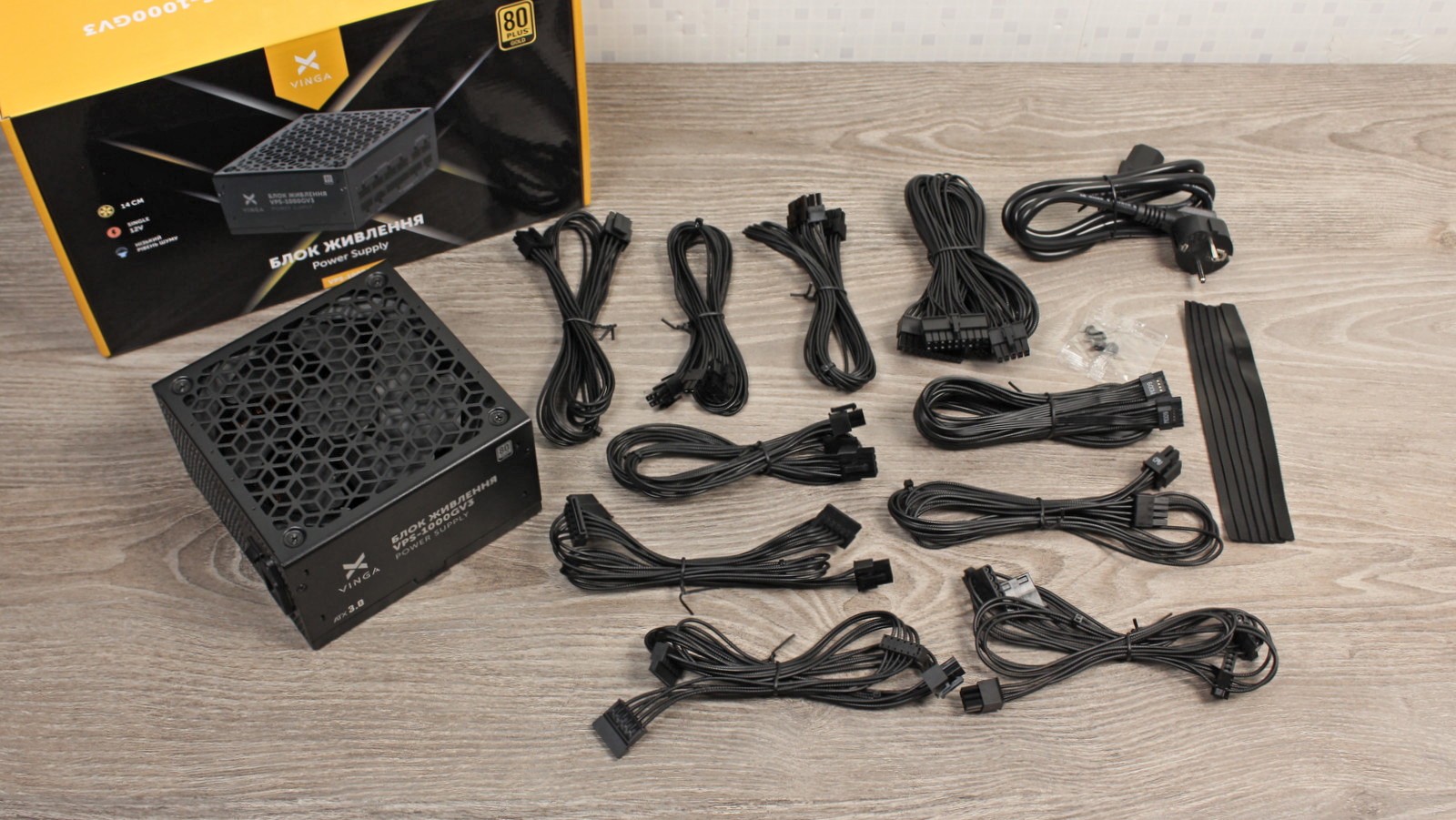
The supply kit is typical for a modular unit: it includes a power cable, modular cables, mounting screws, and a set of Velcro ties.
Appearance
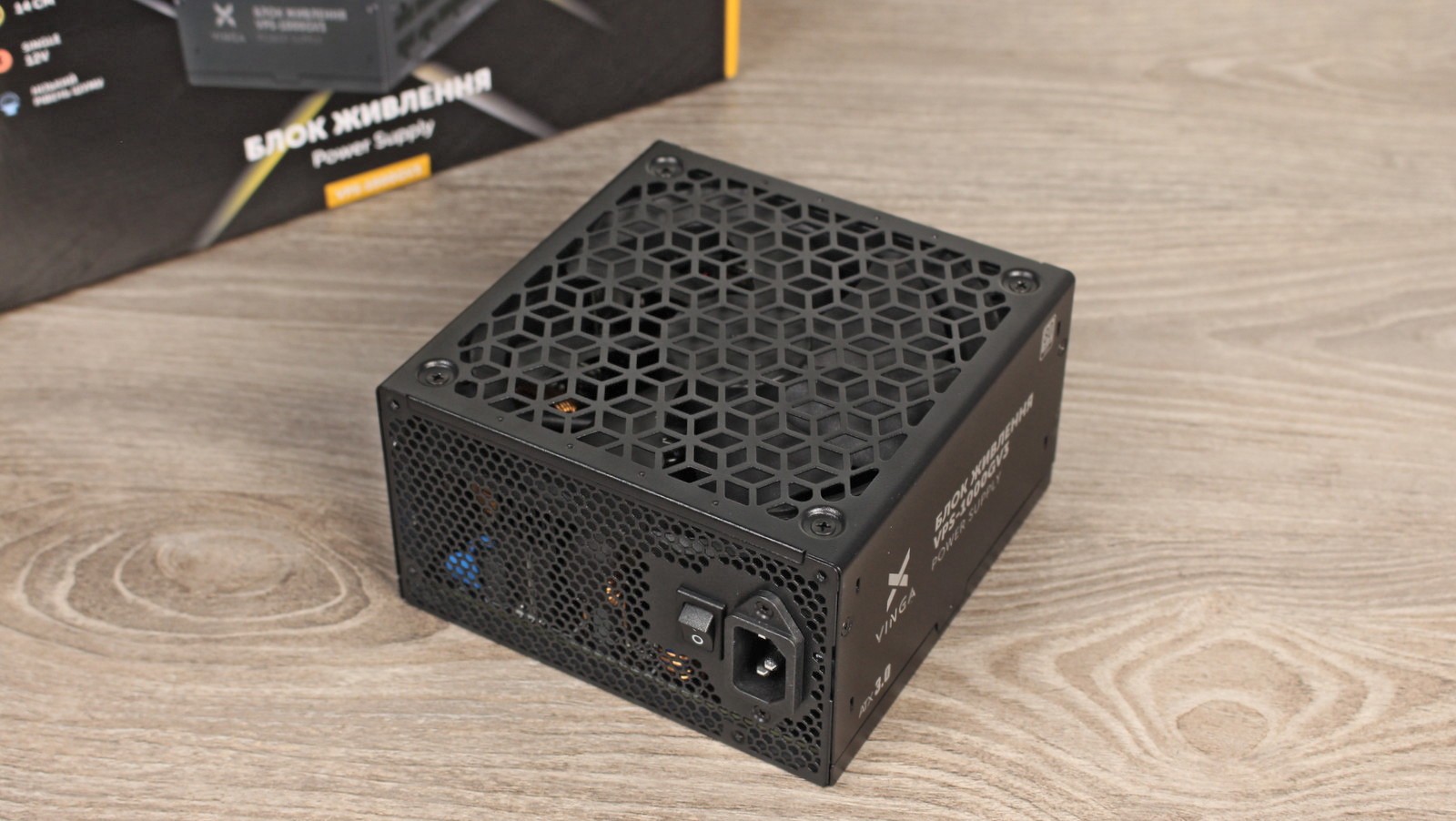
The appearance of the Vinga 1000W (VPS-1000GV3) is notable for its diamond-shaped cutouts above the fan. Otherwise, it has the usual black matte finish and slightly larger than minimal dimensions - 150 × 150 × 86 mm - for excellent compatibility with ATX cases.
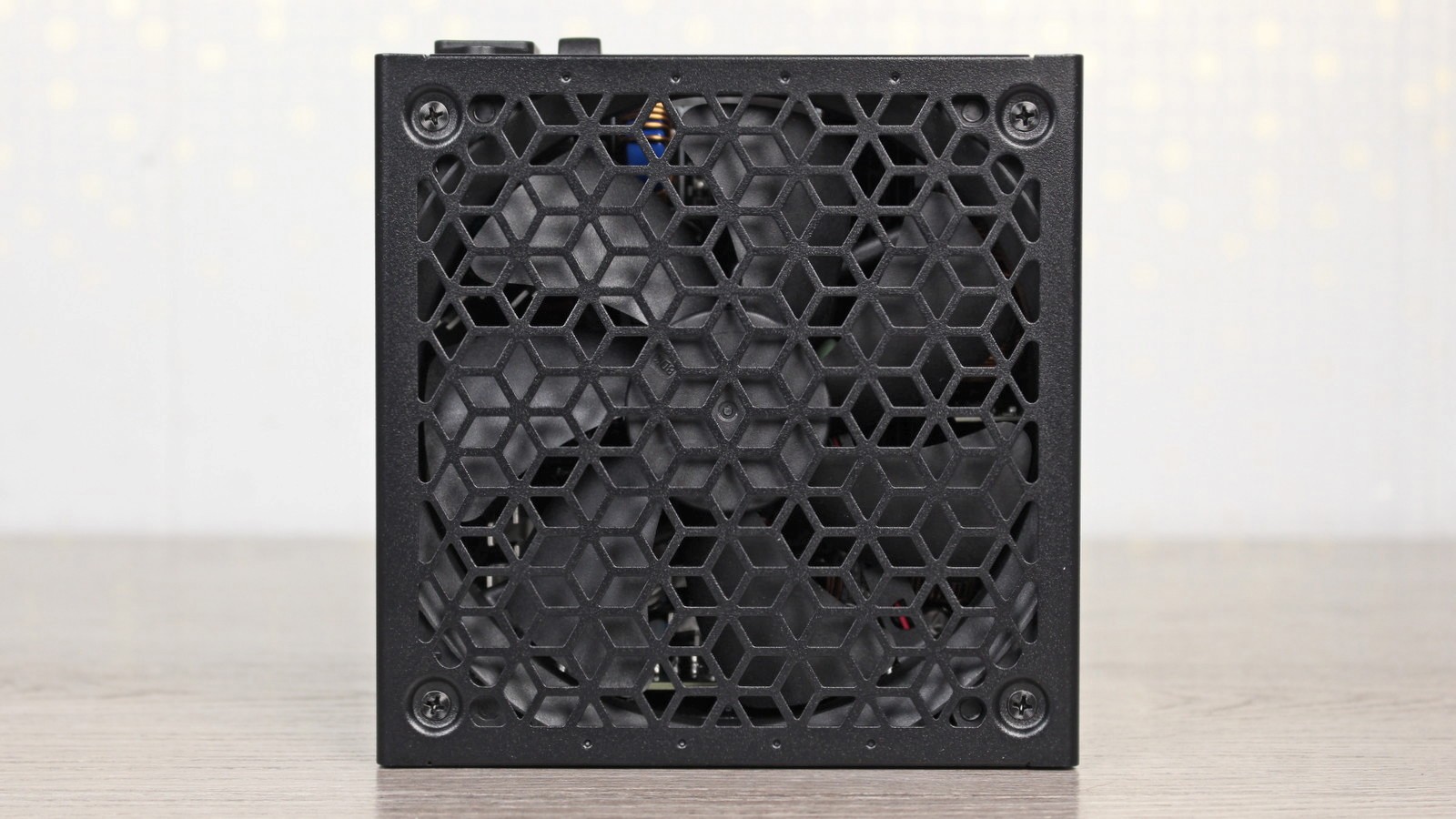
Cooling is provided by a 140mm fan, whereas previous generations of Vinga's "gold" power supplies used 120mm solutions. However, there is no manufacturer's logo here.
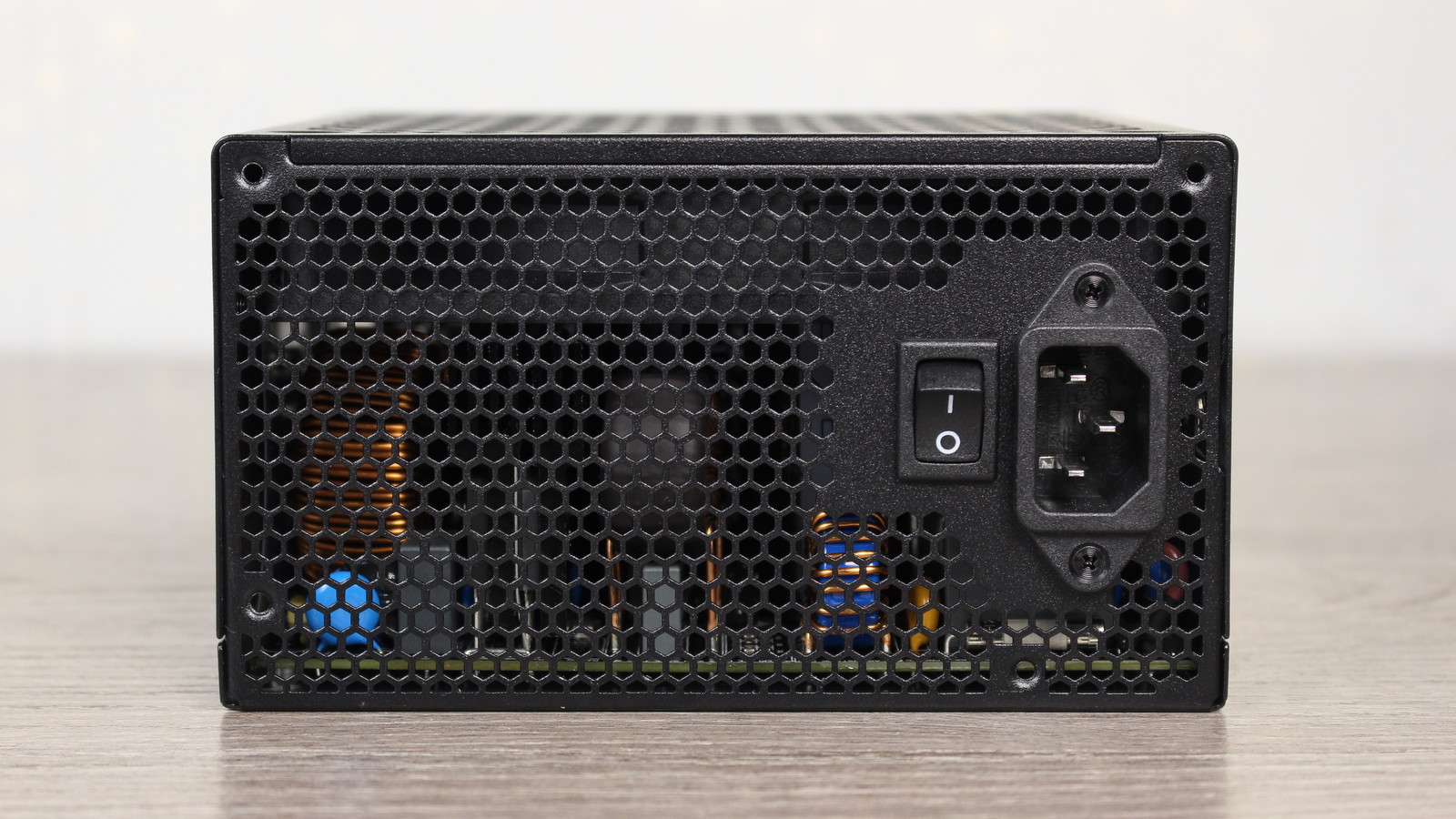
The rear panel is maximally covered with honeycomb-shaped holes. The only exception is the island with the power connector and switch.
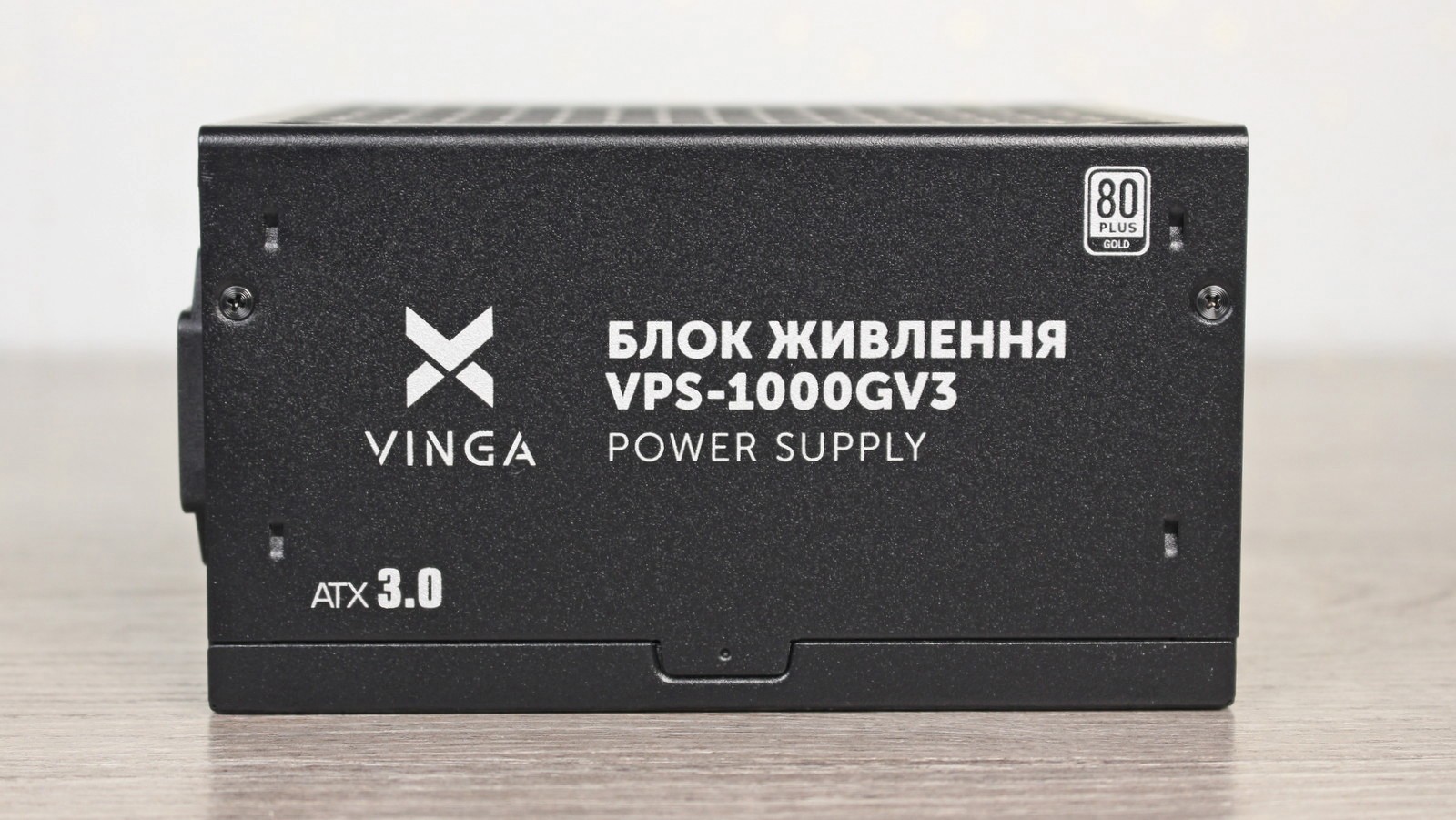
Mentions of the manufacturer are present on both sides, with the inscriptions correctly oriented regardless of the installation method. Additionally, the device model, its 80 PLUS Gold certification, and compliance with the ATX12V 3.0 specification are indicated here. The latter is not the newest, but it remains quite relevant, especially compared to ATX12V 2.x solutions that are still on the market.
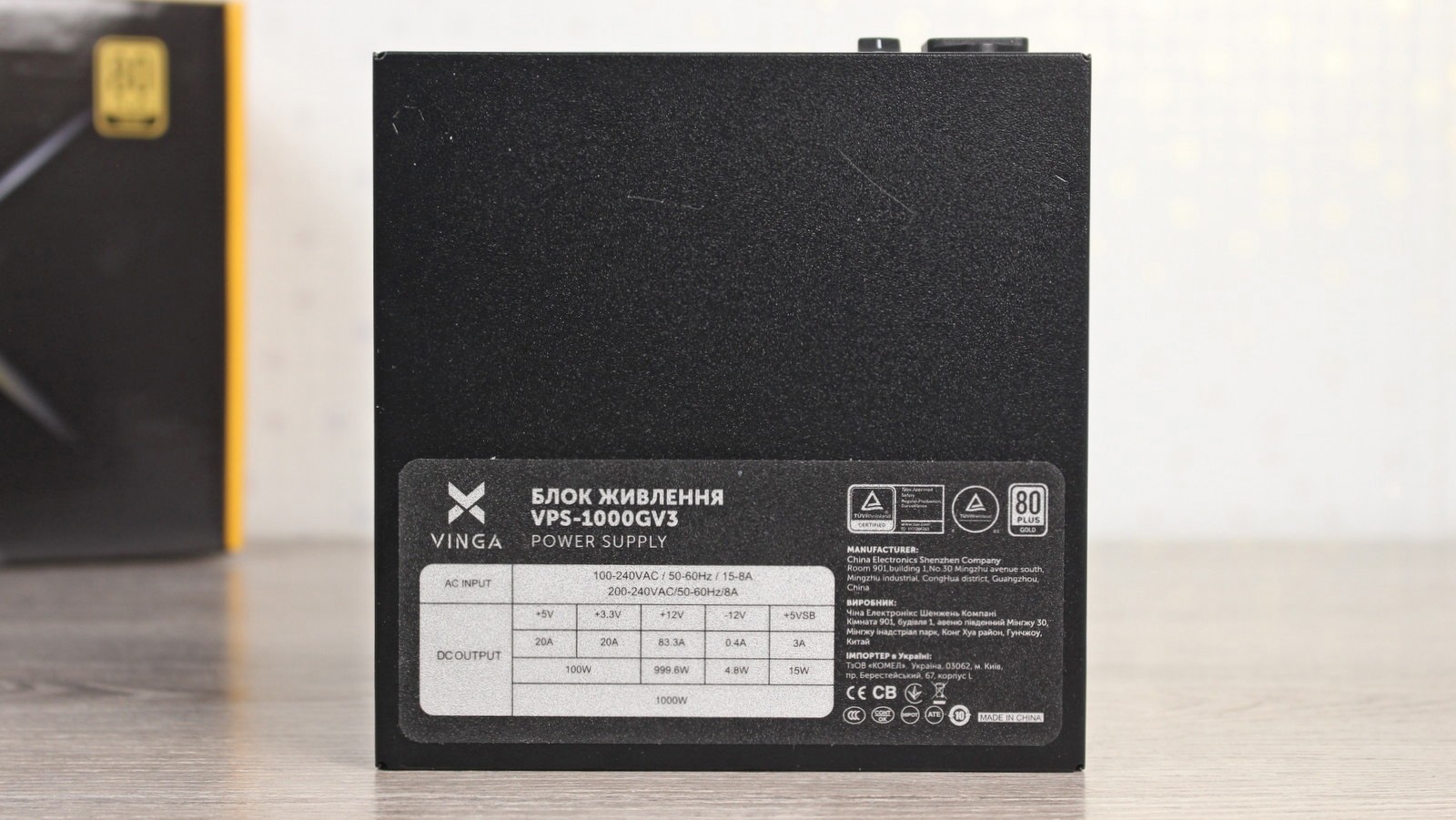
The label boasts excellent electrical specifications. The power of the single +12V rail is 999.6 W and practically matches the maximum, while the lower +3.3V and +5V provide 100 W or 20 A each. Additionally, there is support for a wide voltage range — from 100 to 240 V.
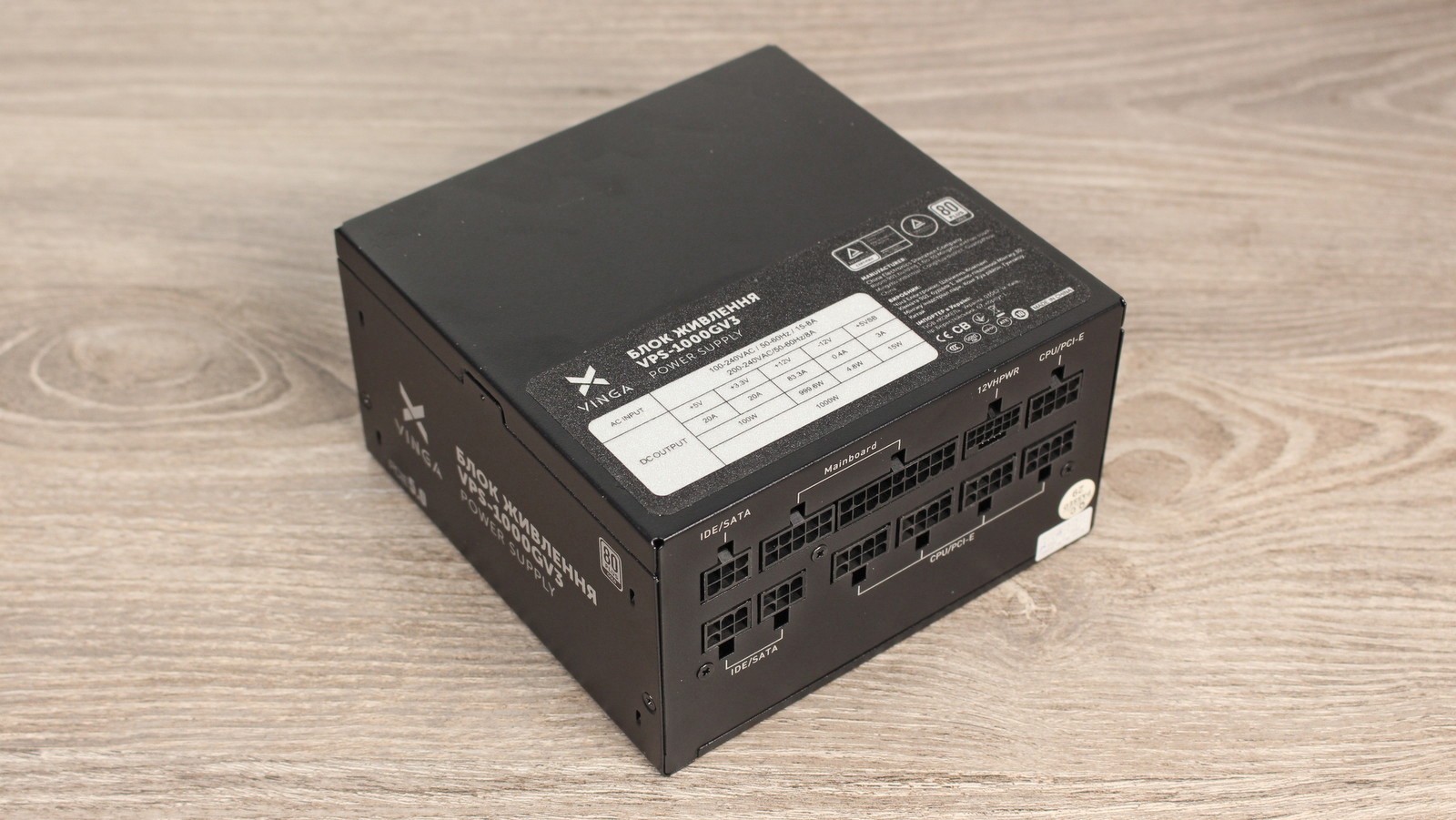
The black-and-white design of the power supply allows it to fit into both dark and light builds. The case also has a warranty sticker with a validity period of 3 years.
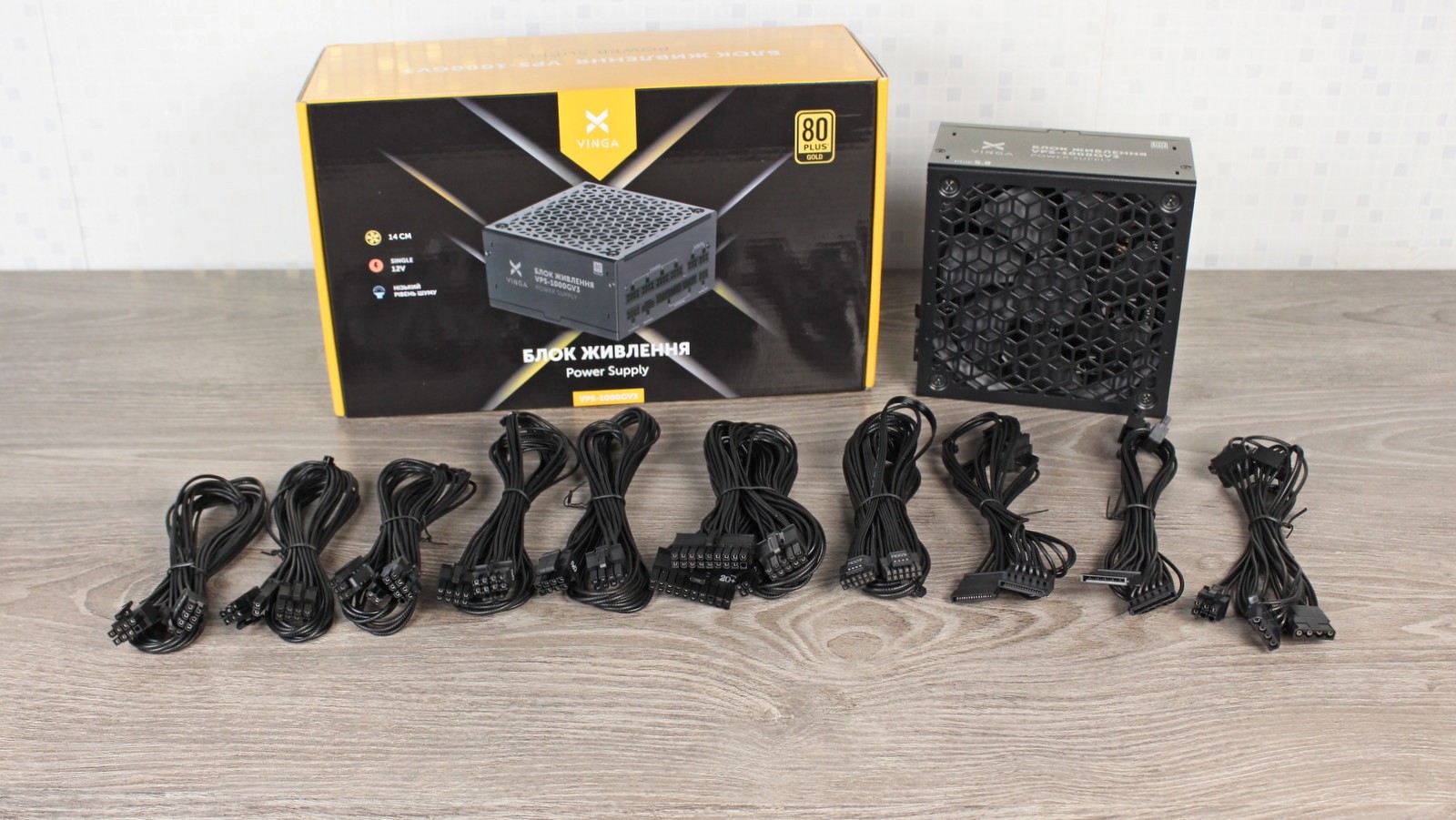
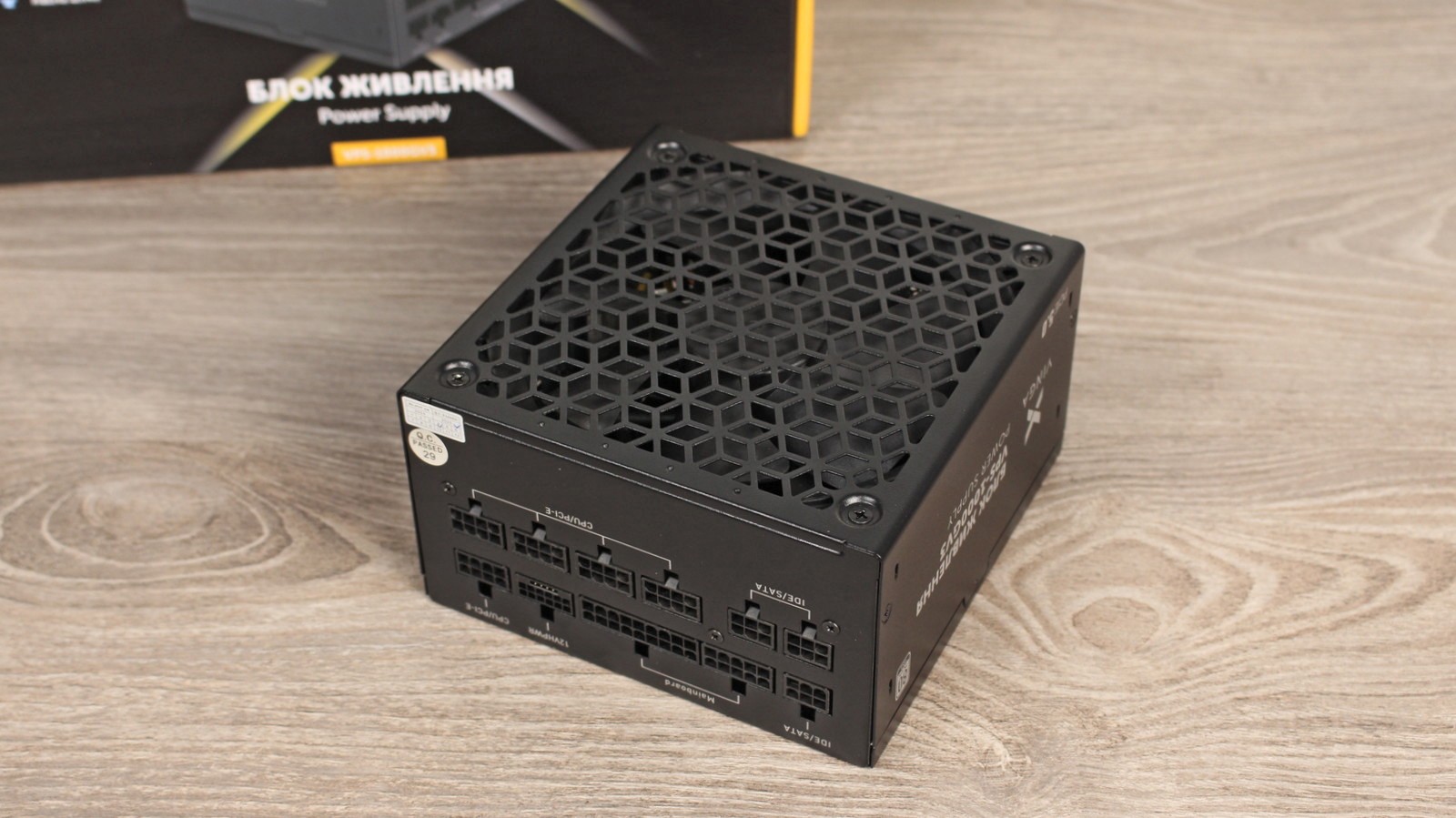
The modular cables of Vinga 1000W (VPS-1000GV3) are made in individual nylon braiding. The wires in the PCIe 5.0 set have a gauge of 16 AWG, while the others are 18 AWG. And the set of connectors will allow powering any modern build:
|
Connectors |
Quantity |
Wire length, cm |
|
20+4-pin ATX |
1 |
60 |
|
4+4-pin ATX12V |
1 |
70 |
|
6+2-pin PCIe |
3 |
60 |
|
PCIe 5.0 (600 W) |
1 |
60 |
|
three SATA + one PATA |
2 |
50-65-80-95 |
|
four PATA |
1 |
50-65-80-95 |
Among them: 20+4-pin ATX, two 4+4-pin ATX12V, three 6+2-pin PCIe, and a 600-watt PCIe 5.0 (also known as 12VHPWR) — it's a pity that it's not the newest PCIe 5.1 (12V-2×6). For drives and peripherals, there are six SATA and the same number of PATA on three cables.
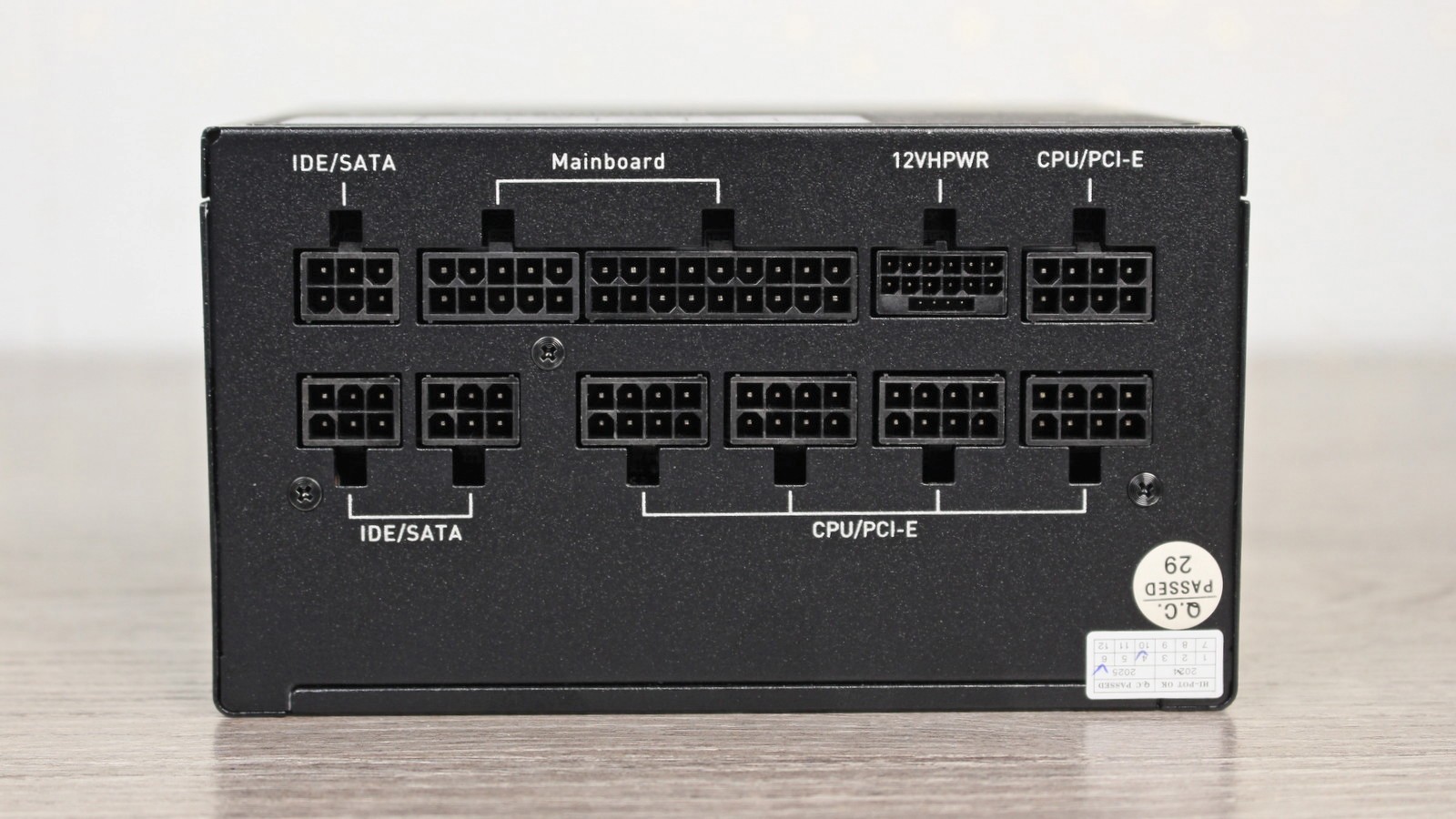
Compared to the 750-watt model, all ATX12V and 6+2-pin PCIe are placed on separate cables, and four additional PATA have appeared. All output connectors are now used for their connection, which have received corresponding labels and different connector shapes, ensuring error-free connection.
Internal Structure
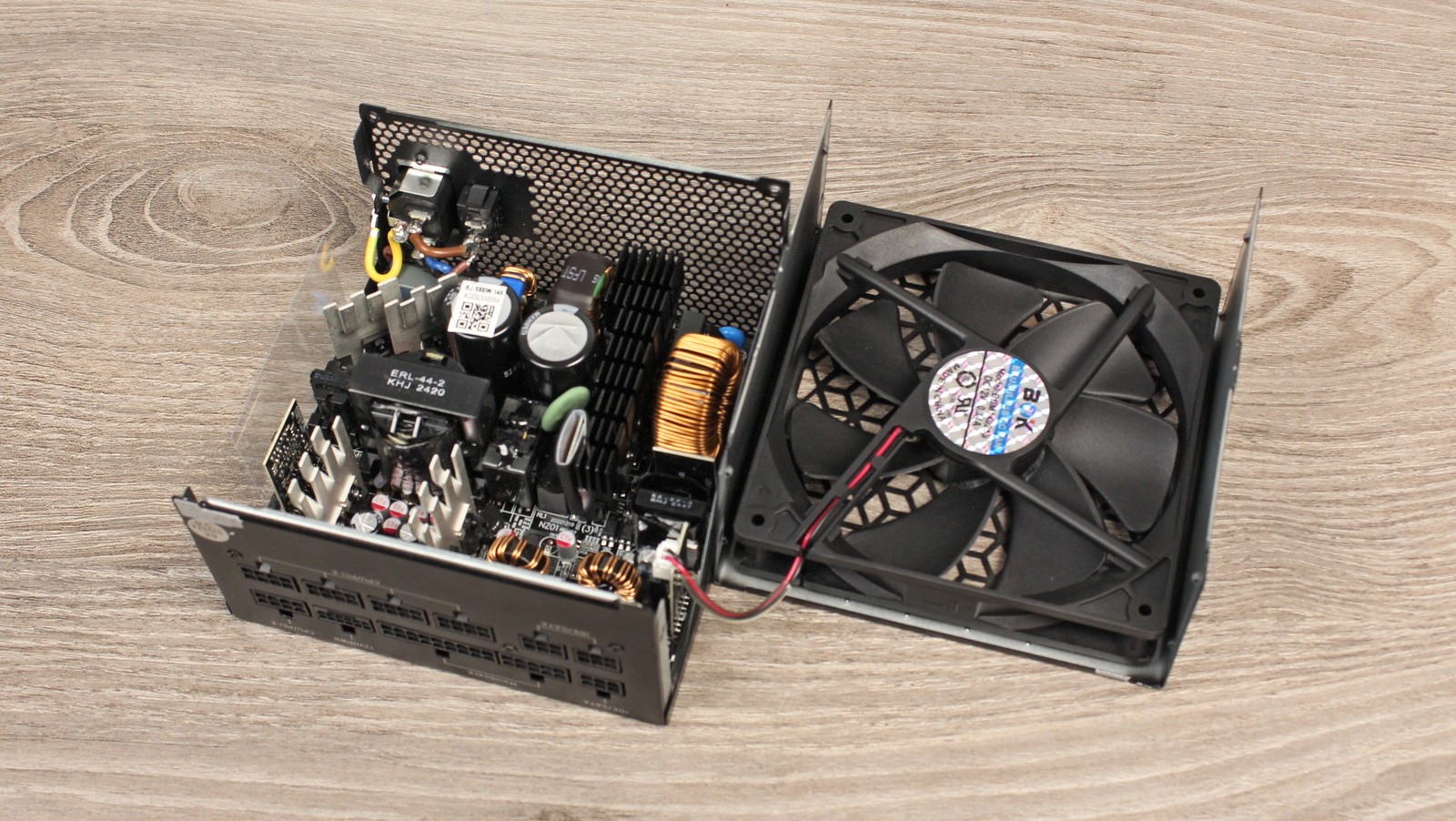
Now about what's hidden inside.
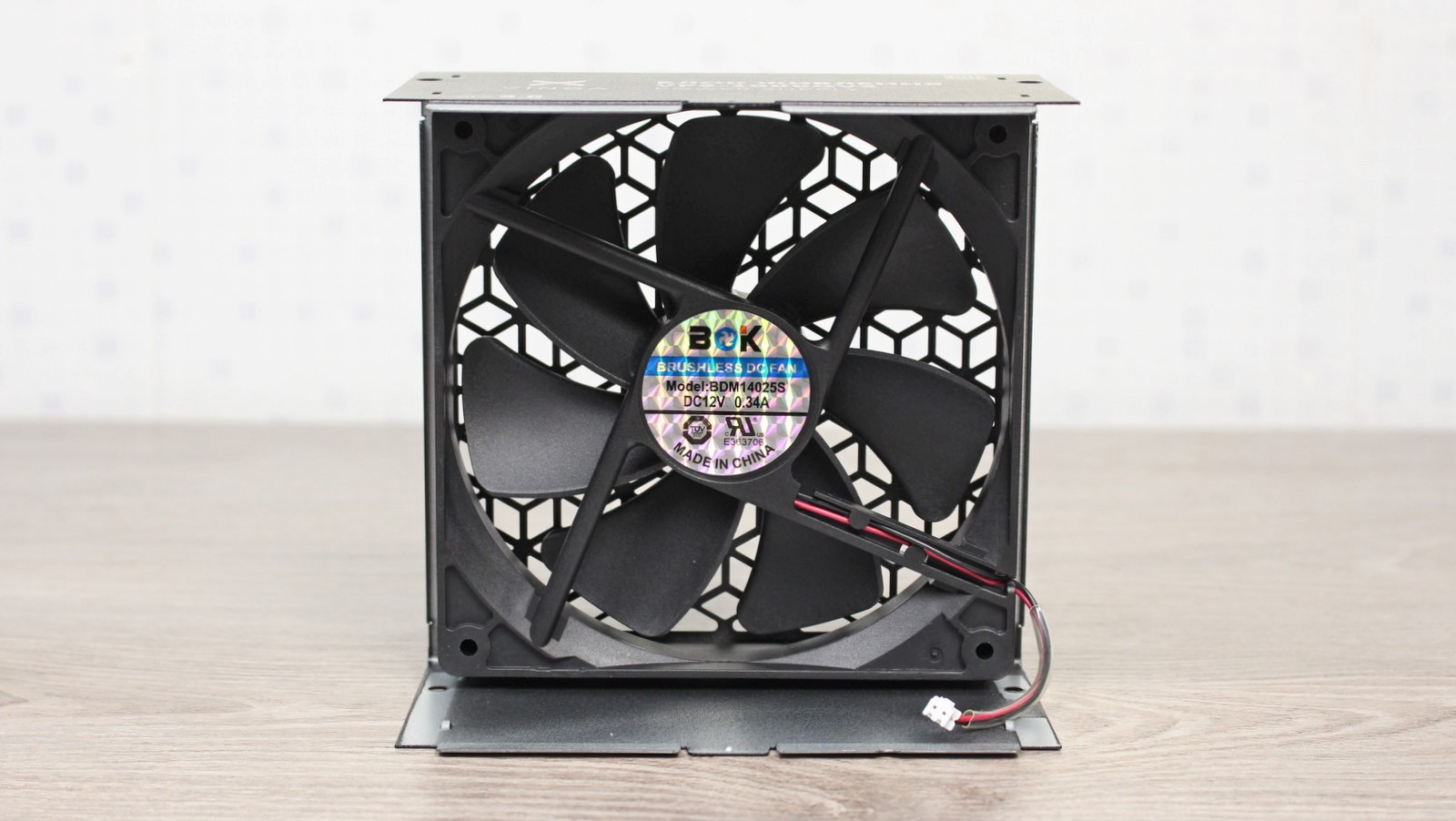
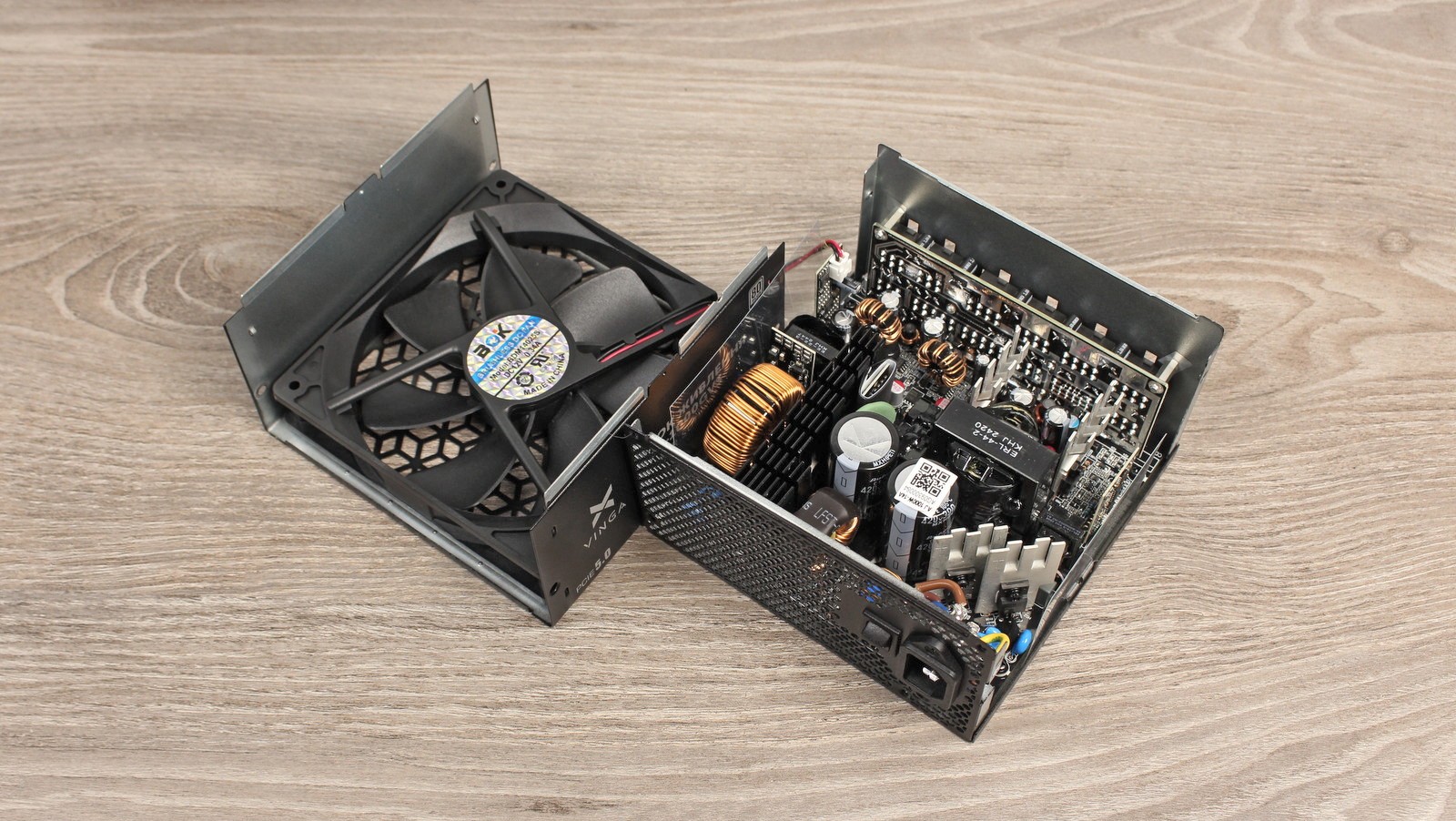
The installed 140-mm fan BDK BDL14025S has already been encountered in the 750-watt model. The letter "S" in the marking likely indicates the use of a sleeve bearing, which is considered the least reliable.
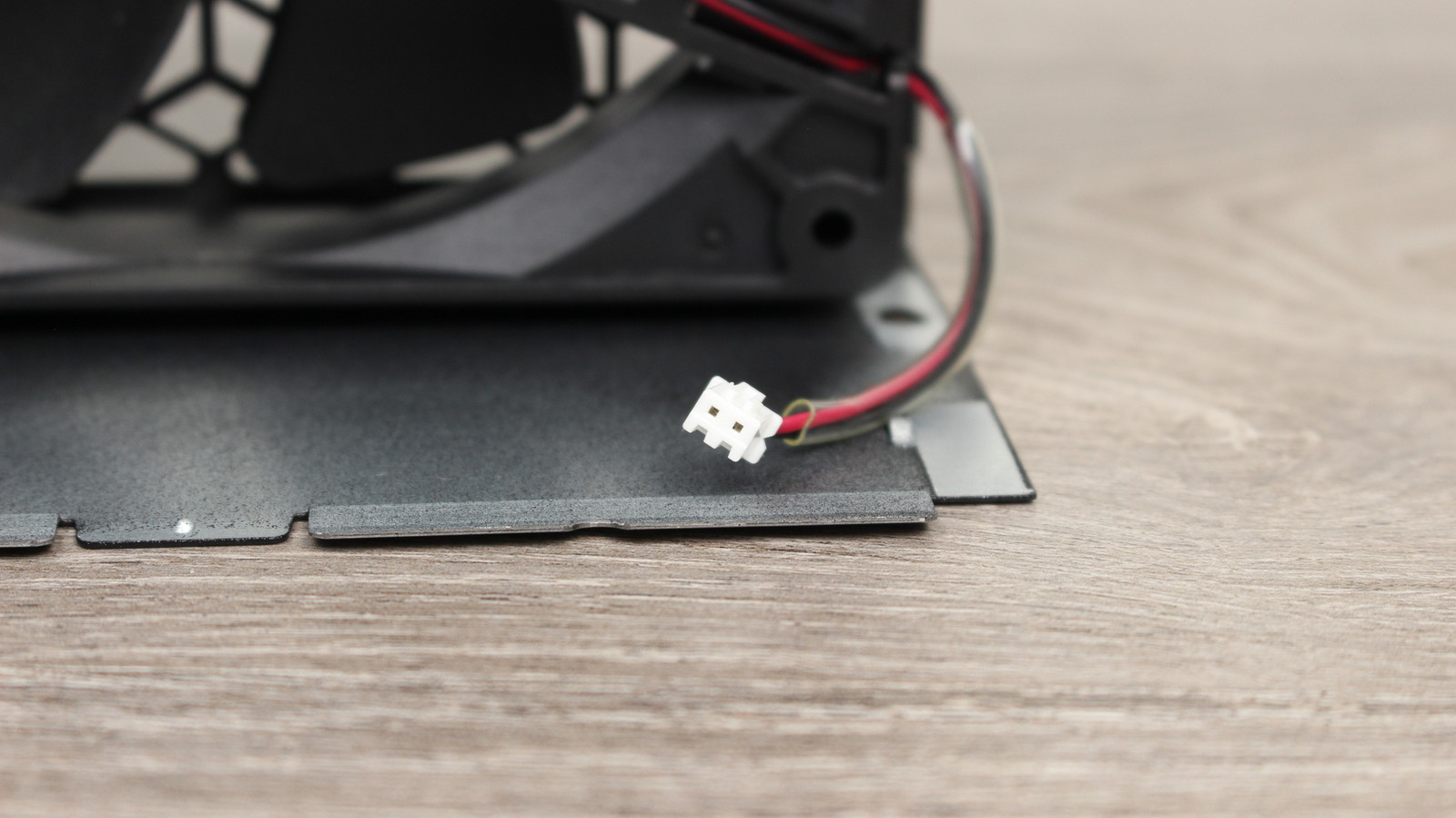
A removable 2-pin connector is used for power. By the way, in the kilowatt model, the fan consumes slightly more power — up to 4 W (12 V at 0.34 A), which is related to the higher rotation speed.
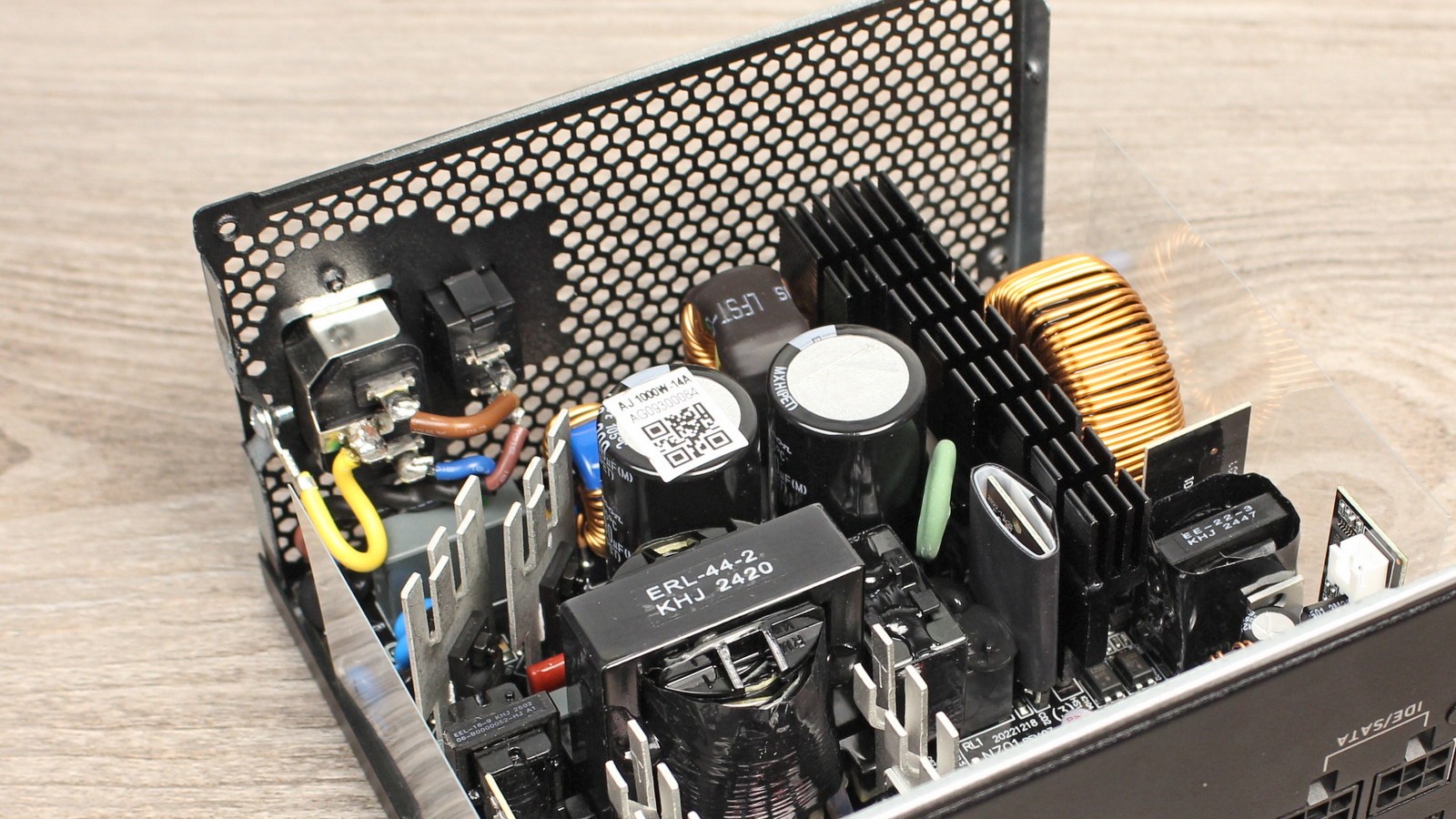
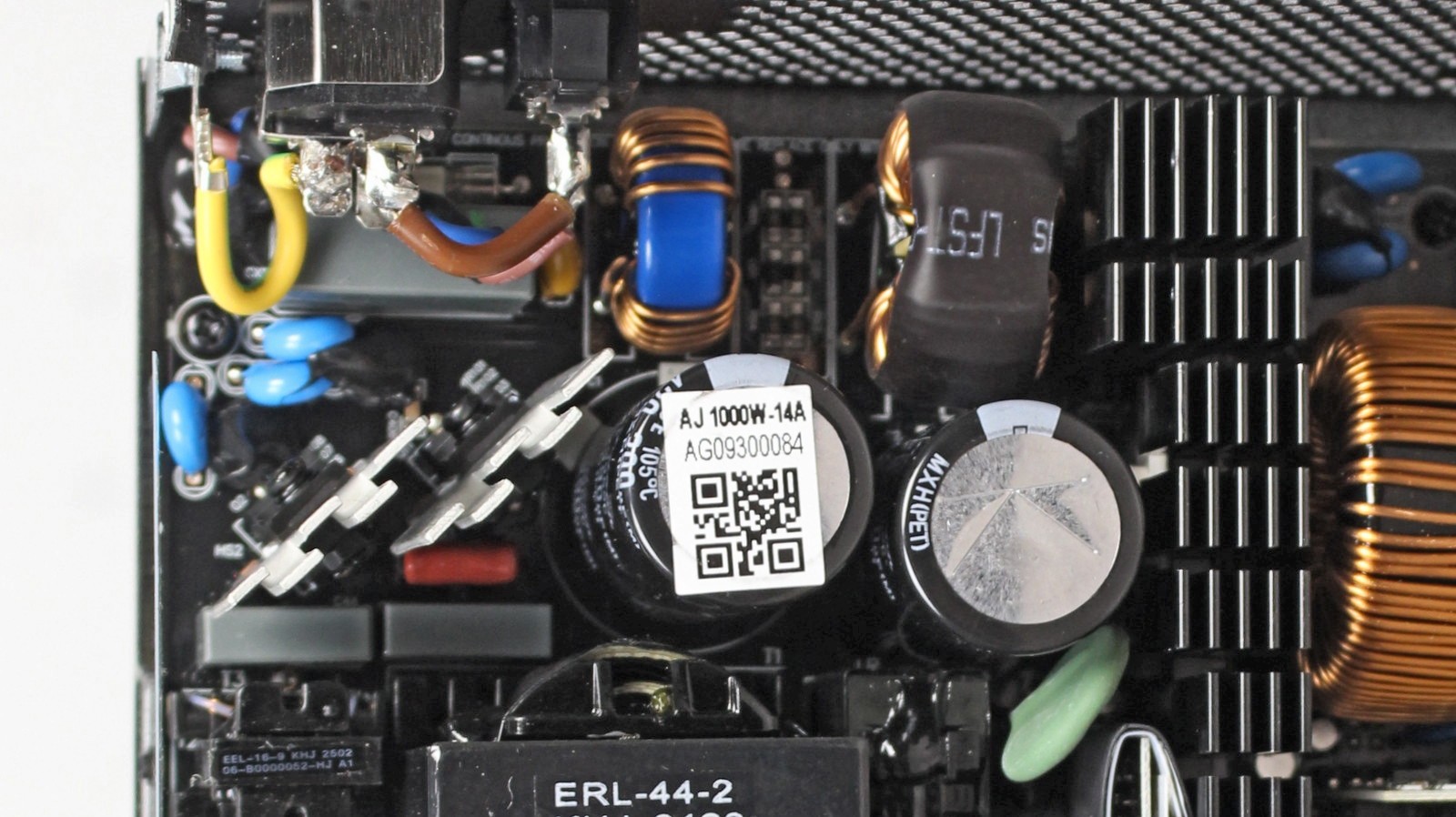
The input electromagnetic filter Vinga 1000W (VPS-1000GV3) includes a pair of chokes, X- and Y-capacitors, as well as a varistor and a fuse.
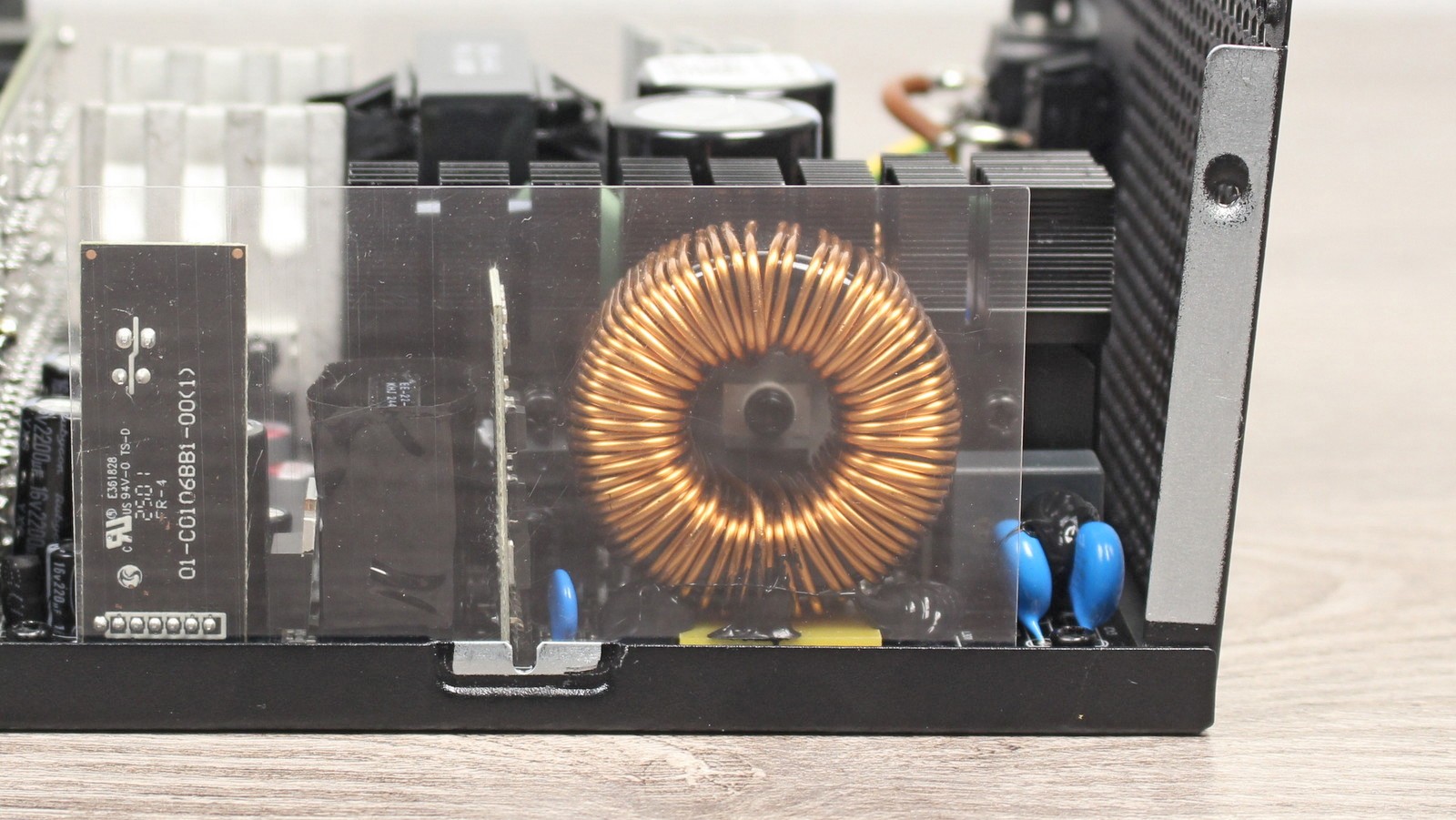
The cooler nearby dissipates heat from the diode assemblies and power elements of the APFC unit. There is also a corresponding large choke.
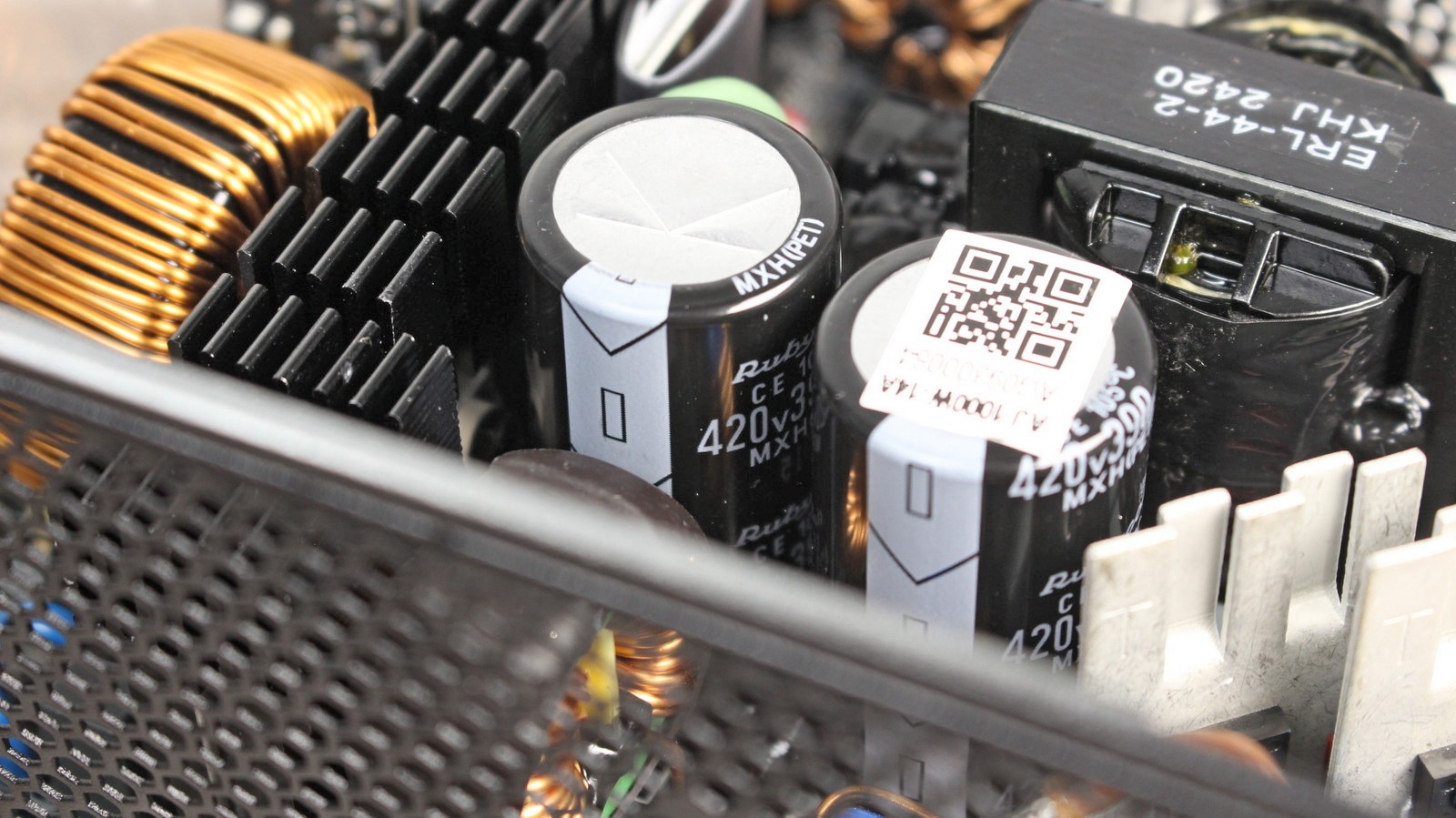
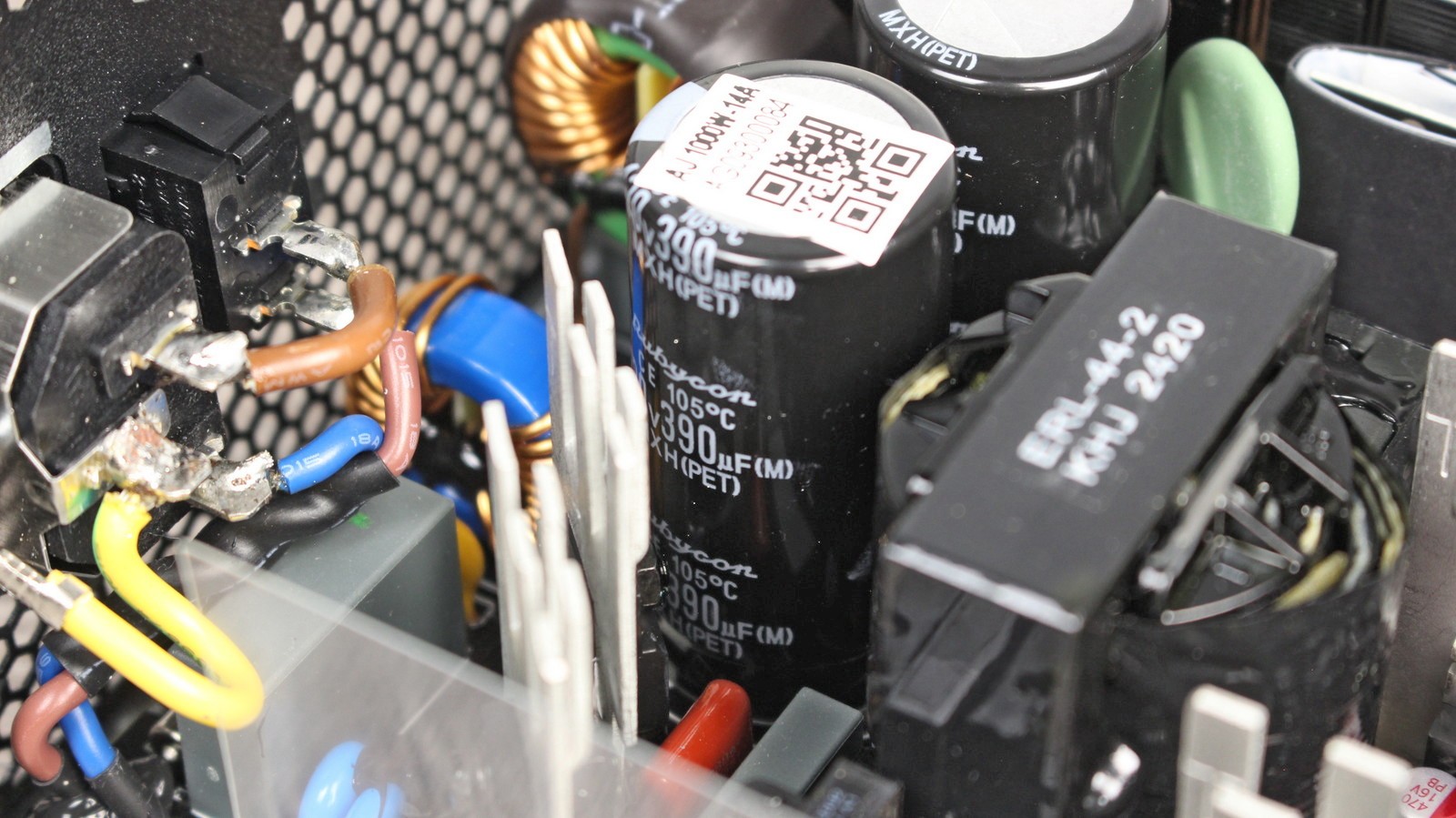
Particular attention should be paid to the pair of input capacitors — these are high-temperature elements from the Japanese company Rubycon. Their total capacity is 780 μF (2 x 390 μF), which is a decent indicator for a relatively inexpensive 1000-watt model.
The power supply unit also includes a thermistor for protection against high inrush currents.
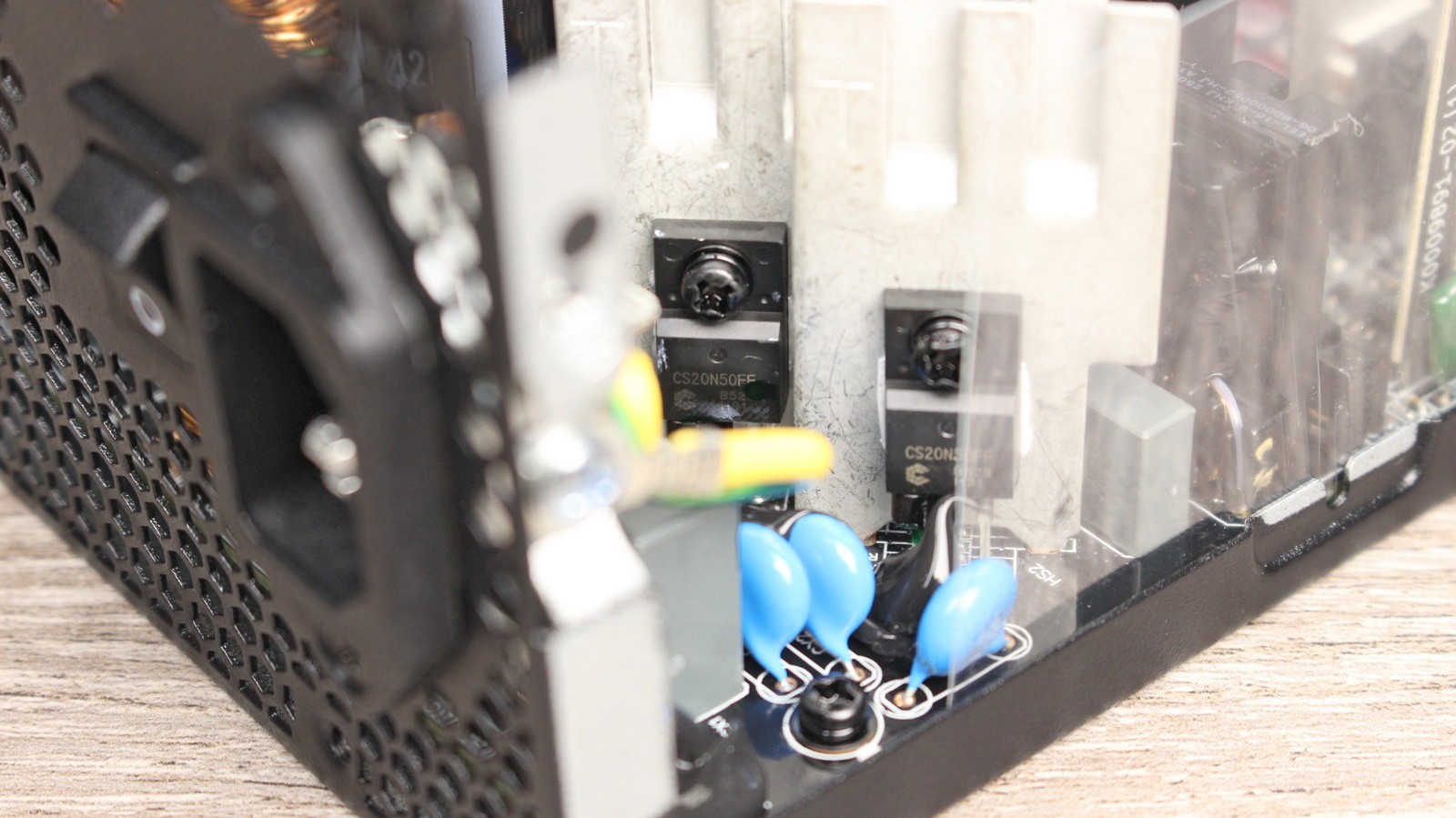
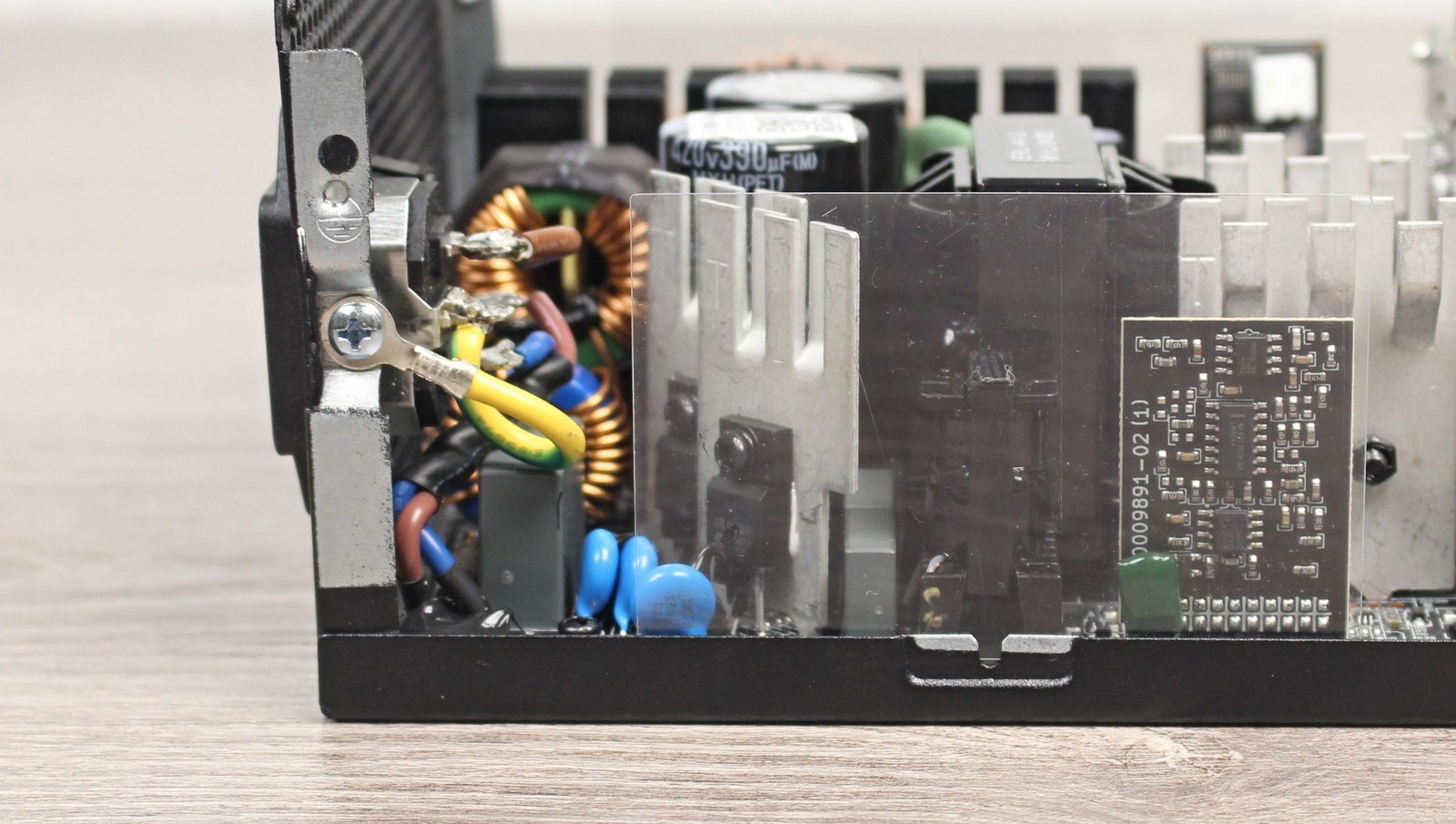
Similar to the 750-watt model, a Half Bridge scheme with doubled keys mounted on heatsink combs is used here. However, the four CS20N50FF transistors used, unlike the electrolytes, have Chinese origin.
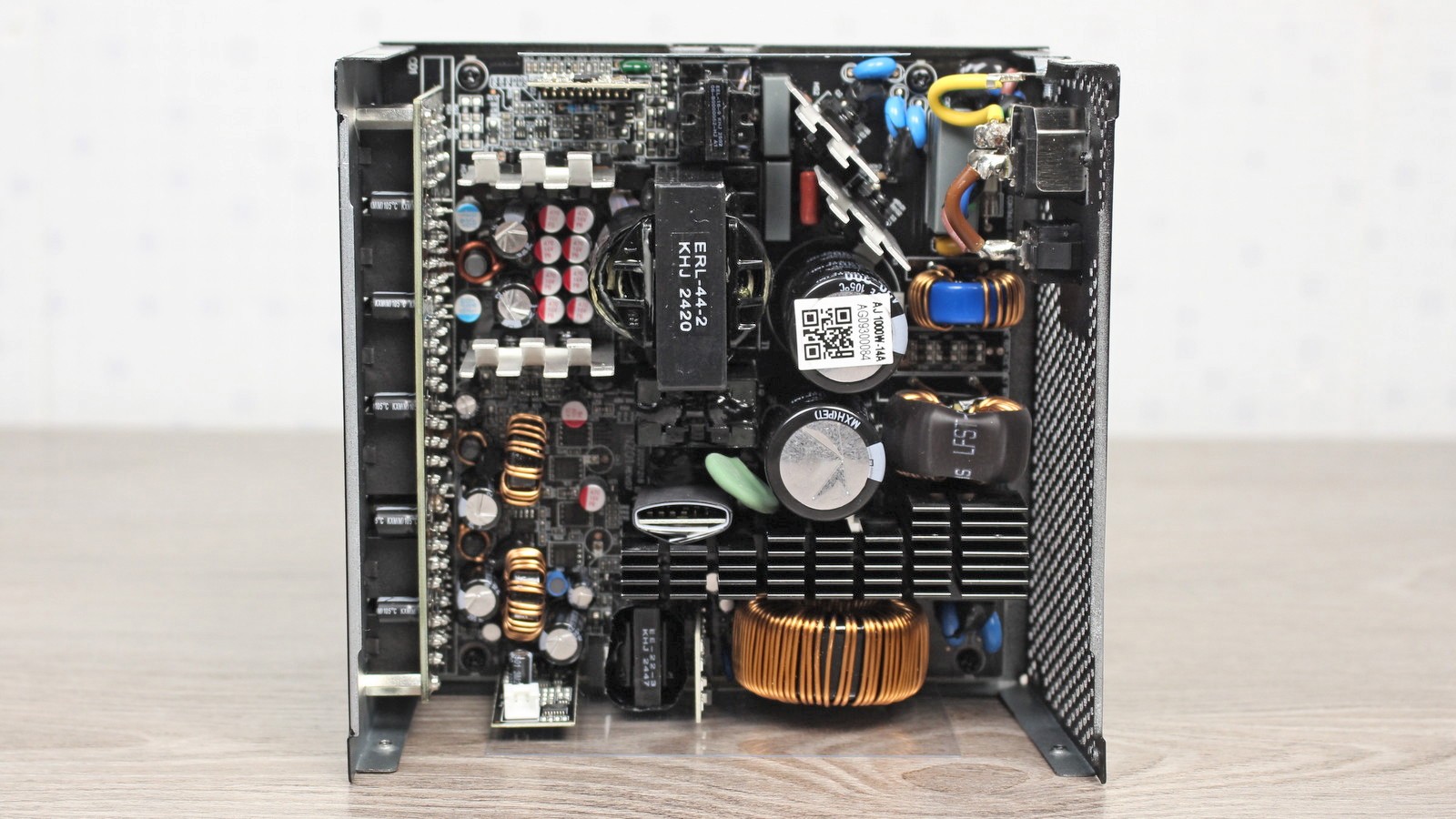
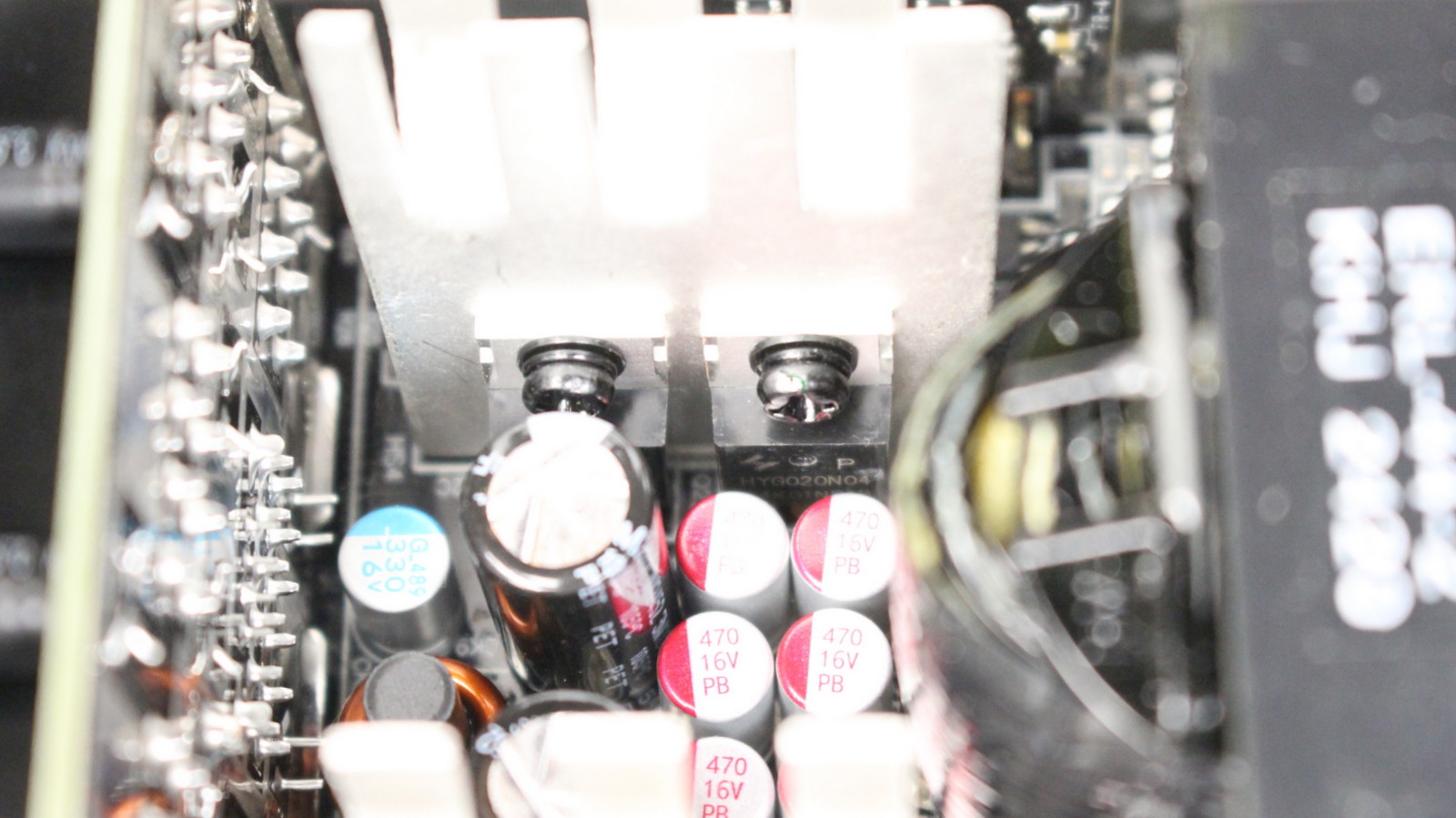
This also applies to the four HUAYI Semiconductor HYGO20N04 transistors in the synchronous rectifier, mounted on two aluminum combs behind the transformer. They form the +12V voltage, and their quality is rated as average.
A little further are the elements of the DC-DC converters, thanks to which the lower +3.3V and +5V channels are formed.
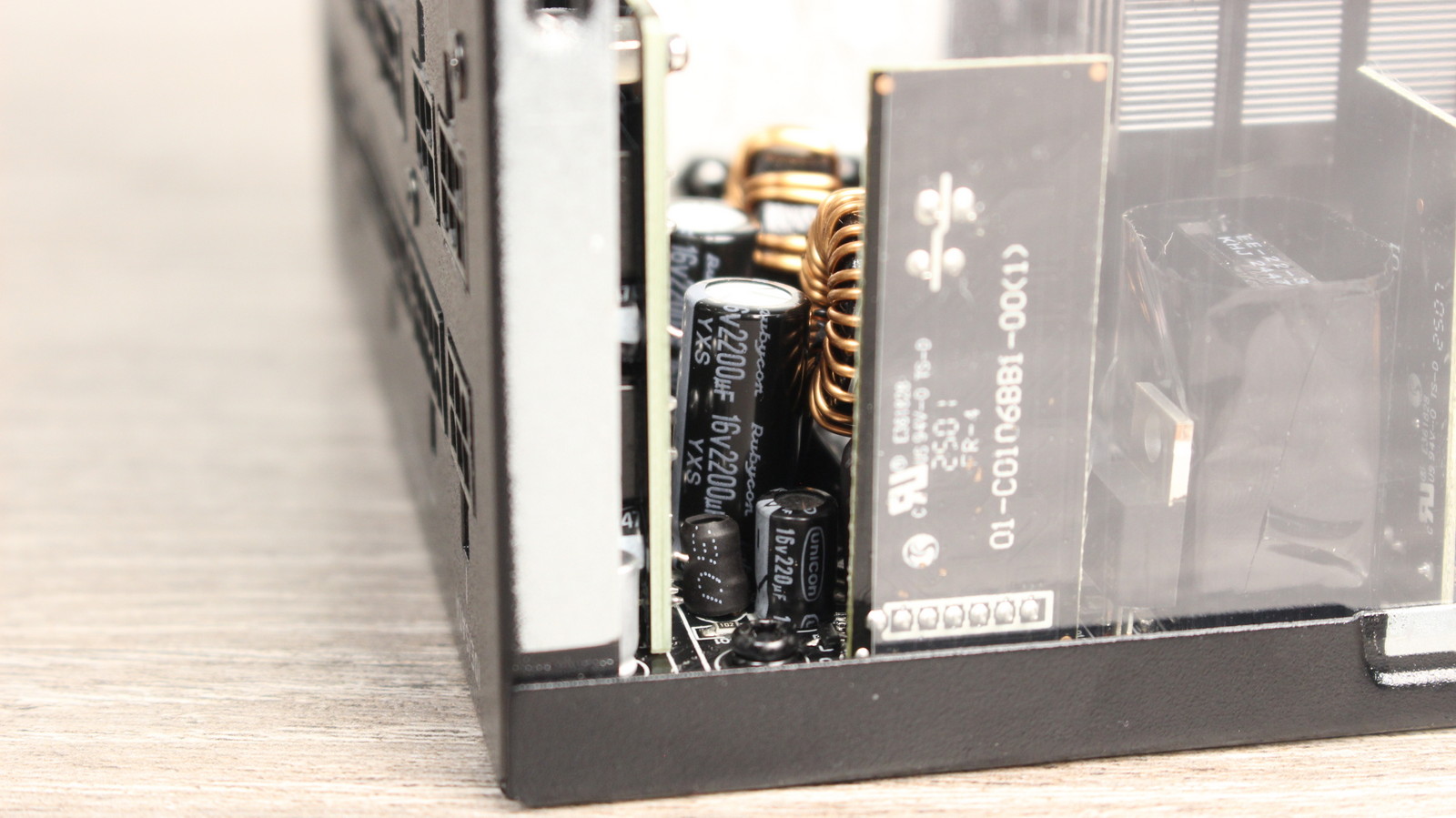
The tested power supply unit contains many reliable polymer capacitors. In addition, there are a number of electrolytes from Japanese companies Rubycon and Unicon.
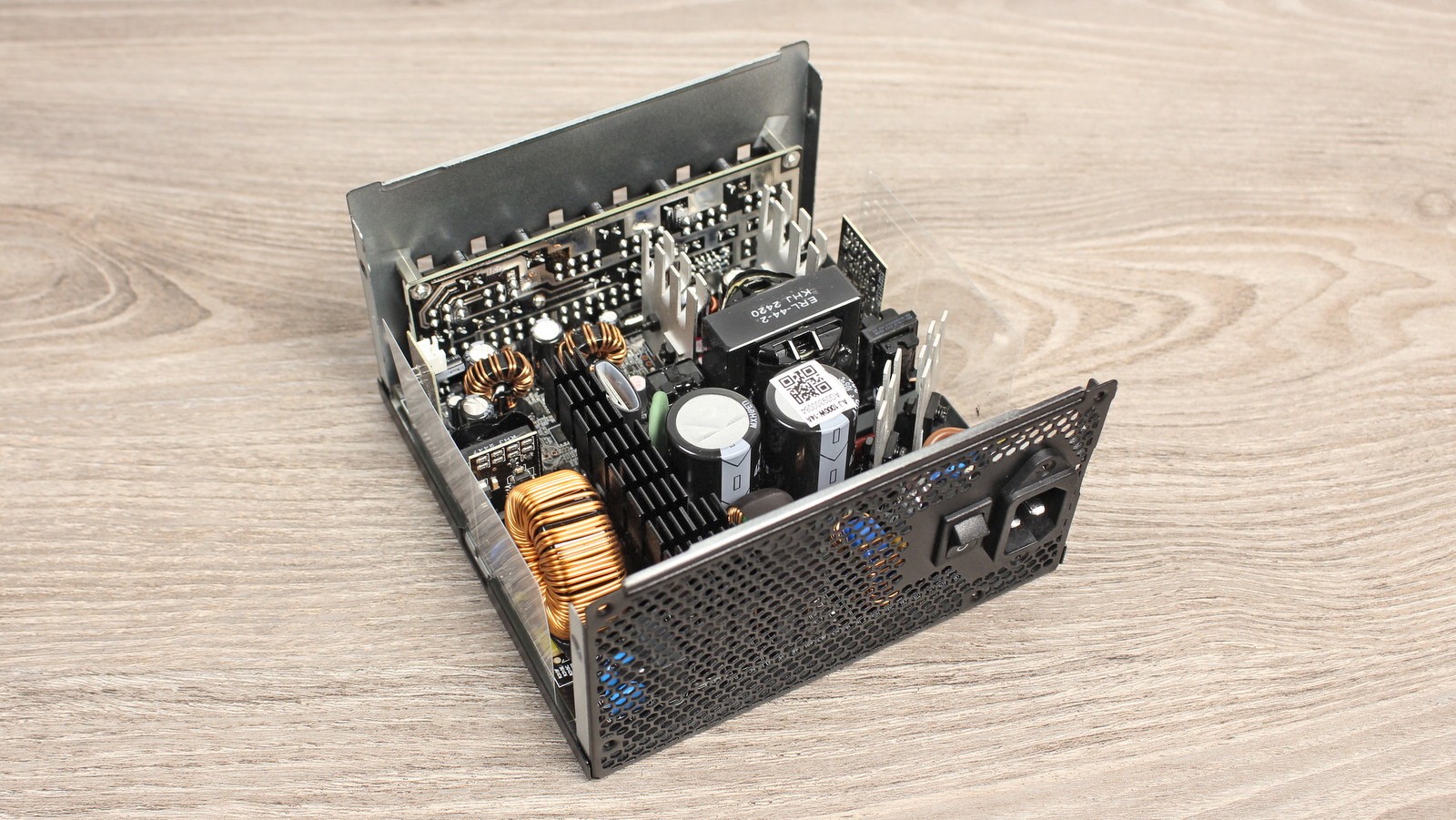
It was also pleasing that the current to the board with output connectors is supplied through conductive tracks, not wires.
As for the list of protections, such information is absent on the manufacturer's website and the box. However, the 750-watt model claims all the main protections, except for OPP (overpower protection). So, considering the similar platform, the same set is most likely implemented here.
Cross-Load Characteristics
How will Vinga 1000W (VPS-1000GV3) perform in practice? We will start a series of tests with the cross-load characteristics of the three main lines, where the ATX12V standard allows voltage deviations within ±5% of the nominal.
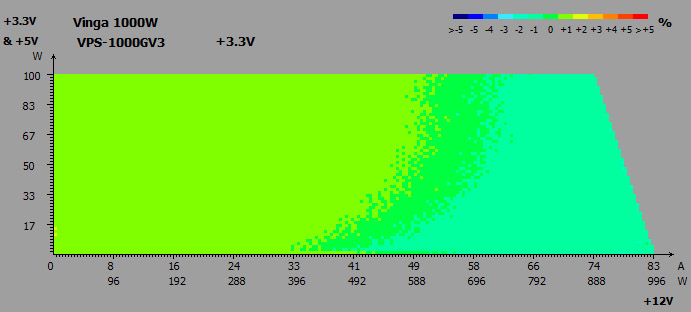
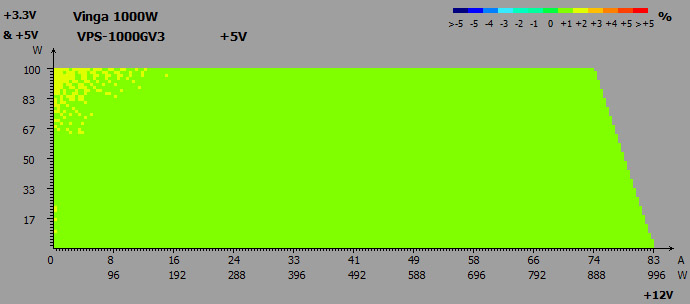
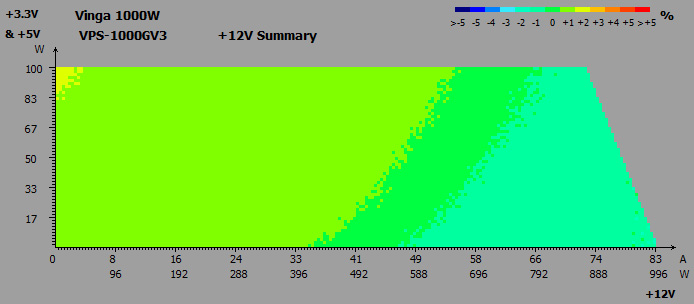
The following deviations were recorded during testing:
- +3.3V line: from -1% to +1%;
- +5V line: from +1% to +2%;
- +12V line: from -1% to +1%.
We got our hands on a sample with exemplary small deviations — the obtained values are worthy even of top power supplies.
Standby Power Line +5VSB
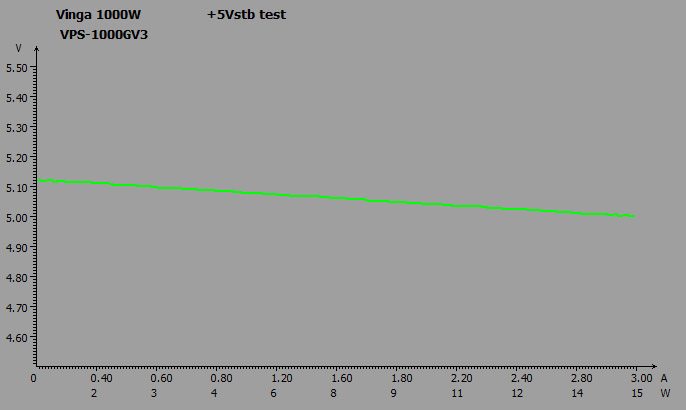
The voltage on the standby power line also deviated within a narrow range — from 5.12 to 5 V (i.e., from +2.4% to 0%).
Noise and Ripple
For the ATX12V standard, the following permissible norms are provided (peak-to-peak):
- +3.3V and +5V lines: 50 mV;
- +12V line: 120 mV.
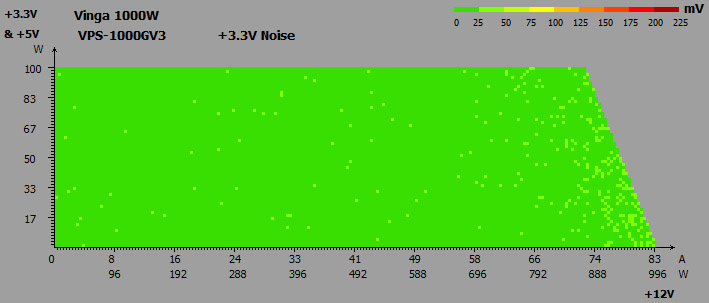
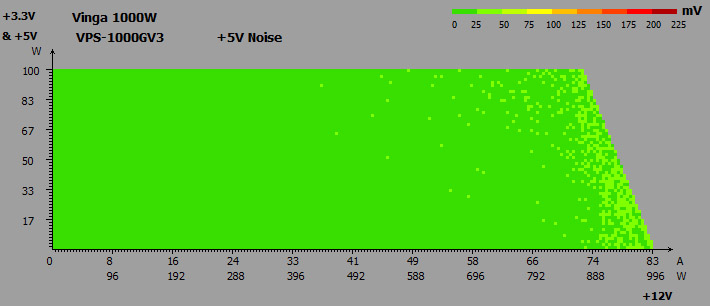
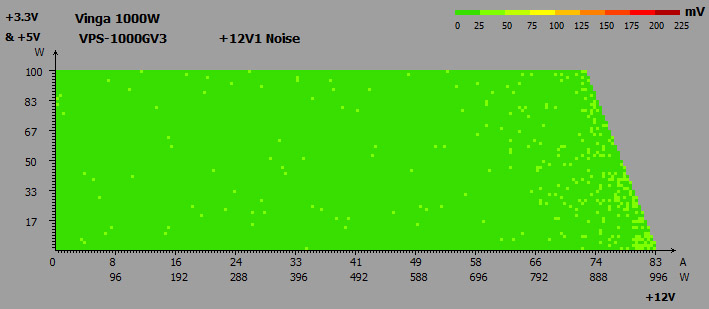
In practice, the ripple did not exceed 50 mV on all three main channels.
PF
Table showing the change in PF depending on the load of the power source:
|
Load, W |
70 |
100 |
150 |
200 |
300 |
400 |
500 |
Load*, % |
7 |
10 |
15 |
20 |
30 |
40 |
50 |
70 |
80 |
100 |
|
PF |
0,72 |
0,82 |
0,88 |
0,9 |
0,94 |
0,96 |
0,97 |
0,98 |
0,99 |
0,99 |
Load* – load as a percentage of the power supply's nominal power.
The power supply boasts a high PF coefficient: 0.9 already at 200-watt load and a maximum of 0.99 at 800W and above.
Efficiency
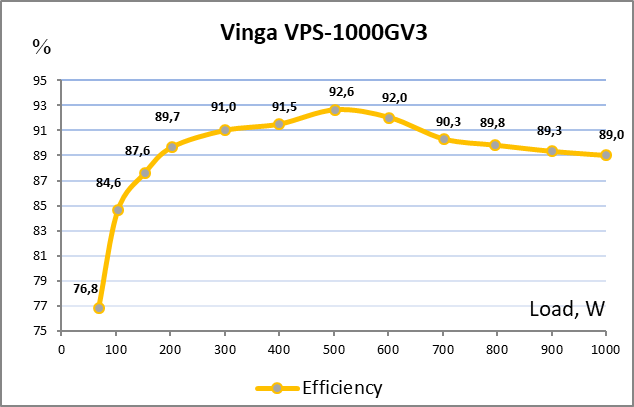
At loads of 20%, 50%, and 100% of the nominal, the efficiency exceeded 88%, 92%, and 88%, respectively, confirming compliance with the 80 PLUS Gold certificate.
Cooling System
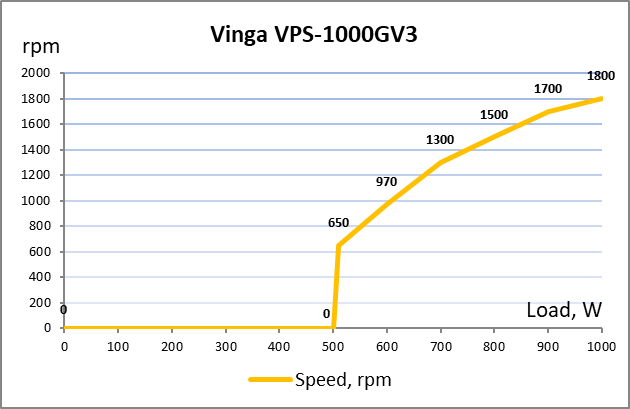
The tested Vinga 1000W (VPS-1000GV3) power supply operated in a passive and completely silent mode up to a load of 500W. Then the fan starts at 650 RPM and gradually increases speed. Up to 650W it's very quiet, up to 800W – quiet, and up to 1000W the propeller noise is below average.
Temperature Mode
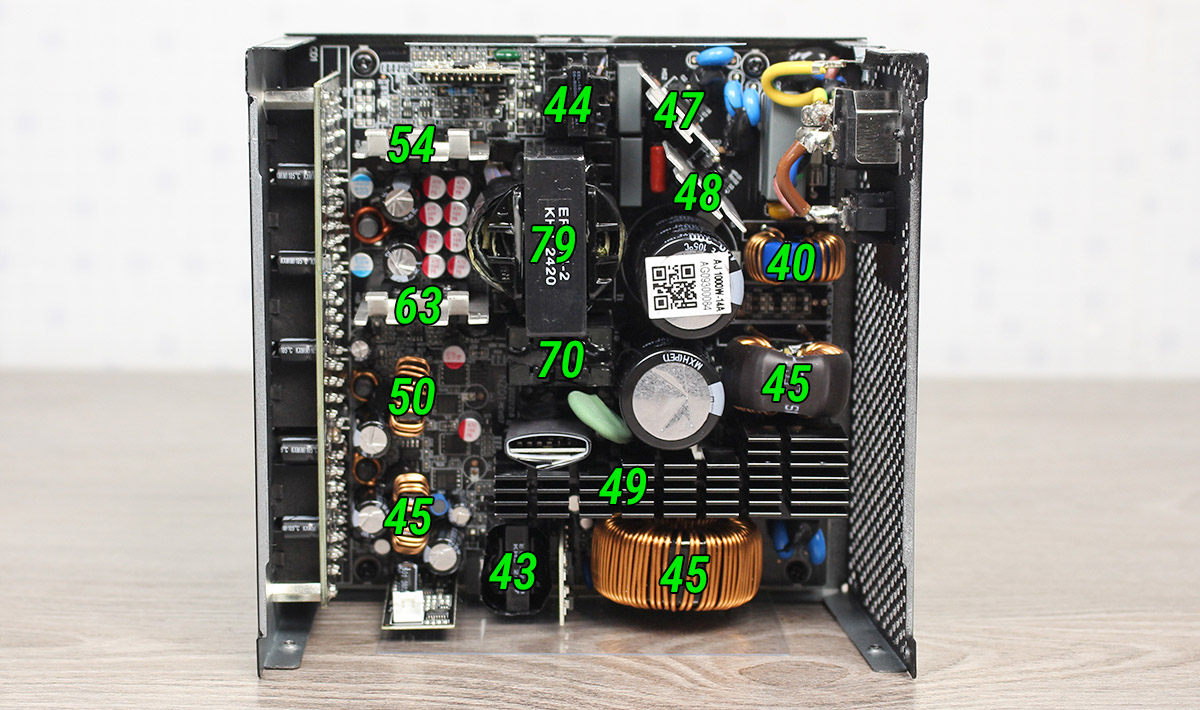
After 15 minutes of operation at a 900W load, the main transformer heated up to 79°C – an excellent result. Other components remained cooler, even at a laboratory temperature of +31°C.
Testing on a Real Configuration
|
Component |
Model |
|
Processor |
AMD Ryzen 9 5900X (Socket AM4, 12 / 24 x 3.7 – 4.8 GHz, TDP 105W) |
|
Cooler |
ASUS TUF Gaming LC II 360 ARGB |
|
Motherboard |
MSI MEG X570 GODLIKE (AMD X570, Socket AM4, DDR4, ATX) |
|
RAM |
2 x DDR4-3600 16GB Kingston FURY Beast RGB (KF436C18BBAK2/32) |
|
Graphics Cards |
ASUS ROG Strix GeForce RTX 3090 Ti Palit GeForce RTX 3090 GamingPro |
|
SSD |
Kingston KC600 512 GB (SKC600/512G) |
|
Wattmeter |
Seasonic PowerAngel |
|
Multimeter |
MASTECH MY64 |
We tested the capabilities of Vinga 1000W (VPS-1000GV3) on a system with a 105-watt processor and a pair of graphics cards with TDP of 450 and 350W. Measurements were taken in "Idle" and "Maximum Load" modes (using the FurMark Donut (GK) test in the MSI Kombuster utility). The following values were obtained:
|
Mode |
Value, V |
Deviation, % |
|
+12V |
||
|
Idle |
12.20 |
1.7 |
|
Burn |
12.36 |
3.0 |
|
+5V |
||
|
Idle |
5.10 |
2.0 |
|
Burn |
5.09 |
1.8 |
|
+3.3V |
||
|
Idle |
3.34 |
1.2 |
|
Burn |
3.34 |
1.2 |
|
Input Power Consumption, W |
||
|
Idle |
107 |
|
|
Burn |
982 |
|
Separate voltage stabilization provided deviations within only 1.2–3%, without sags and with a modest difference between Idle and Burn – up to 1.3%.
Power Consumption in Idle and Off State
Additionally, the tested device consumes a modest 2W in the off state and 5W in sleep mode.
Conclusion
Despite the fact that Vinga 1000W (VPS-1000GV3) belongs to the most affordable kilowatt power supplies, it is indeed capable of delivering the claimed 1000W. Thanks to separate voltage stabilization, its indicators remain decent even under load.
Inside, the use of Japanese electrolytic capacitors and polymer elements was pleasantly surprising. The passive cooling system operation up to 500W load was also pleasing. Furthermore, the power supply components remain far from critical temperatures even under significant load, and the noise level remains moderate.
Among other advantages are modular cables with individual braiding and support for PCIe 5.0, although not the latest PCIe 5.1 version. At the same time, savings are also noticeable: Chinese power elements are used, and the fan is equipped with a sleeve bearing. This likely explains the three-year warranty, while many models in this class offer a five-year or even longer warranty.
Overall, Vinga 1000W (VPS-1000GV3) is an interesting option for those who need a powerful power supply without overpaying for a brand. Although the savings are noticeable, it does not prevent it from performing its main task.
Advantages:
- very good efficiency level (80 PLUS Gold);
- DC-DC converters in the secondary circuit;
- use of Japanese high-temperature electrolytic capacitors and polymer elements;
- good voltage condition on main power lines;
- no voltage sags even when connected to a powerful configuration;
- ability to operate in a wide range of mains voltage;
- three 6+2-pin PCIe connectors and one 600-watt PCIe 5.0 (12VHPWR);
- fully modular cables;
- efficient and quite quiet cooling system;
- silent operation up to 500W load;
- compact size;
- affordable price.
Features:
- use of PCIe 5.0 (12VHPWR) connector instead of the more modern PCIe 5.1 (12V-2×6);
- fan based on a sleeve bearing.