In the computer monitor segment, the vast majority of models for sale have a Full HD resolution and a diagonal ranging from 23 to 28 inches. However, with televisions, the situation is different: most solutions are characterized by 4K resolution (3840 x 2160) and a diagonal from 49 to 55 inches. This doesn't necessarily mean they are the most popular, but it indicates that in these categories, you will have the widest choice.

Therefore, it is no coincidence that the Vinga L50UHD20B TV came to us for testing. It is one of the most affordable representatives of 50-inch 4K solutions with an approximate price tag of 12,996 UAH ($450) at the time of preparing the material. It boasts a wide range of external interfaces and a built-in digital tuner but lacks SmartTV support. We will discuss the rest of the advantages and disadvantages of this model below.
Specification
|
Model |
Vinga L50UHD20B |
|
Panel Type |
LCD with Direct LED backlighting |
|
Diagonal, inches |
50 |
|
Aspect Ratio |
16:9 |
|
Maximum Resolution |
3840 x 2160 |
|
Vertical Refresh Rate, Hz |
60 |
|
Response Time GtG, ms |
8 |
|
Brightness, cd/m2 |
240 |
|
Contrast Ratio |
800:1 |
|
Horizontal / Vertical Viewing Angles, ° |
178 / 178 |
|
Color System Standards Support |
SECAM, PAL |
|
Video Signal Support |
2160p, 1080i, 1080p, 720p, 480i, 480p |
|
Tuner Type |
Digital (DVB-C, DVB-S2, DVB-T2) |
|
Smart TV Support |
No |
|
Built-in Speaker Power, W |
16 (2 x 8) |
|
Interfaces |
1 x CI+ 1 x 3.5mm audio 1 x RF (S2) 1 x RF (T2) 3 x HDMI 1 x D-Sub 1 x SCART 1 x Component In (Y/Pb/Pr) 1 x Coax |
|
Typical Power Consumption in Active Mode, W |
108 |
|
VESA Mount Support, mm |
400 x 200 |
|
Dimensions with Stand / without Stand, mm |
1120 x 244 x 700 / 1120 x 61 x 644 |
|
Weight with Stand, kg |
12.2 |
|
Warranty, months |
12 |
|
Manufacturer's Website |
|
|
Product Page |
|
|
Purchase Page |
Packaging and Delivery Set


Budget model - budget packaging! In this case, the savings are entirely justified, as you can evaluate the appearance of the TV and familiarize yourself with its key parameters on the official page. The only disappointment is a discrepancy in technical characteristics: the static contrast on the packaging is 1200 cd/m2, while in the specification on the official website, it is 800:1. In the testing block, we will check this aspect for each preset profile.

Inside the box, we found a set of paper documentation, a pair of legs and four screws for their attachment, as well as a remote control and a pair of AAA batteries for its power supply.


The remote control is made of matte plastic. It is quite long, so owners of small palms may find it not very comfortable, but on the back, its creators have provided ergonomic indentations for the fingers. Almost all buttons have large and clear markings, but if there are any questions regarding their purpose, you can refer to the user manual for explanations.
It is pleasant that to operate the remote, it is not necessary to point it directly at the sensor in the TV: activation occurs from the top, bottom, and side directions. There is even reflected activation at a short distance.
Appearance and operational features

While in the design of cases Vinga tries to surprise with shapes and combinations of materials, in the appearance of TVs, continuity is maintained, and there is not much room for imagination. Therefore, the Vinga L50UHD20B is very similar to the previously reviewed Vinga S55UHD20G: an identical silver frame is used along the contour of the front panel, and legs are located at the edges to ensure secure screen retention.

At their tips, there are small rubber inserts that contribute to more secure retention of the TV and prevent scratching the surface of the table.

Vinga L50UHD20B

Vinga S55UHD20G
However, the back side has noticeably changed. Subjectively, it has become more attractive, although it is still quite smudgy. In the central area, you can see holes for the VESA bracket (400 x 200 mm), so if desired, you can wall-mount the TV or attach a mini-PC to it.


Traditionally, all interface connectors are directed either downward or to the side, which noticeably simplifies access to them in case of wall mounting. Moreover, they are all labeled, so even beginners should not have problems with connection. The presence of three HDMI ports, an analog D-Sub, two USB, and additional interfaces is pleasing.

For access and convenient navigation through the menu, a joystick with comfortable pressing force is provided in the lower left corner of the rear panel. It is also used to turn the TV on/off.
Also, on the edges of the rear side, you can see holes for sound output, although in previously reviewed models, they were only on the bottom side. The Vinga L50UHD20B integrates a pair of 8-watt speakers. The sound quality is quite sufficient for watching movies and shows. Even bass is felt in the frequency spectrum, but it is not very pronounced. However, at maximum volume, the sound quality is not distorted and does not spoil the impression.

In terms of functional capabilities, the Vinga L50UHD20B loses to models with SmartTV support. However, it performs its direct duties quite well. Thanks to the built-in digital tuner with support for the DVB-T2 standard, which is relevant for our country, you can watch all available digital channels in excellent quality.

The presence of two USB ports allows you to play multimedia content directly from a flash drive. We managed to play AVI, MP4, and TS videos, but there were problems with MKV and WMV. If you connect the TV to a PC (for example, via an HDMI port), it can serve as a large window into the world of multimedia and gaming entertainment.
On-screen menu
To access the menu and adjust settings, you can use the joystick on the rear panel or the remote control. The functional capabilities allow you to select the input signal source, a pre-installed image profile, or audio subsystem mode, set the time and sleep timer, set channel blocking, specify the image format, and much more. The presence of high-quality Ukrainian localization in the menu is pleasing.
Testing
The hardware platform during the testing of the Vinga L50UHD20B TV was the ZOTAC ZBOX nano ID65 PLUS mini-computer. A full description of the methodology for researching characteristics can be found in the relevant material.

The display includes four color profiles: "Dynamic," "User," "Standard," and "Mild." For convenience, we have compiled all their parameters in a single table:
|
|
"Dynamic" |
"User" |
"Standard" |
"Mild" |
|
White field brightness, cd/m2 |
231 |
210 |
211 |
199 |
|
Black field brightness, cd/m2 |
0.3919 |
0.3323 |
0.3291 |
0.295 |
|
Contrast ratio |
589:1 |
632:1 |
641:1 |
674:1 |
|
White point color temperature, K |
7375 |
6972 |
6927 |
6933 |
|
Compliance with sRGB color space standard, % |
88.3 |
92.2 |
92.6 |
96.1 |
|
Compliance with Adobe RGB color space standard, % |
64.6 |
67.3 |
67.6 |
69.3 |
|
Average deviation dE*94 (∆E) |
5.85 |
5.55 |
5.55 |
4.75 |
|
Maximum deviation dE*94 (∆E) |
15.14 |
12.97 |
13.16 |
11.68 |
|
Average gamma |
2.16 |
2.13 |
2.14 |
2.16 |
|
Power consumption, W |
102 |
102 |
102 |
102 |
There were no questions about the brightness indicator: it is at the level of 199 - 231 cd/m2, which is slightly below the declared 240 cd/m2, but it is enough for comfortable viewing of videos and TV shows. In turn, the static contrast is in the range from 589:1 to 674:1, which is closer to the information on the official website (800:1). Overall, the picture on the screen looks good and does not cause any particular complaints.
Color coverage


CIE diagrams of the "Dynamic" profile for sRGB and Adobe RGB spaces


CIE diagrams of the "Custom" profile for sRGB and Adobe RGB spaces


CIE diagrams of the "Standard" profile for sRGB and Adobe RGB spaces


CIE diagrams of the "Moderate" profile for sRGB and Adobe RGB spaces
The color space coverage of sRGB in the Vinga L50UHD20B TV reaches 96%, and Adobe RGB exceeds 69%. For non-professional solutions, 90% and 65% respectively or higher are considered acceptable.
In all CIE diagrams for sRGB, we observe a shift of all three reference points, causing oversaturation in the green, yellow, red, and pink areas.
Color accuracy

Diagram of deviation of primary colors and shades from standards in the "Dynamic" profile

Diagram of deviation of primary colors and shades from standards in the "Custom" profile

Diagram of deviation of primary colors and shades from standards in the "Standard" profile

Diagram of deviation of primary colors and shades from standards in the "Moderate" profile
Unfortunately, none of the profiles managed to fit within the specified norms for average (1.5) and maximum (4) deviation. The "Moderate" mode performed the best, while "Dynamic" performed the worst, although the difference between them is not that significant.
RGB levels

RGB levels graph of the "Dynamic" profile

RGB levels graph of the "Custom" profile

RGB levels graph of the "Standard" profile

RGB levels graph of the "Moderate" profile
However, the RGB levels settings look much better: in most of the range in all four profiles, they are within ±10% of the reference black line. Only at the beginning of the range do we see an excess of the blue component, which will make the picture cooler at a low brightness level.
Gamma

Gamma curves graph in the "Dynamic" profile

Gamma curves graph in the "Custom" profile

Gamma curves graph in the "Standard" profile

Gamma curves graph in the "Moderate" profile
The gamma curve settings are also well executed: in all profiles, they are only slightly above the reference black line, and the average indicator (2.13 – 2.16) is close to the desired (2.2). Therefore, there is no need to worry about overexposure of midtones and loss of detail in bright areas of the image.
Brightness Range
According to the test results, the most balanced profile in the Vinga L50UHD20B TV is "User", so further research was conducted based on it.

The brightness range was from 16 to 245 cd/m2. The minimum value will be very comfortable for viewing in the dark, while the upper limit will ensure work in bright sunlight. Moreover, it even slightly exceeds the declared figure.
Monitor Calibration


CIE diagrams of the calibrated profile for sRGB and Adobe RGB spaces

Diagram of deviation of primary colors and shades from standards in the calibrated profile

RGB levels graph of the calibrated profile

Gamma curves graph in the calibrated profile
The calibration file is available at this link. The results obtained before and after hardware calibration are summarized in the table.
|
Parameters |
"User" |
Calibrated |
|
White field brightness, cd/m2 |
210 |
251 |
|
Black field brightness, cd/m2 |
0.3323 |
0.1551 |
|
Contrast ratio |
632:1 |
1617:1 |
|
White point color temperature, K |
6972 |
6152 |
|
sRGB color space compliance, % |
92.2 |
86.2 |
|
Adobe RGB color space compliance, % |
67.3 |
63.5 |
|
Average deviation dE*94 (∆E) |
5.55 |
4.21 |
|
Maximum deviation dE*94 (∆E) |
12.97 |
13.16 |
|
Average gamma |
2.13 |
2.38 |
The key improvement of manual calibration can be considered the increase in static contrast to 1617:1 and a slight improvement in average deviation (from 5.55 to 4.21). Other parameters even slightly worsened. This indicates that the factory calibration has already squeezed the maximum potential out of the applied panel.
Screen Backlight Uniformity

Usually, we manage to reduce the backlight to 100 cd/m2 to compare the results with other models. But in this case, we only managed to achieve 248 cd/m2 in the central zone. The maximum deviation of other areas does not exceed 40 cd/m2.


There were no issues with the white point temperature: in the central area, it was 5821 K, and the maximum deviation of 221 K was recorded in the upper right corner. But it fits within the permissible range of ±250 K, so there are no contentious areas on the 3D diagram.
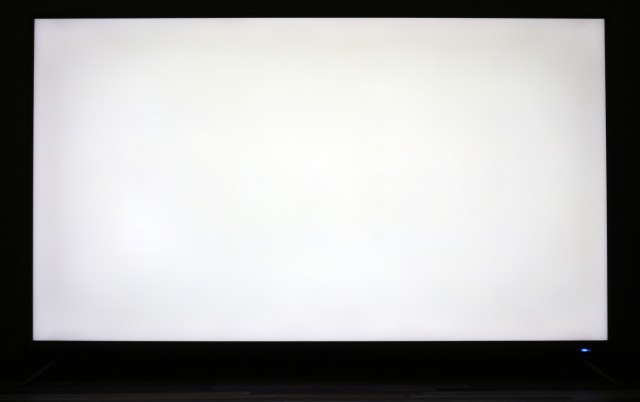
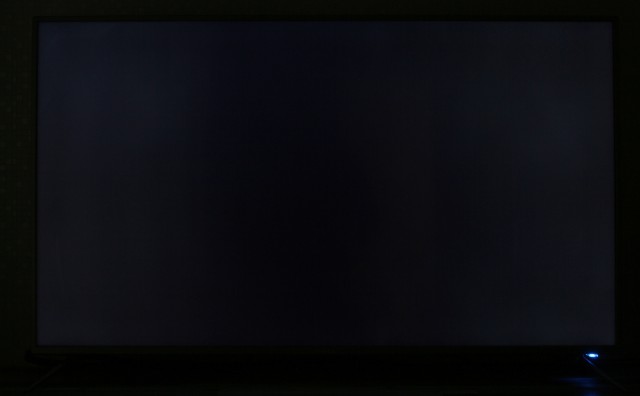
In the black background fill test, small backlight leaks are visible on the right and left, which is quite normal for a 50-inch diagonal.
Matrix Speed and PWM

The matrix response speed in the Vinga L50UHD20B model is stated at 8 ms. In the real test, we see small trails from moving objects, so the result is objectively worse than in 5 or 1 ms matrices, but it will be extremely difficult to notice the difference by eye. While watching videos and playing games, we did not notice any unpleasant artifacts or trails.
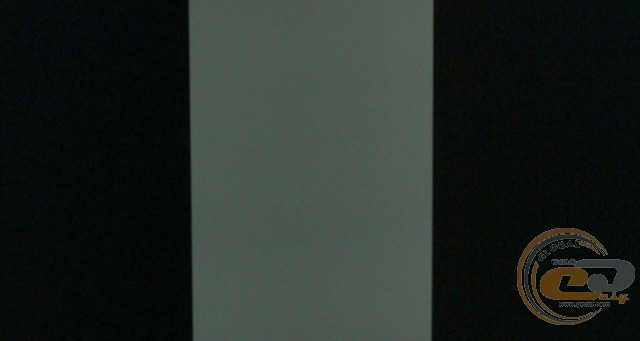
Brightness – 25%, exposure – 1/15
We were pleased with the absence of visible backlight flicker, as indicated by the single solid front in the image. This reduces eye strain for the viewer and increases comfort during prolonged screen time.
Viewing Angles
The viewing angles of the Vinga L50UHD20B are claimed to be 178°. When viewed at an acute angle from the sides or diagonally, a slight whitening of the picture is observed. Therefore, in the case of wall mounting, it is better to check the image quality from the permanent viewing location beforehand.
Conclusions
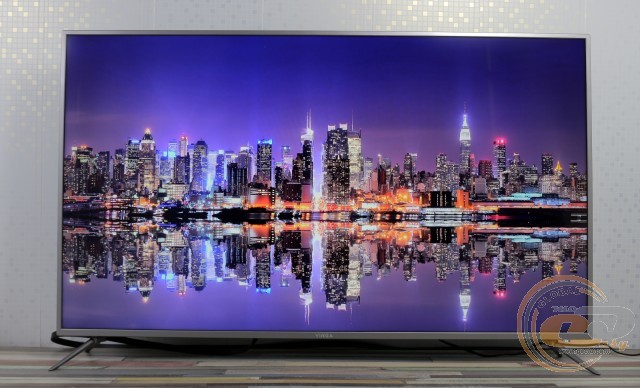
Time to sum up. At an approximate cost of 12,996 UAH ($450), the Vinga L50UHD20B TV is one of the most affordable options among 50-inch 4K models. It does not have SmartTV functionality (although Vinga does offer such models), but paired with a system unit or mini-PC, it becomes an excellent entertainment center.
Its advantages include a pleasant design, a wide range of external interfaces with convenient orientation for wall mounting, a built-in tuner supporting the DVB-T2 standard relevant for our country, stereo speakers with a total power of 16 W with decent sound quality, and the ability to play some multimedia formats directly from an external USB drive. The generally convenient remote control, comfortable joystick for menu settings, and high-quality localization of the menu items were also pleasing.
The factory calibration of the panel offers sufficient coverage of the sRGB and Adobe RGB spaces, good gamma curve settings, and RGB levels. However, the accuracy of color and shade reproduction is not pleasing. There are no particular problems with backlighting or matrix speed – everything is at the proper level for this price category. Moreover, there is no visible flickering of the backlight, which reduces eye strain.
Overall, the Vinga L50UHD20B is quite a decent alternative to well-known brands for users who want to join the world of 4K content but have limited financial resources.
Advantages:
- 50-inch panel with 4K resolution;
- attractive and functionally thoughtful body design;
- easy-to-use remote control;
- convenient joystick for operation;
- expanded set of external interfaces;
- ability to play multimedia content from an external USB drive;
- support for digital television;
- convenient orientation of interfaces for wall mounting;
- presence of a pair of built-in speakers with a total power of 16 W;
- functional menu with Ukrainian localization;
- good brightness range;
- support for wall mounting.
Disadvantages:
- actual static contrast turned out to be lower than stated.
Author: Serhiy Budilovskyi
Translation: Yuriy Koval