Everyone is used to the fact that good gaming peripherals are expensive. Recently, the market has been abuzz with talk of magnetic switches, wireless technologies, and crazy gamer hertz, but such technologies come at a high cost. However, Vinga understands perfectly well that there is always a demand for simple, affordable, and highly pragmatic solutions in the market. Why pay more if you just want to try the "classic"?

Today, we have the Vinga KBGM-110 for review — an ultra-budget mechanical keyboard in a compact TKL format, priced at just around 1099 UAH. It doesn't try to impress with wireless modules or complex software. Its feature is different: to offer a beginner gamer or an undemanding user full-fledged mechanical switches with clear tactile feedback and bright LED backlighting at the price of a regular membrane keyboard.
Can such a budget model provide comfortable typing and withstand intense gaming sessions in practice? What compromises had to be made for such a price? The answers are further in the review.
Specification
|
Model |
Vinga KBGM-110 (KBGM-110 87 key LED Blue Switch USB Black) |
|
Article |
KBGM-110 Black |
|
Construction type |
Skeleton, with metal plate |
|
Connection type |
Wired (USB 2.0) |
|
Switch type |
Mechanical, clicky |
|
Switch lifespan, million presses |
50 |
|
Hot Swap switch replacement |
No |
|
Backlight diode orientation |
North |
|
Keyboard layout |
Modified ISO 80% TKL |
|
Number of keys |
87 |
|
Polling rate, Hz |
125 |
|
Built-in memory |
None |
|
Case color: top / bottom |
black / dark gray |
|
Case material |
Metal (plate) / ABS plastic (base) |
|
Keycap profile |
OEM |
|
Keycap material: |
ABS plastic |
|
Keycap legend backlighting |
Yes |
|
Cable length, m |
1.5 |
|
Cable type, presence of braiding |
non-detachable USB Type-A cable without braiding, with ferrite filter |
|
Additional features |
|
|
Package contents |
|
|
Size, mm |
363 x 130 x 35 |
|
Keyboard weight, g |
760 |
|
System requirements |
Windows 2000/XP/Vista/7/8/8.1/10/11 |
|
User guide |
|
|
Keyboard configuration software |
None (Plug & Play) |
|
Manufacturer's website |
|
|
Device page |
Packaging and contents
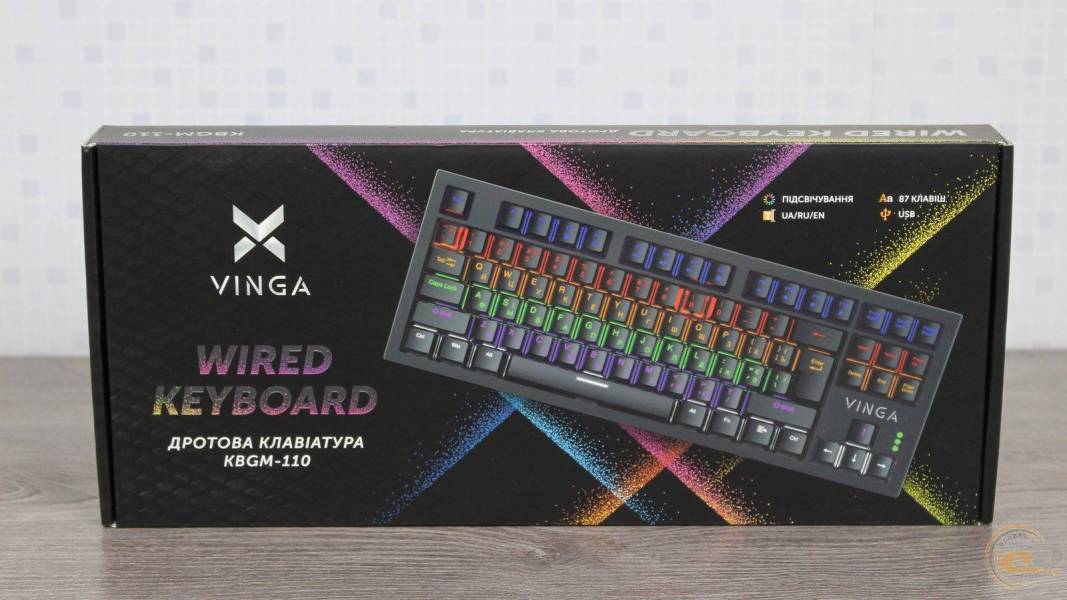
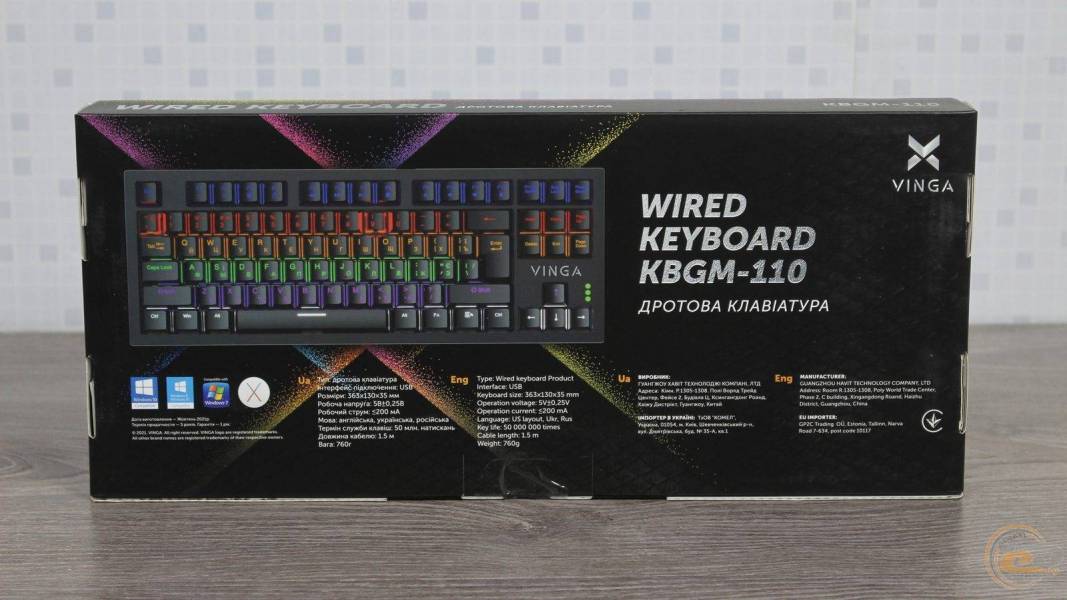
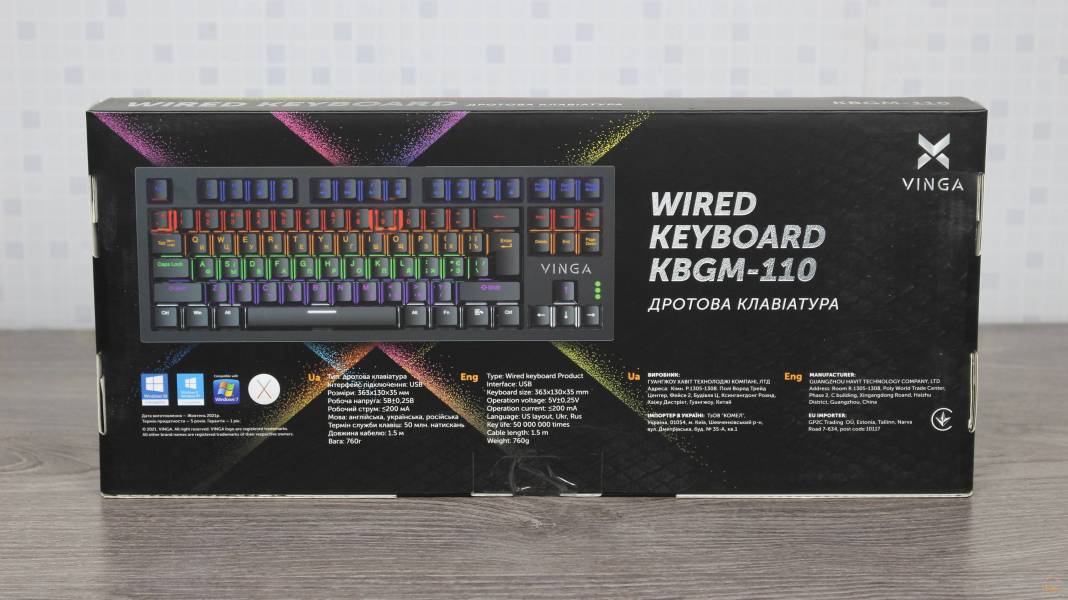
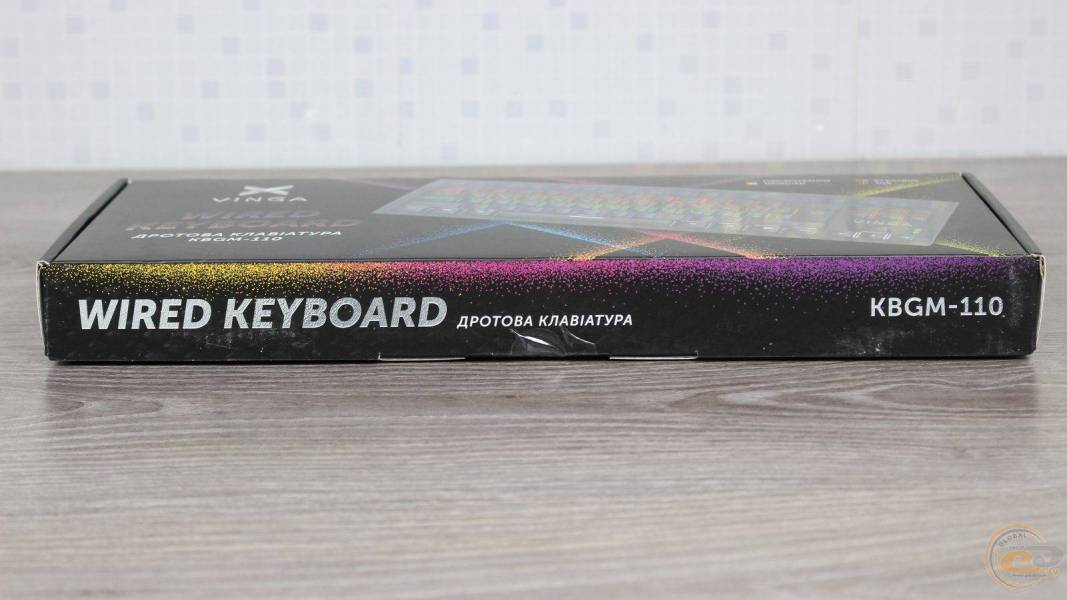
Vinga KBGM-110 comes in a compact cardboard box with bright black and colorful design. The packaging is highly informative: renders of the keyboard with the backlight on are placed on both the front and back sides. The back also provides key technical specifications of the device and compatibility logos with Windows OS.
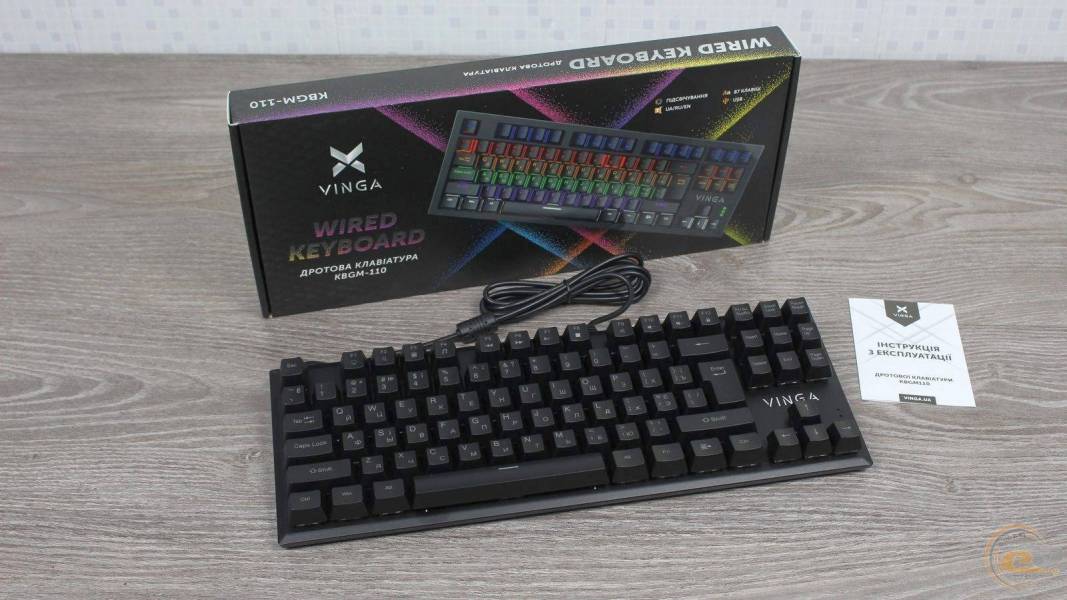
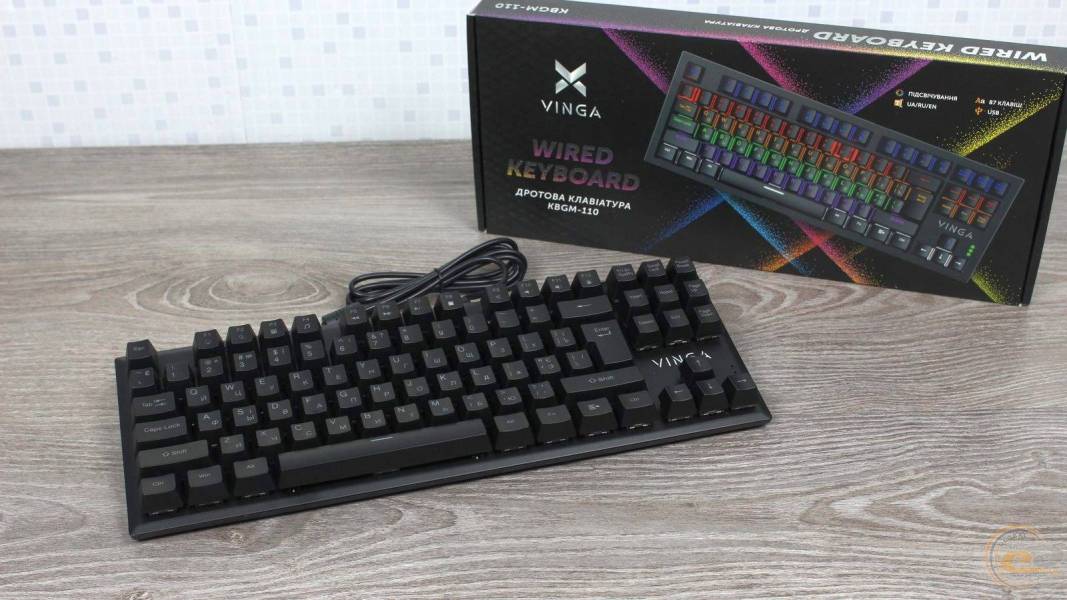
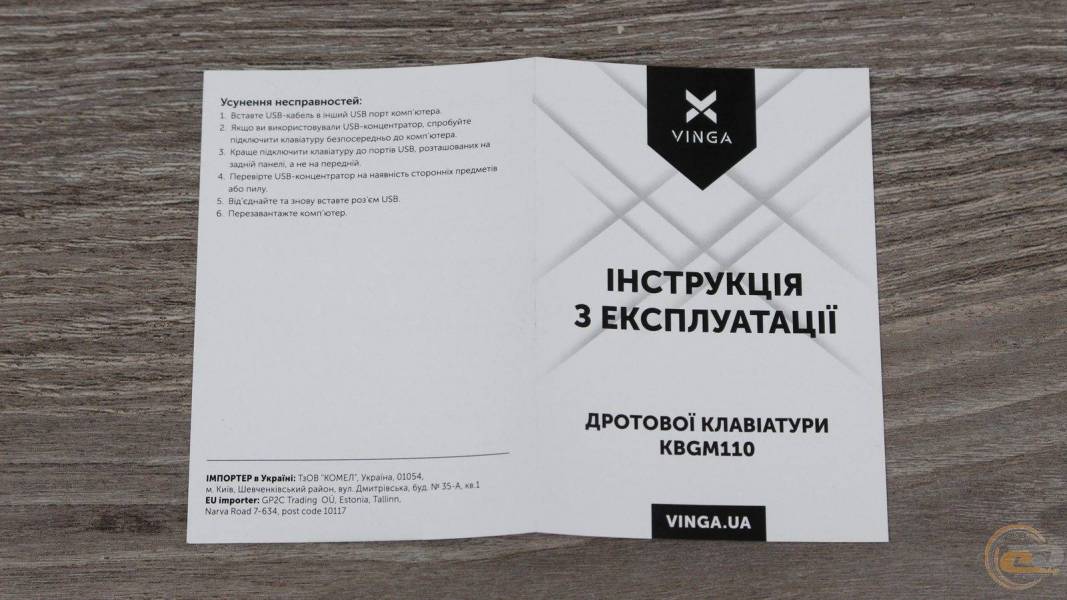
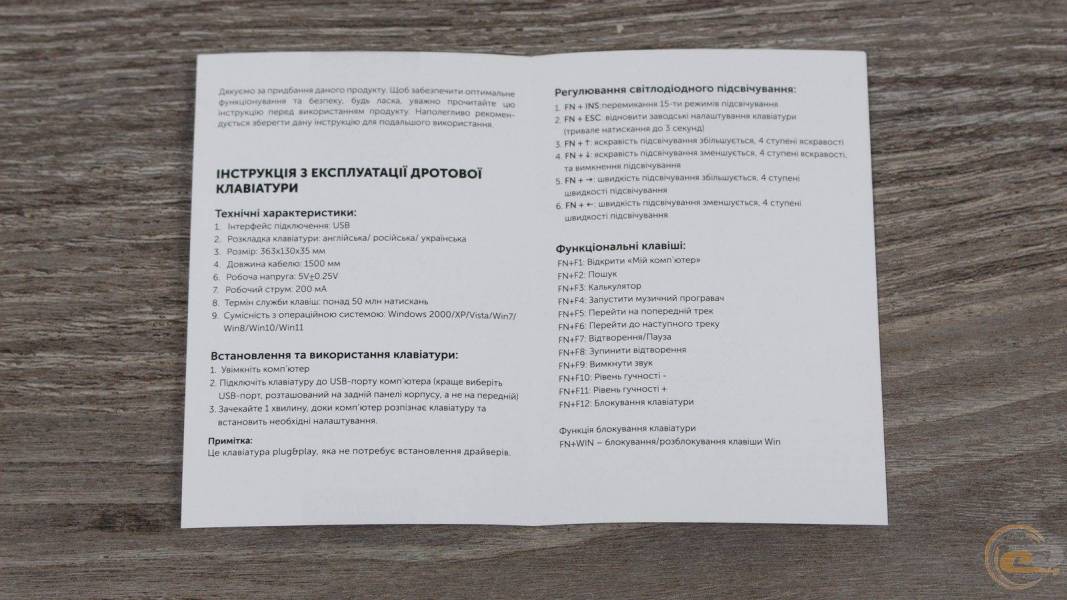
Inside the box, the device is protected by cardboard dividers and a polyethylene bag. The package is as concise and practical as possible: the user receives the wired Vinga KBGM-110 keyboard with a non-detachable interface cable and a short paper user manual containing basic recommendations for connection and troubleshooting.
Appearance and construction
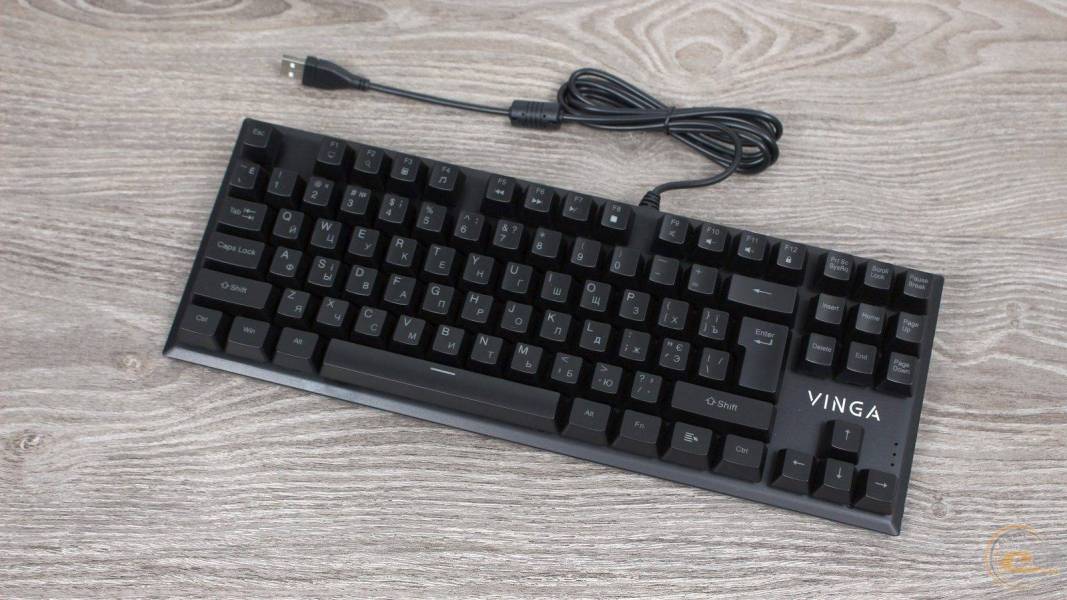
Vinga KBGM-110 belongs to the compact TKL (Tenkeyless) format. This is a classic 80% solution with 87 keys, where the manufacturer simply removed the right numeric block, leaving all other key elements — a full F-row, arrows, and a complete set of navigation keys.

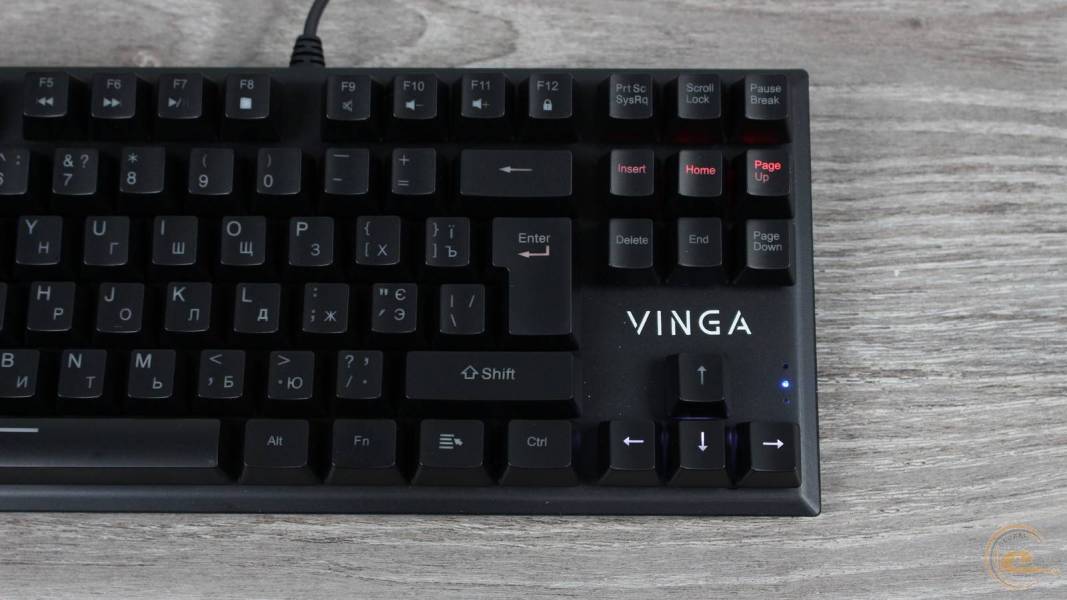
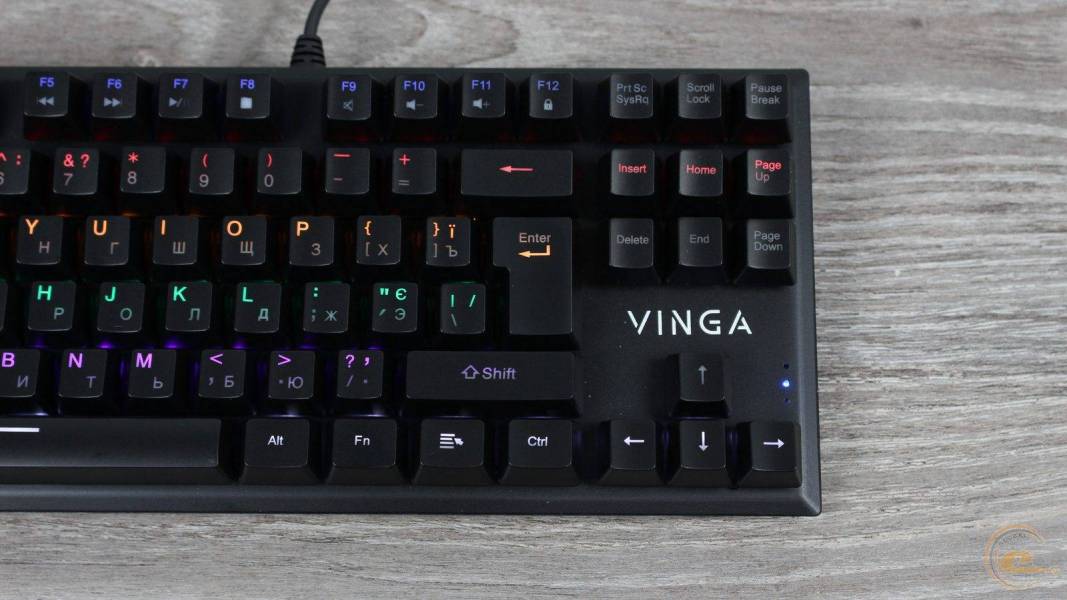
While the overall format is standard, the keyboard layout has interesting and very practical modifications. It is based on the European type (ISO), the main feature of which is the large two-story Enter key — it's almost impossible to miss it during touch typing.
At the same time, the manufacturer deviated from the strict ISO canons, where the left Shift is usually made short and an additional key is added next to it. Here, both Shifts are kept long, as in the American layout (ANSI), which is a huge plus for gamers. Additionally, the bottom row has also been changed: the manufacturer completely abandoned the right Win key. In its place, the Fn key has been moved, now located to the right of Alt. All other keys, including Prt Scr, Scroll Lock, and Pause/Break, remain in their usual places, so adaptation to the device happens almost instantly.
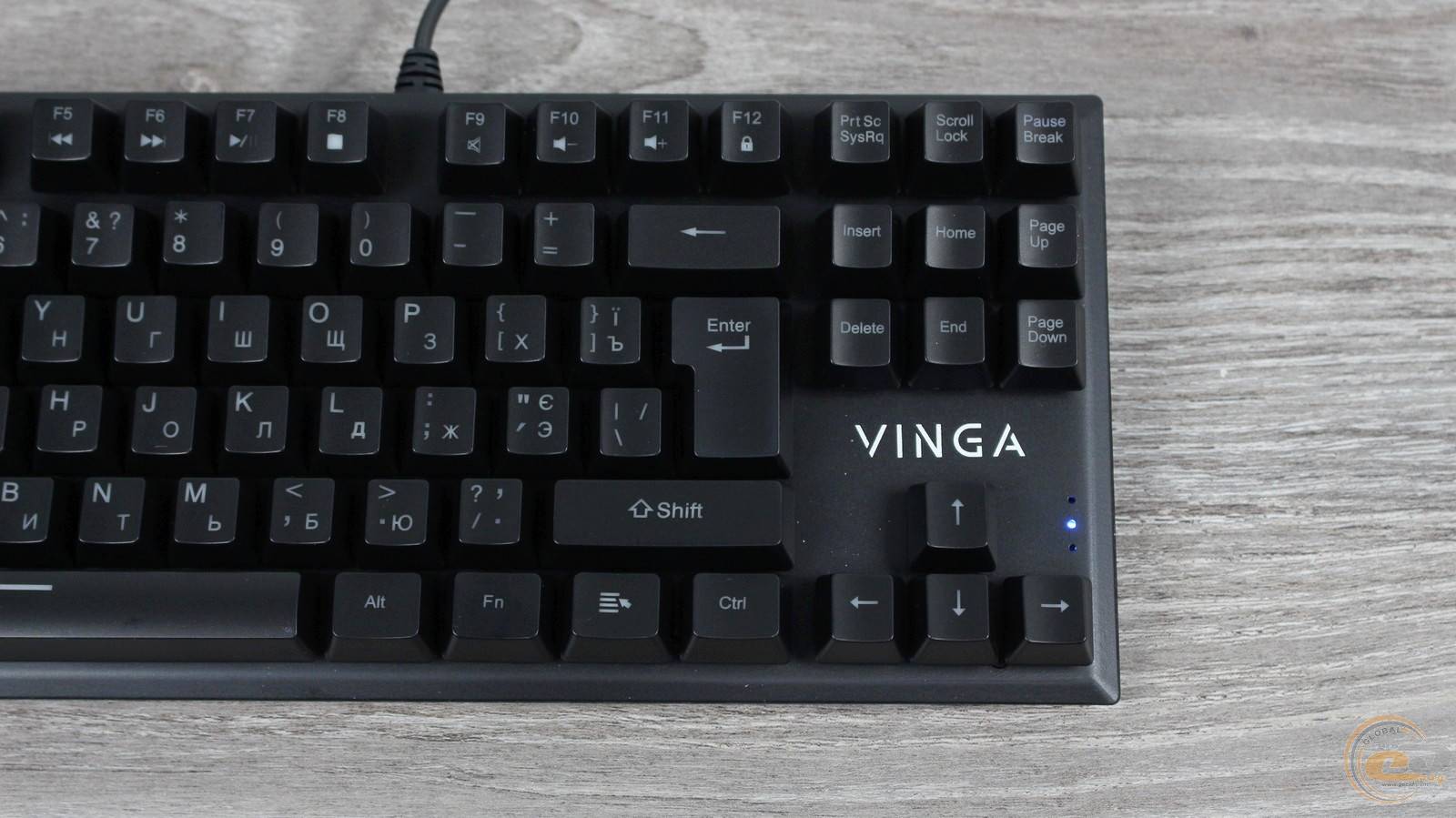
The visual accent of the right part is the branded Vinga logo, applied in white directly on the metal plate above the arrow block. To the right of it, near the very edge of the case, are three vertically arranged round blue LED indicators, responsible for displaying the statuses of Caps Lock, Scroll Lock, and Win Lock. They have moderate brightness and do not glare in the dark.
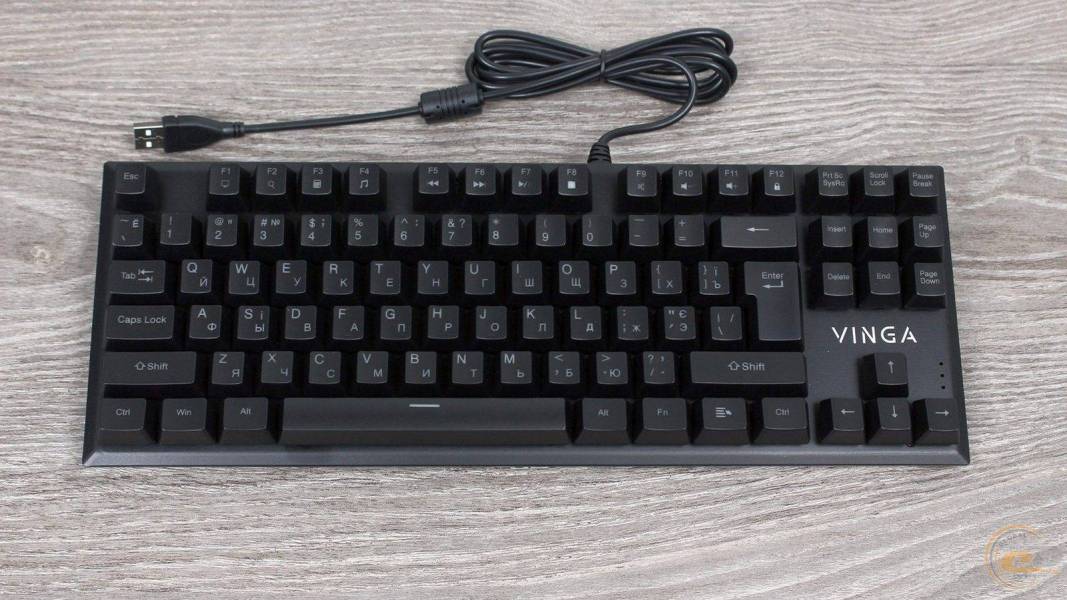
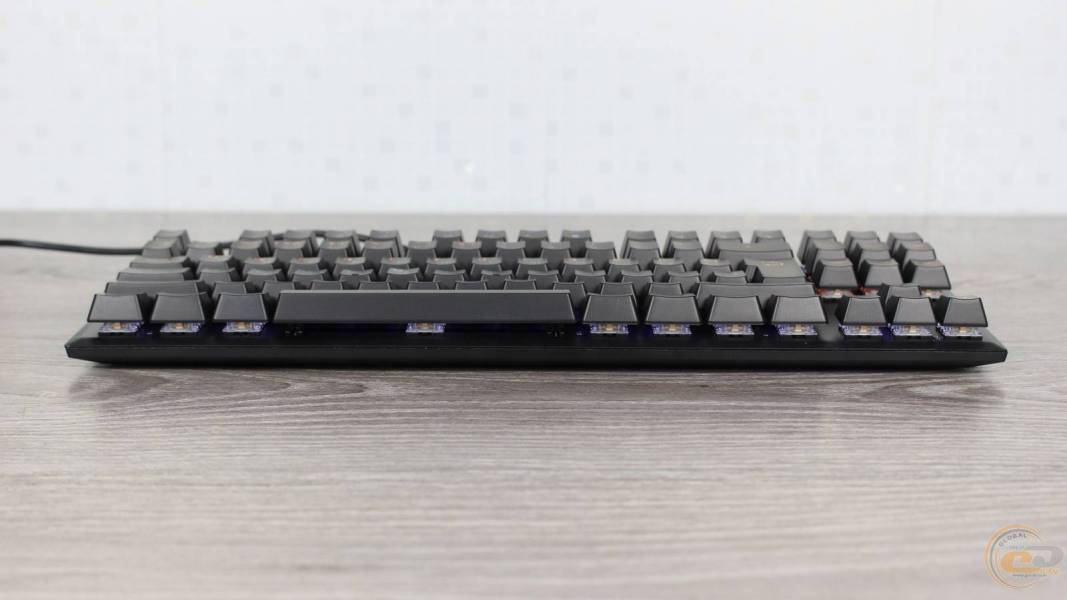
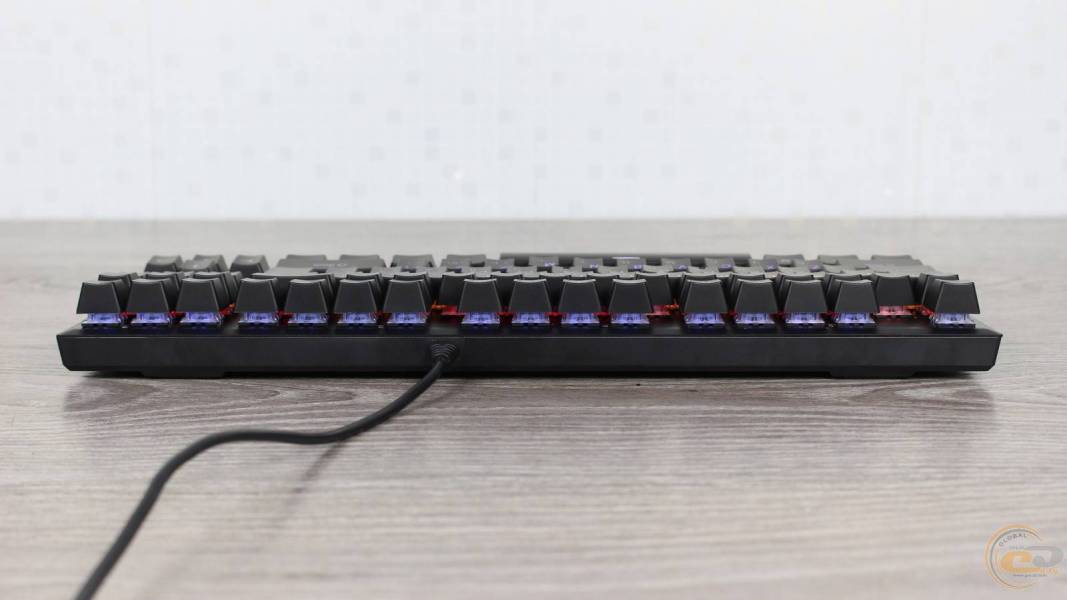
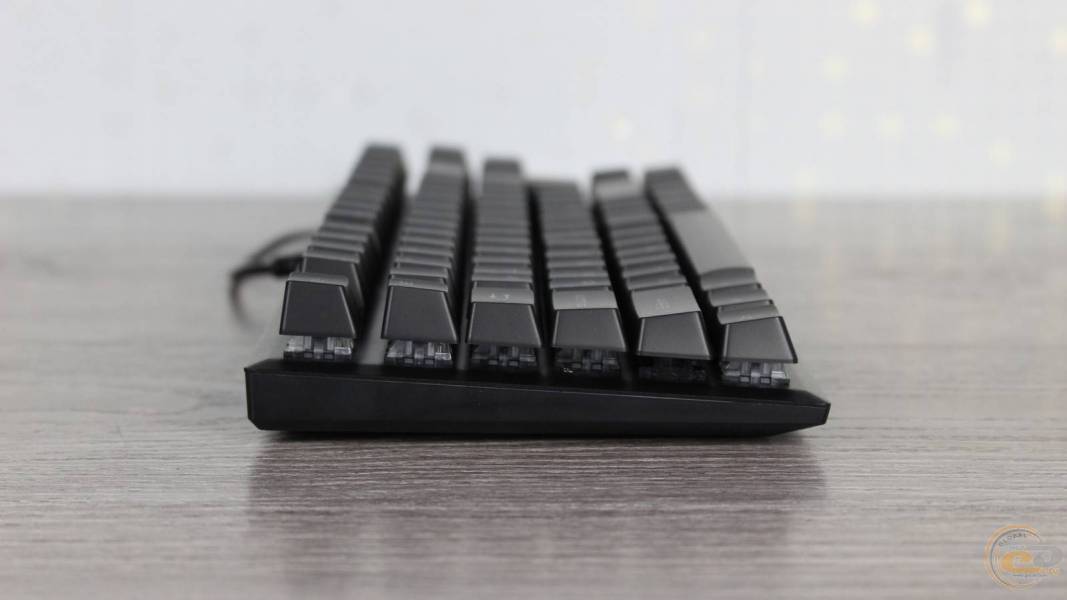
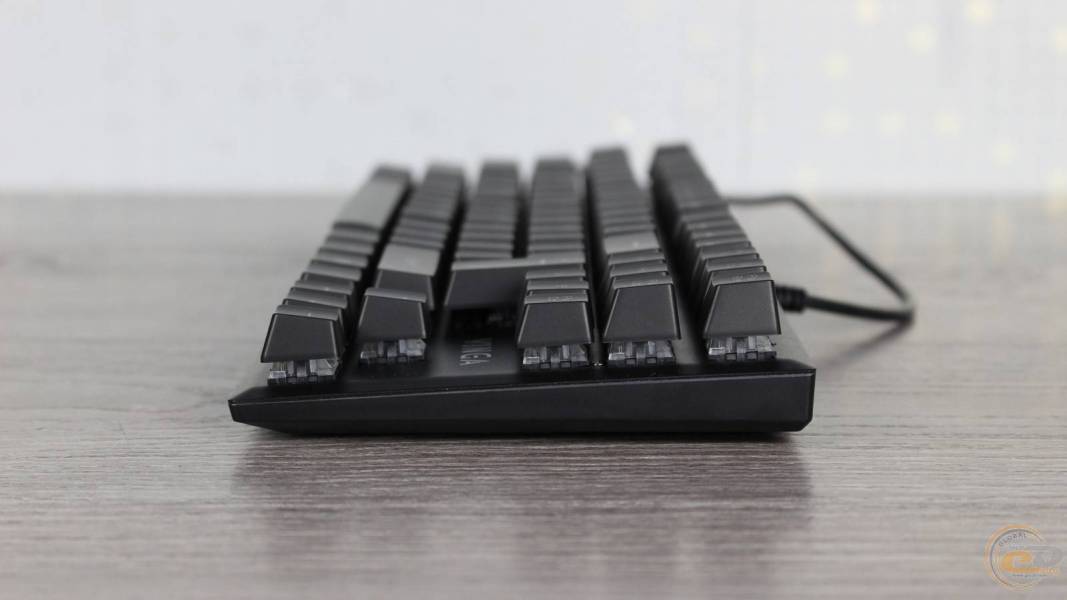
The construction is of the Skeleton type, where the front panel is a rigid metal plate painted black and complemented with a matte texture. The switches are installed directly on it, adding significant strength to the device. The case feels monolithic: it does not deform during typing and does not produce extraneous sounds, while the matte finish successfully resists fingerprints.
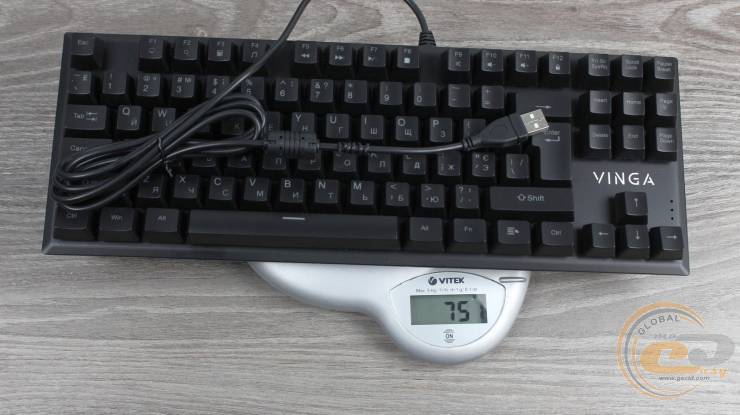
Our own measurements showed that the actual weight of the keyboard, along with the built-in cable, is 751 g. The metal base combined with the plastic tray provides perfect stability on the table. It does not feel excessively heavy, yet it ensures that the device will not slide on the work surface even during intensive use.
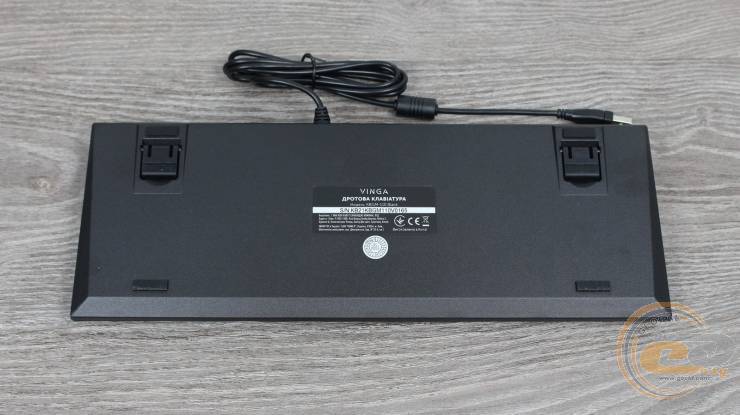
The bottom panel is made of matte black plastic with a practical, slightly rough texture that does not collect dust and fingerprints.
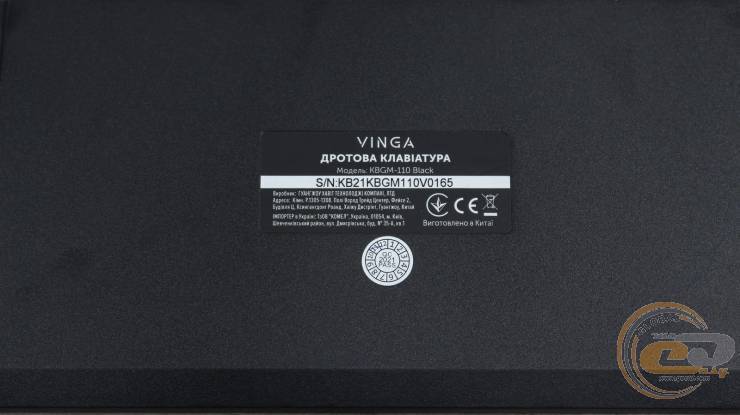
In the center, there is a concise label with technical information and a serial number, and slightly below — a round factory quality control seal.
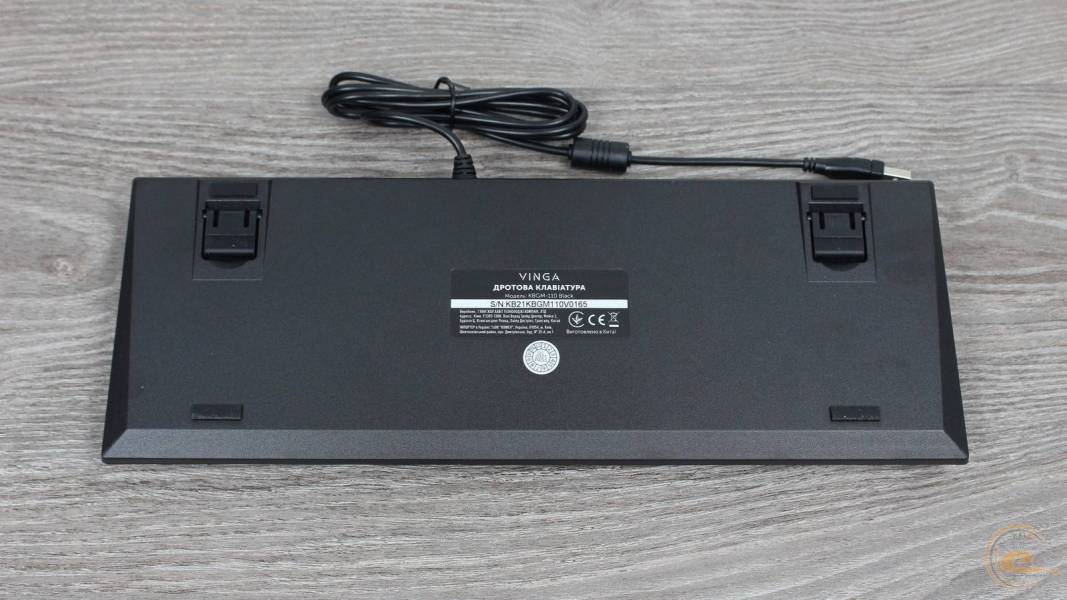
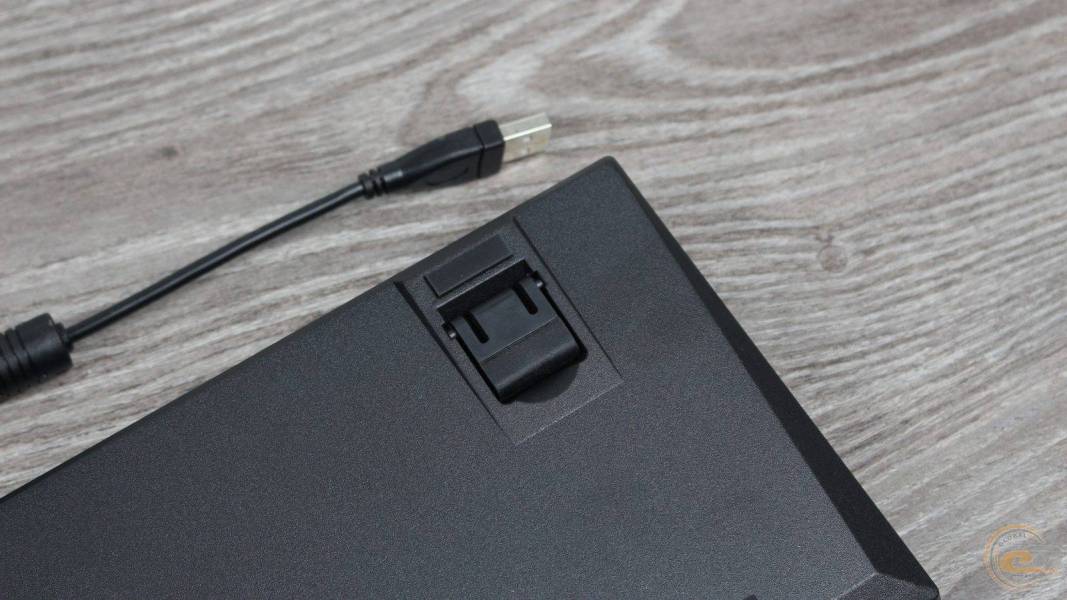
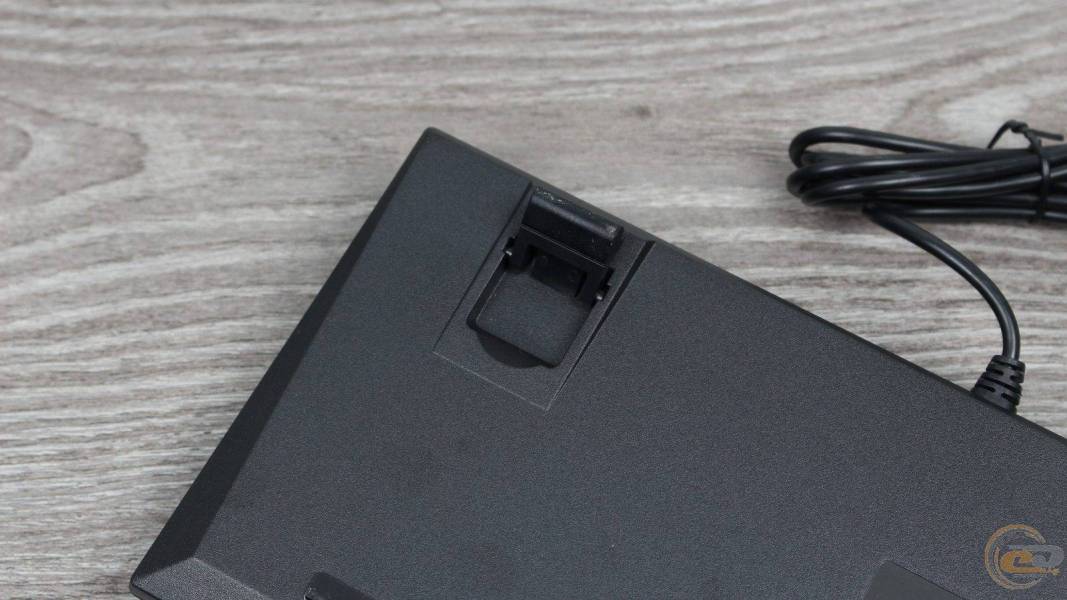
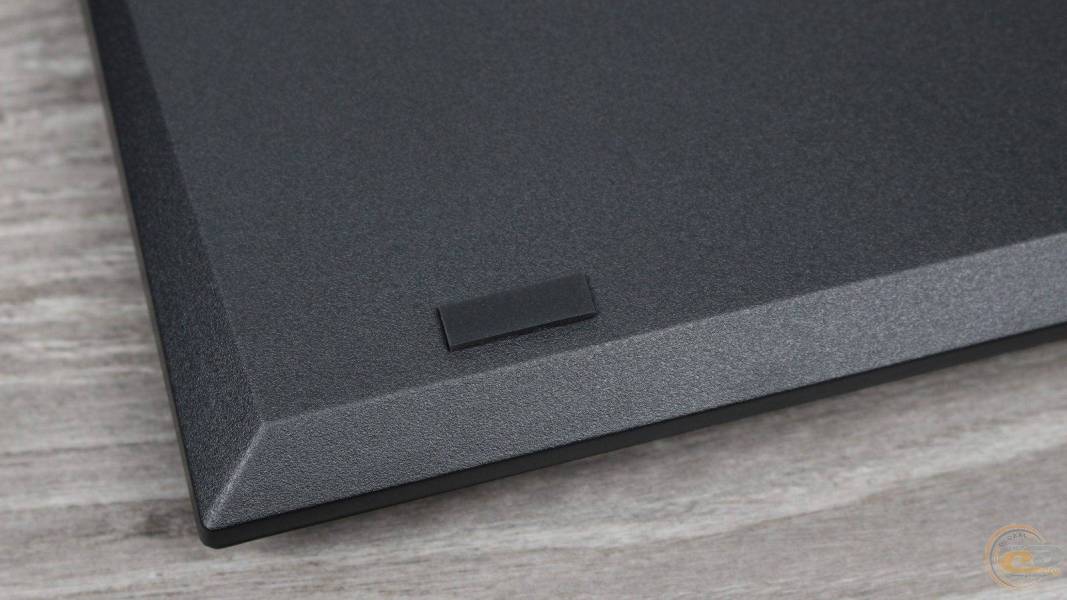
To prevent slipping on the table, the bottom part of the case has four small rectangular rubber supports: two are placed at the corners in the lower zone, and two more — in the upper, directly above the folding legs. They provide reliable grip with the surface and ensure the overall stability of the device.
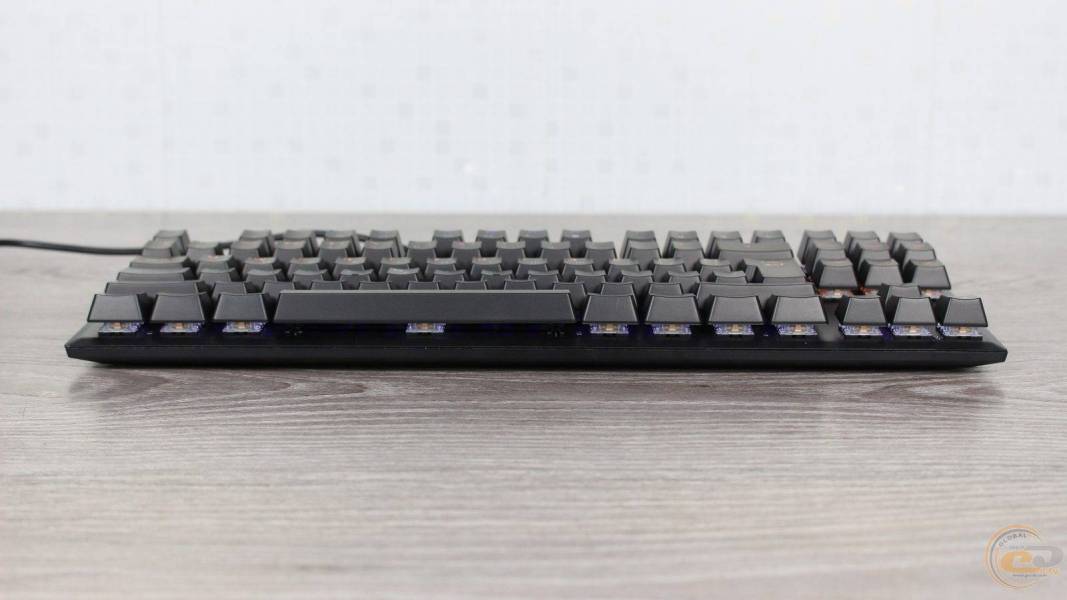
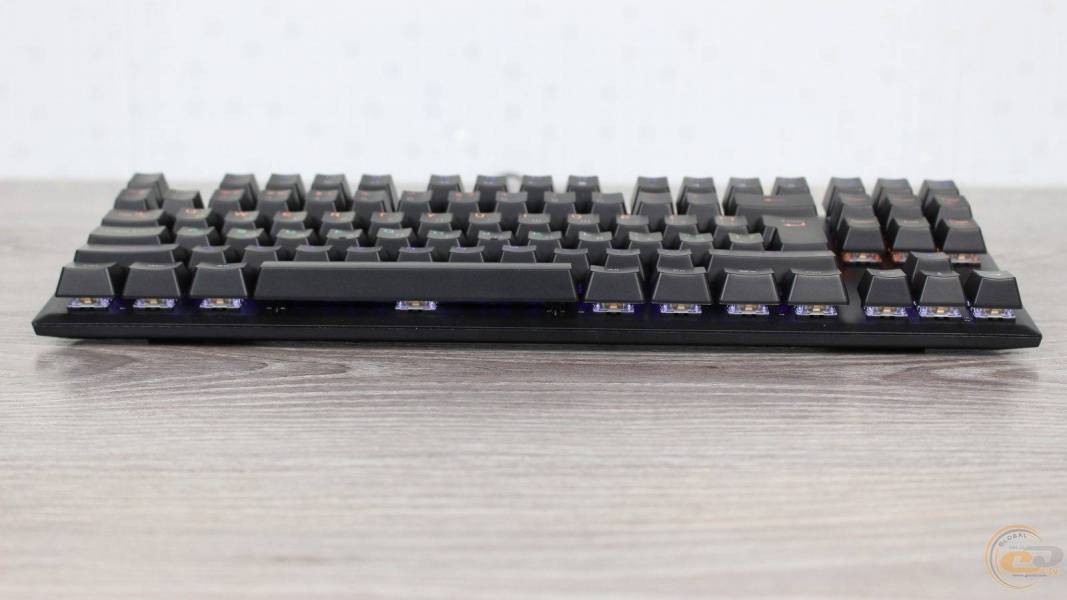
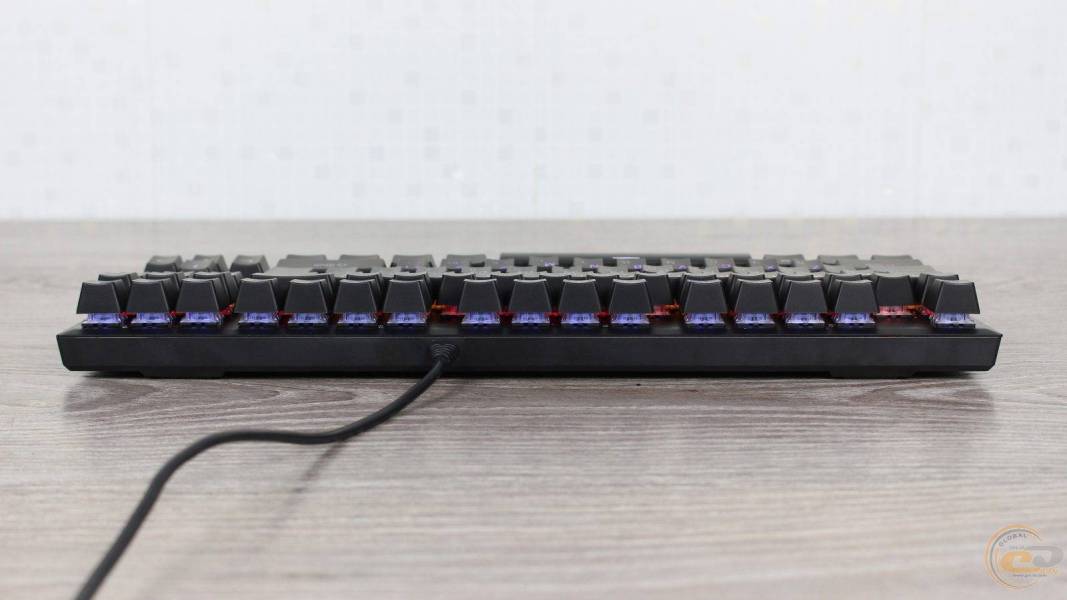
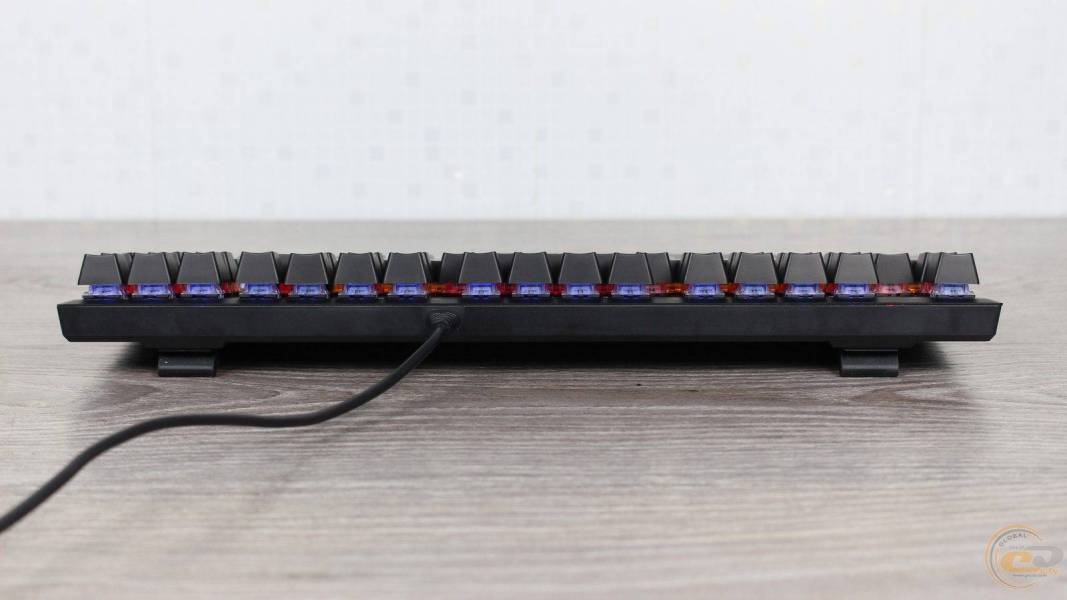
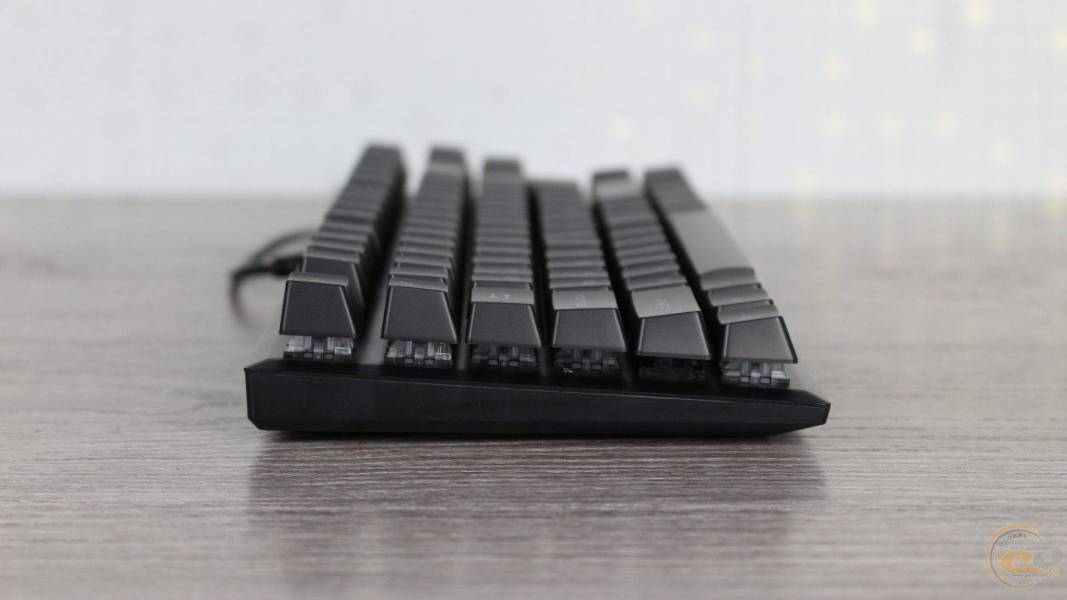
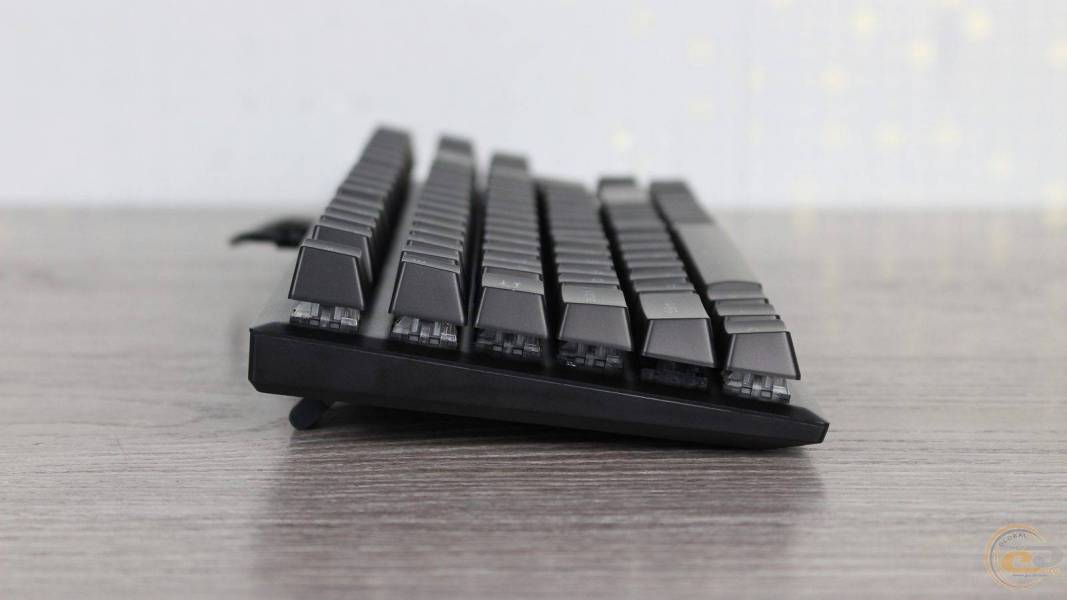
The construction is complemented by single-tier folding legs, which allow changing the keyboard tilt angle up to 7°. In the unfolded position, the rear part of the case rises by 10 mm. This allows the user to choose a comfortable tilt level for convenient typing or gaming. Thanks to the rubberized pads on the ends of the legs, the keyboard maintains excellent grip with the surface and remains stable in any position.
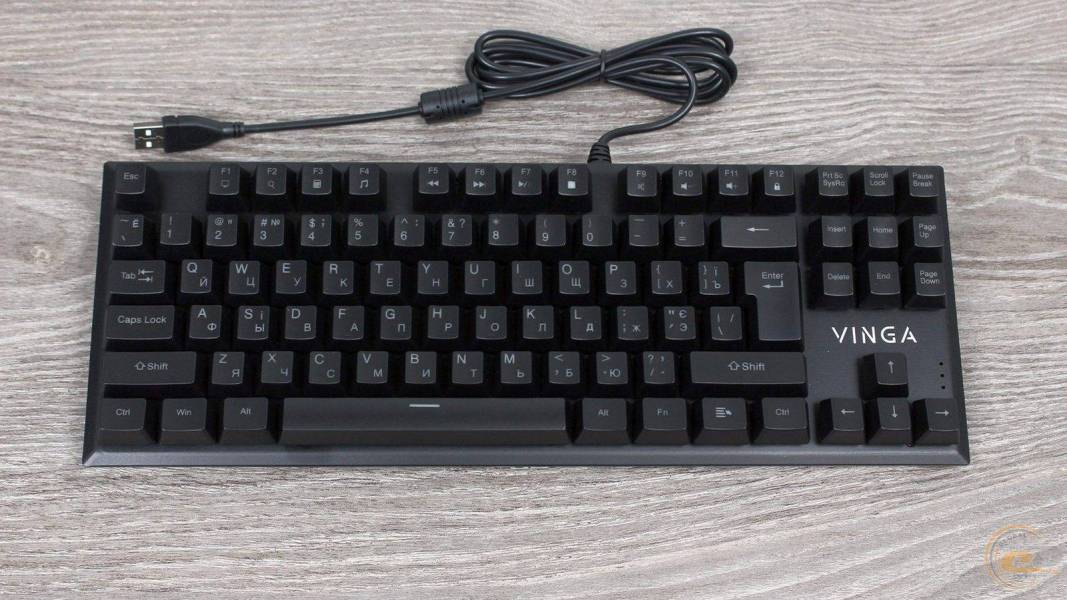
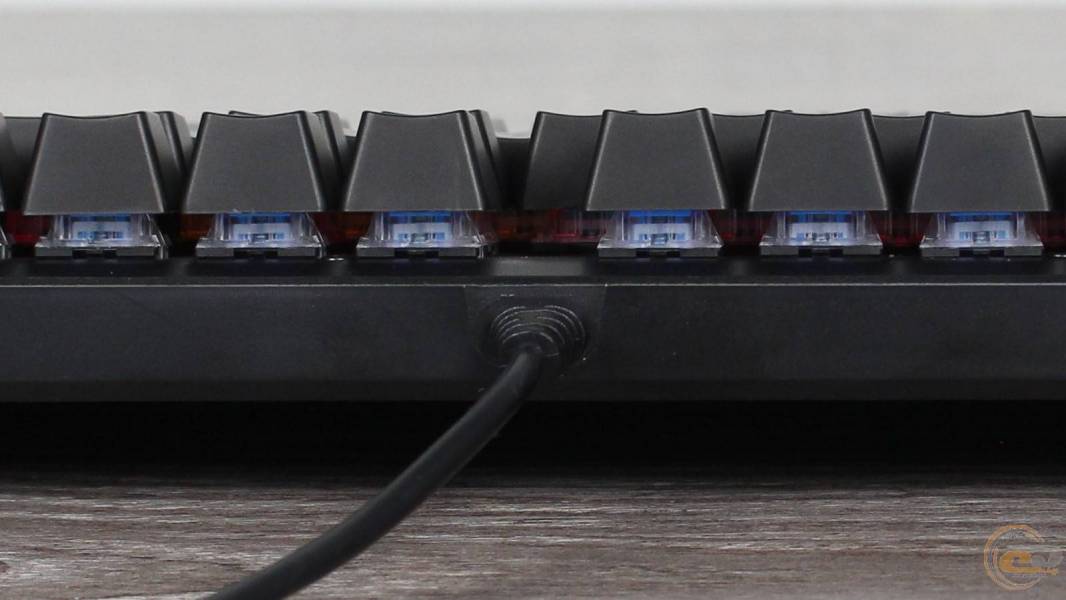
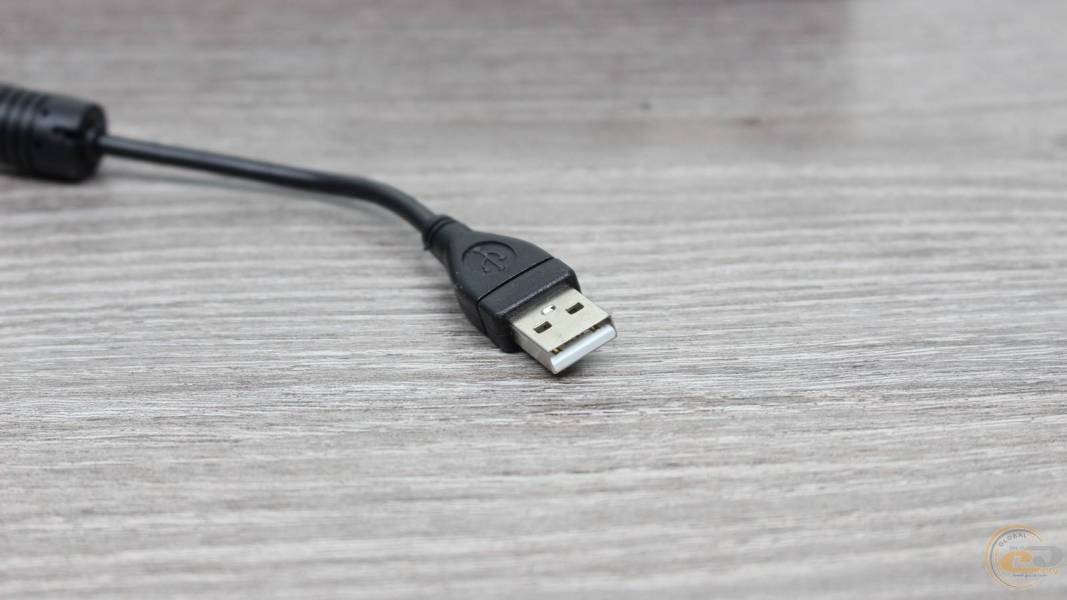
Vinga KBGM-110 connects via a non-detachable USB-A cable 1.5 m long. The cable exit is slightly shifted to the right of the center of the rear edge and is protected by a rubber sleeve from bending. The cable has a diameter of 3 mm and a simple smooth coating without braiding, making it flexible and convenient to lay out. A ferrite filter is installed closer to the end for interference protection.

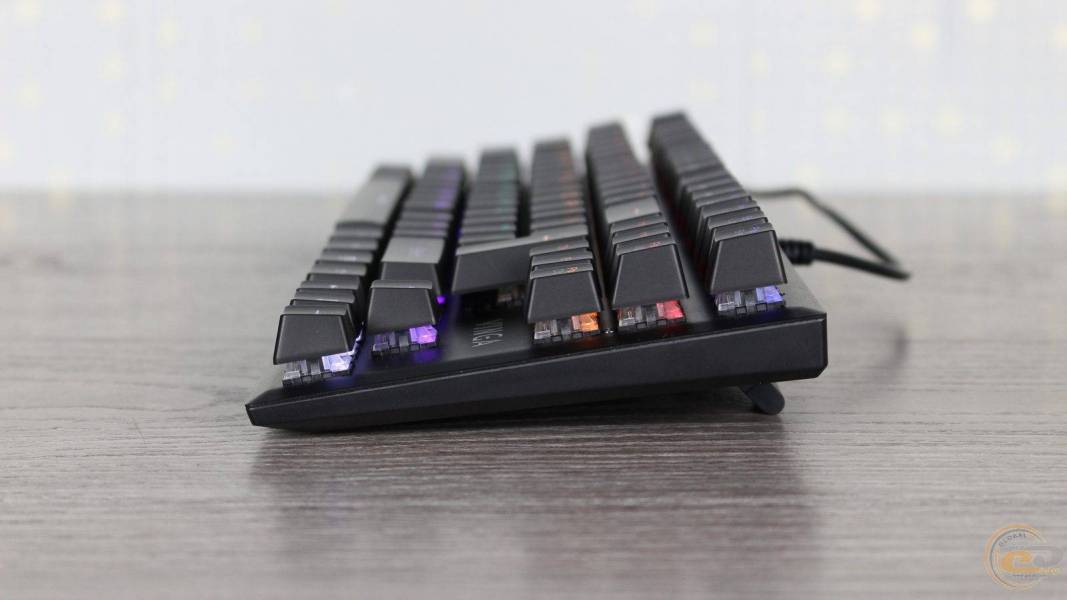
The heart of the keyboard is the mechanical Content Blue switches with an official lifespan of up to 50 million presses. These are classic clicky switches with a standard cross-shaped stem and a clear tactile response. Hot Swap technology is not provided here — the switches are soldered directly onto the board. Directly above each switch is an RGB LED with a north-facing orientation, providing bright illumination of the symbols.
The acoustic character of the device is quite specific and loud. This is an ultra-budget solution with no internal soundproofing. Moreover, in the wide cutout of the metal plate under the spacebar, the exposed green printed circuit board (PCB) is clearly visible, causing the cavity of the plastic tray to act as an acoustic resonator.
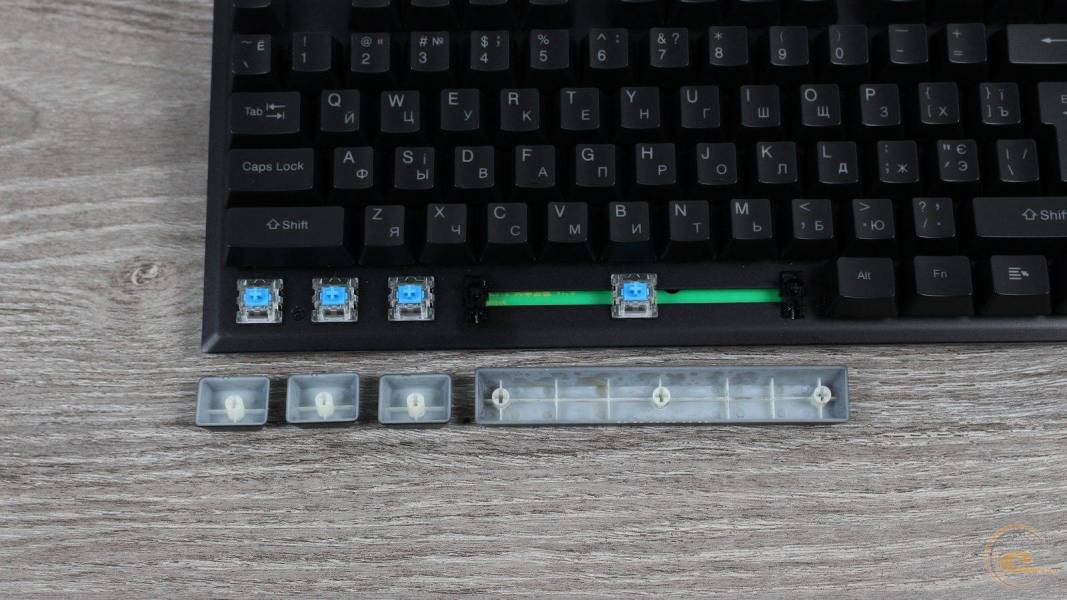
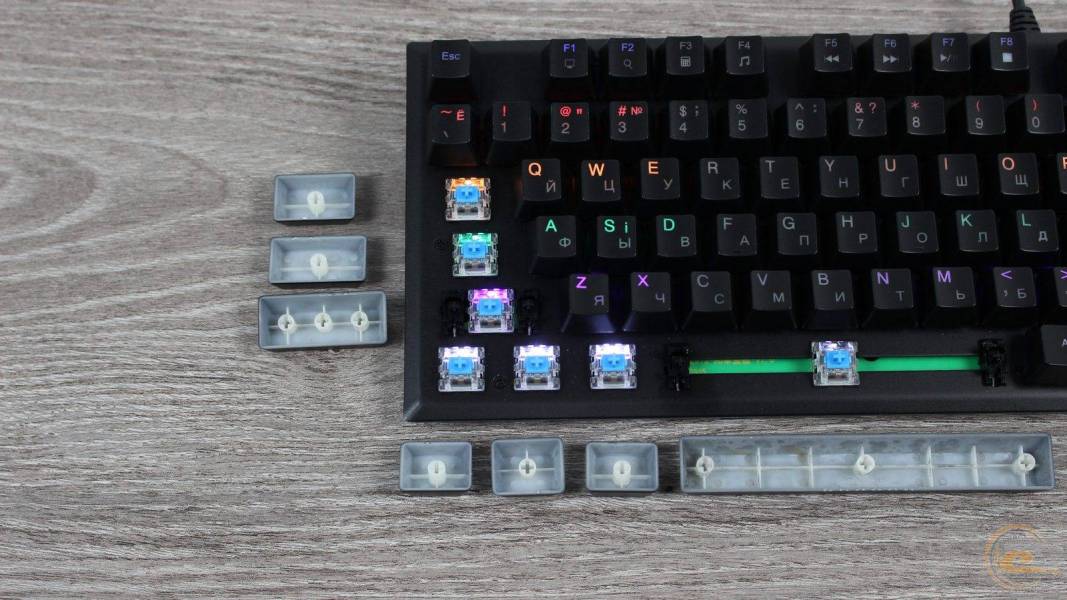
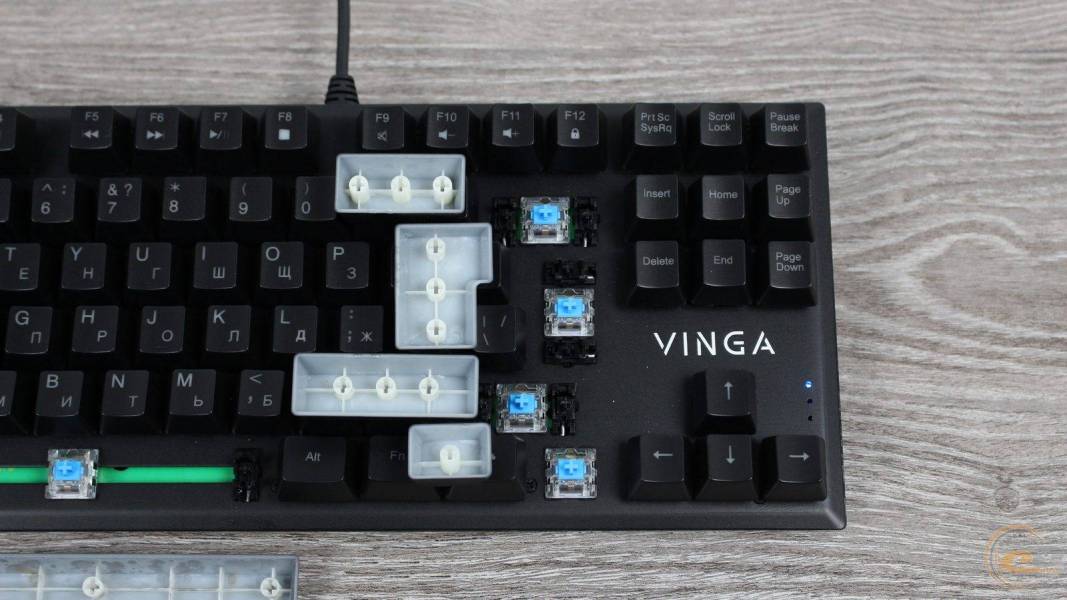
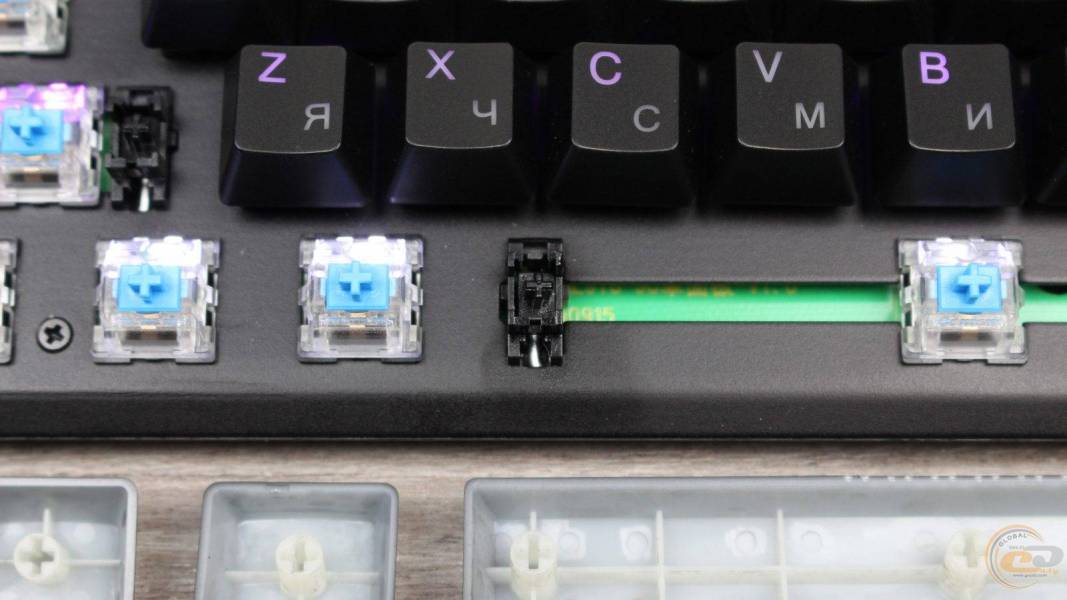
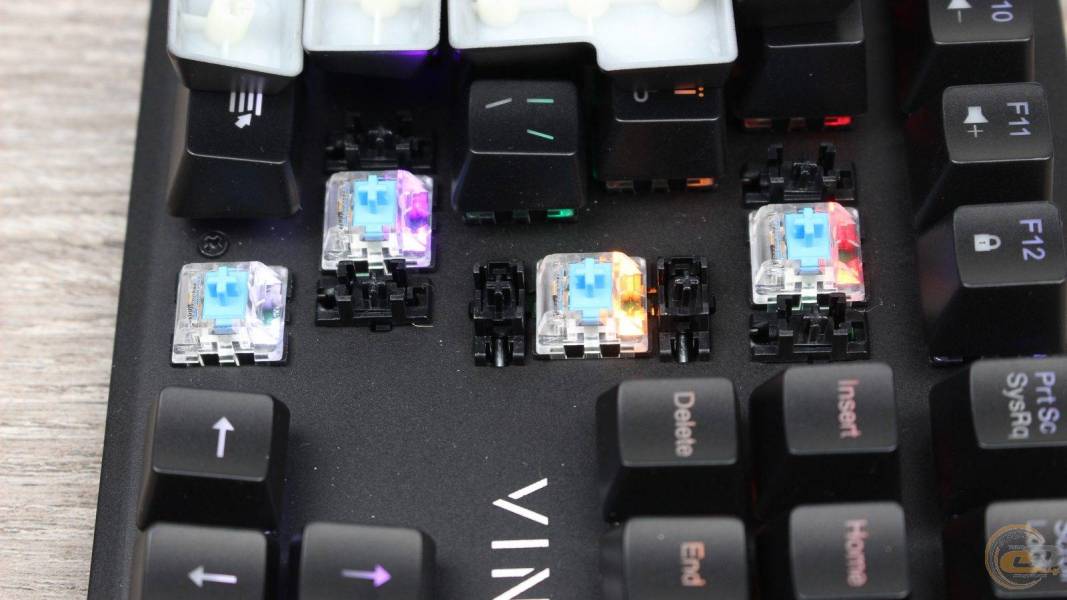
The stabilizers of the long keys have only a symbolic minimal layer of lubrication, so the characteristic dry click of the switches is accompanied by a noticeable metallic echo and rattling of the steel bars. Such a "ringing" accompaniment is unlikely to be suitable for night sessions in the same room with loved ones, but it will definitely appeal to fans of the loud retro sound of early mechanics.
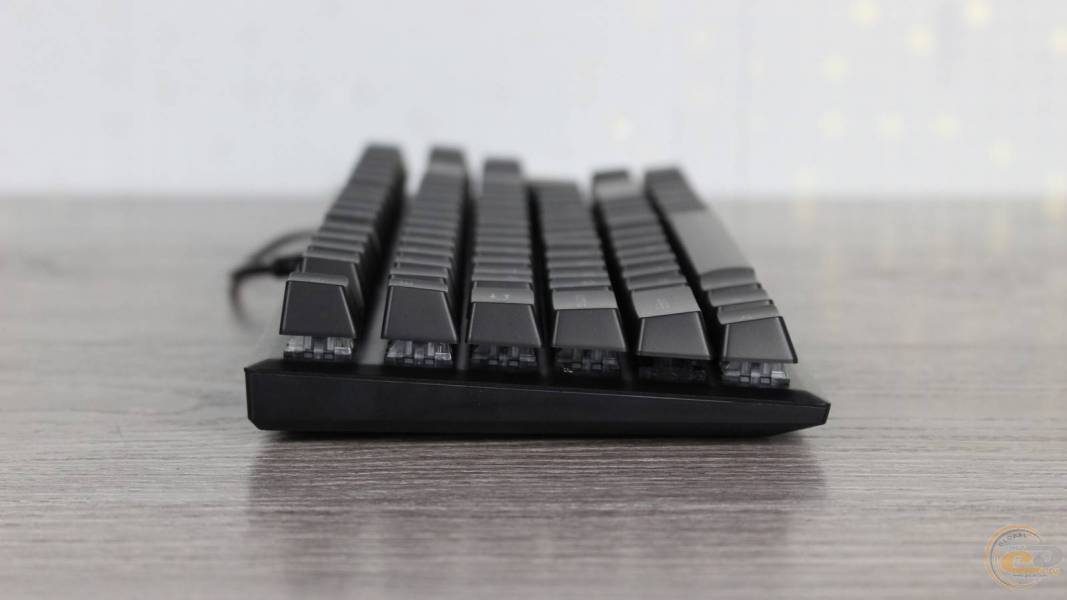
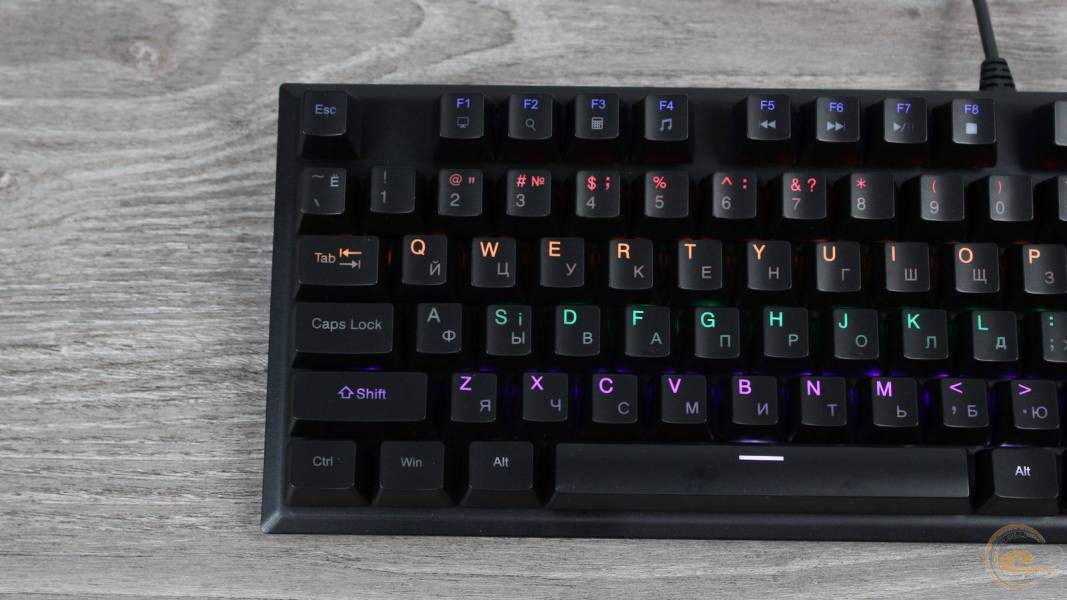
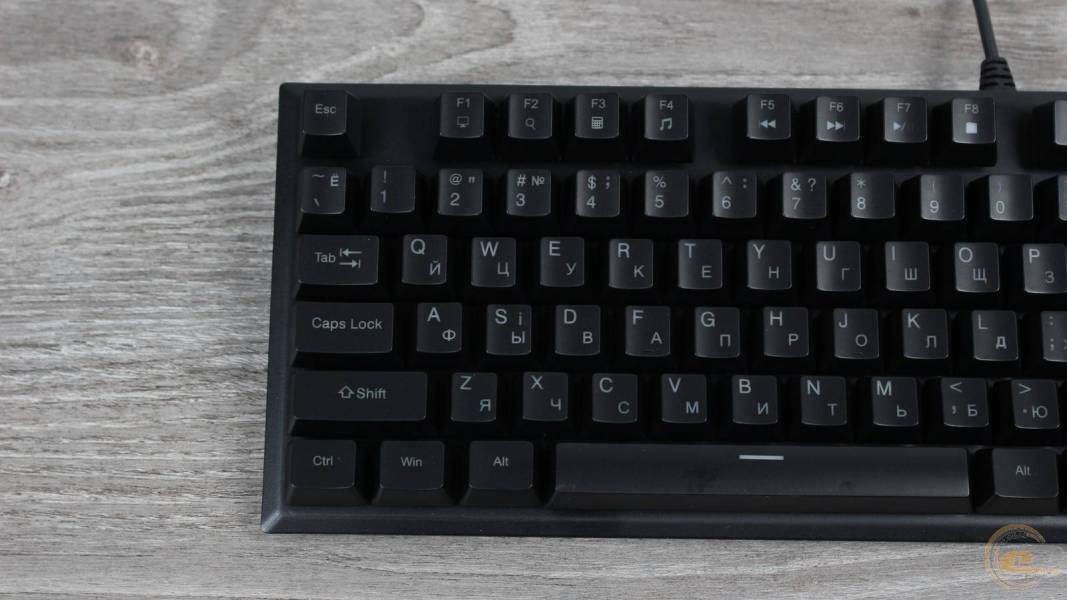
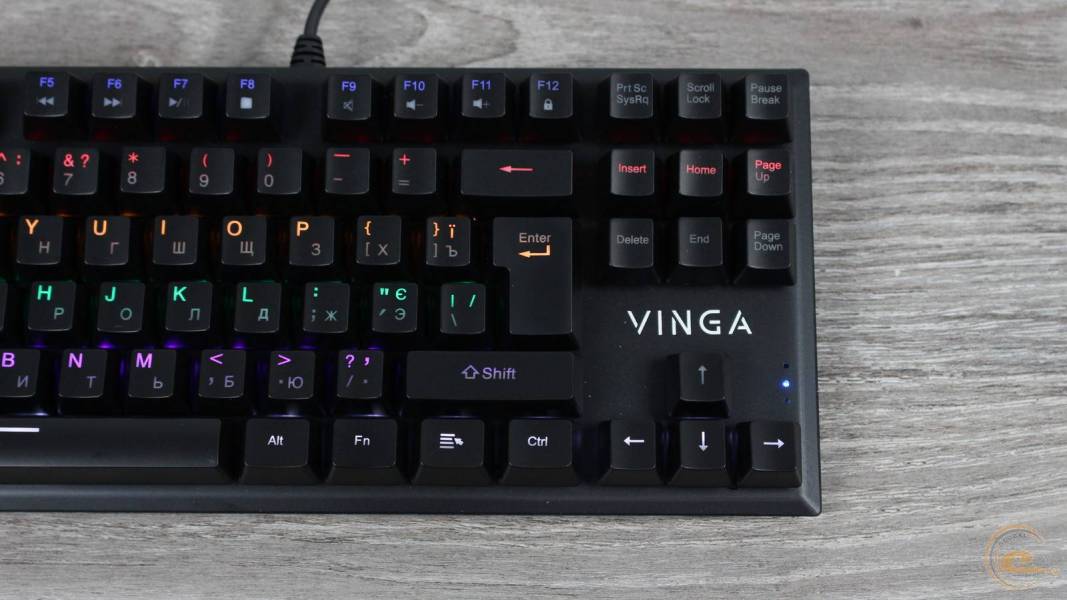
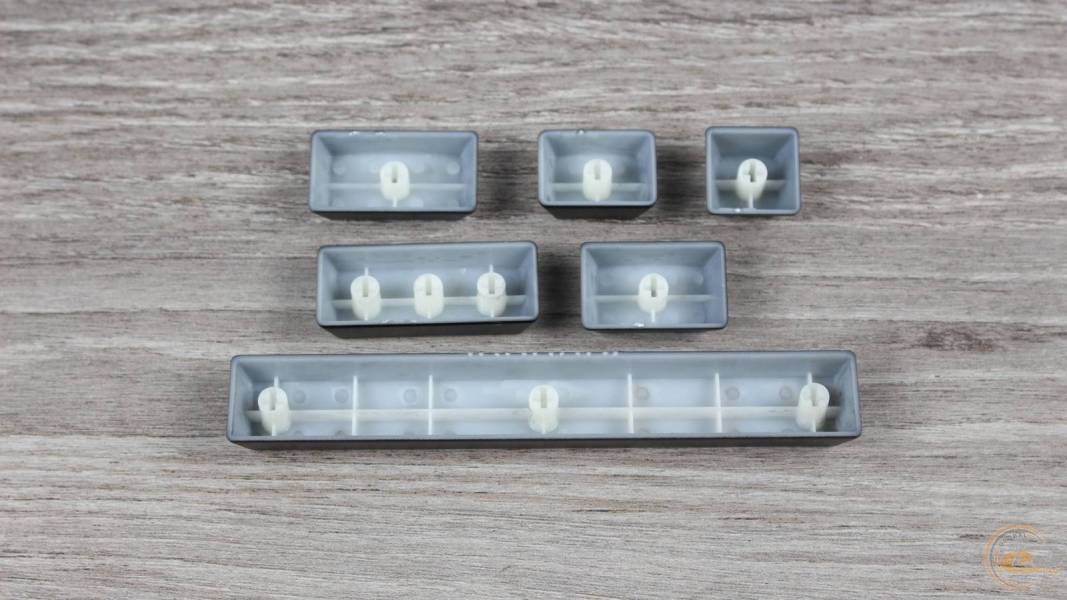
The keycaps have a classic OEM profile with an ergonomic row height curve. They are made using a common technology in this class: the base of the keycaps is molded from translucent plastic, onto which a black matte coating is applied, and the wall thickness is a standard 1.3 mm. The Latin letters and top row symbols are created using laser engraving directly above the north-facing LEDs, ensuring they are illuminated as brightly and clearly as possible.
The localization is fully implemented — the keys feature both Ukrainian and Russian symbols. They are applied to the lower part of the keycaps and lack internal illumination. While the main Latin symbols are clearly visible under normal lighting conditions, the Cyrillic legends appear quite indistinct. In complete darkness, this difference becomes even more noticeable, as the LEDs only illuminate the upper part of the keys.
The keyboard is equipped with zonal Rainbow backlighting with a fixed color for each row of keys. The device operates on a Plug-and-Play principle and does not require the installation of any proprietary software or drivers. All available settings are made exclusively using hotkey combinations with the Fn modifier.
The illumination offers 15 built-in operating modes, which are switched by pressing Fn + Ins. The user can flexibly adjust the brightness (four levels available or complete shutdown via Fn + ↑/↓) and change the speed of dynamic effects using the Fn + ←/→ combinations. To quickly reset all lighting presets to factory settings, simply hold the Fn + Esc combination for 3 seconds.
Conclusions
The mechanical keyboard Vinga KBGM-110 is a classic entry ticket into the world of tactile switches for those on a modest budget or simply wanting to try "clicky mechanics" at the price of a regular membrane keyboard. It offers a reliable Skeleton-type construction with a metal top plate, a time-tested TKL format, and full-sized gaming Shift keys.
Of course, the budget status implies a number of compromises: complete lack of soundproofing, rattling stabilizers, and indistinct engraving of Cyrillic symbols. However, the simplicity of use with Plug & Play, bright backlighting, and affordable price make it a pragmatic choice for beginner gamers who understand well what they are spending their money on.
Advantages:
- full-fledged mechanical switches at the price of a membrane keyboard;
- compact 80% TKL format;
- rigid construction with a metal plate that does not flex during operation;
- successful layout modification with a double-decker Enter and long Shift keys;
- bright Latin backlighting with 15 modes and quick control;
- complete independence from third-party software and easy control using key combinations.
Features:
- high noise level, metallic echo of the case, and rattling stabilizers;
- lack of Hot Swap support for quick switch replacement.