It happened! The first processors of the AMD Ryzen line have gone on sale, and along with them, the embargo on publishing independent test results has ended. Today, we will independently evaluate the capabilities of the 8-core (16-thread) AMD Ryzen 7 1700X processor, so the most impatient can immediately proceed to the second page of the review to familiarize themselves with the test results. If you want to refresh your memory on the key advantages of the line and the features of the microarchitecture, then we offer a small theoretical excursion.
A bit of history and a look at key features
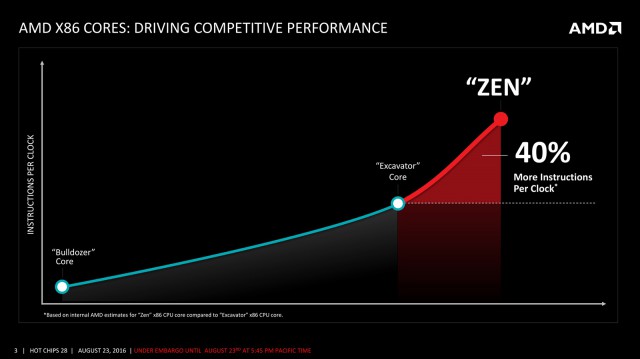
The development of the new processor microarchitecture by AMD began back in 2012 (by IT industry standards). A high-class professional, Jim Keller, was specially invited for this. He was involved in the creation of the AMD K7 microarchitecture and worked as the lead architect in the creation of AMD K8, then joined Apple, where under his leadership, the Apple A4 and Apple A5 chips were released. From 2012 to 2015, the development of AMD Zen was conducted in strict secrecy, and only in the second half of 2015 was it announced to the public. In August 2016, the official presentation of the AMD Zen microarchitecture took place, highlighting some advantages. In December of last year, desktop processors of the AMD Ryzen line, created based on it, were announced. At the end of February, the high-performance AMD Ryzen 7 series debuted, and only at the beginning of March did they appear on sale.
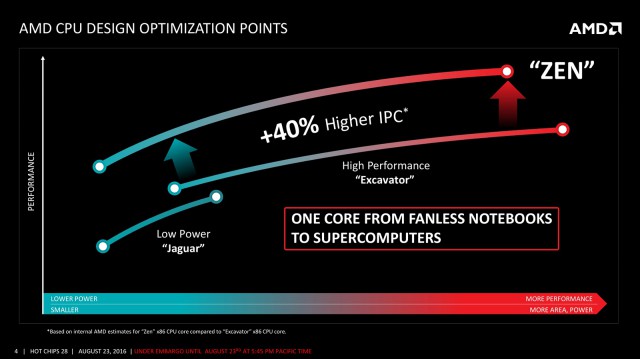
During all this time, AMD and unofficial sources fueled interest in the new microarchitecture and processors based on it, as the presence of real competition in the market always positively affects the price/performance ratio of end products. The AMD Zen microarchitecture itself was created with a focus on versatility, so that it could be used in both energy-efficient mobile processors and powerful server solutions. And this, you must agree, is a very challenging task.
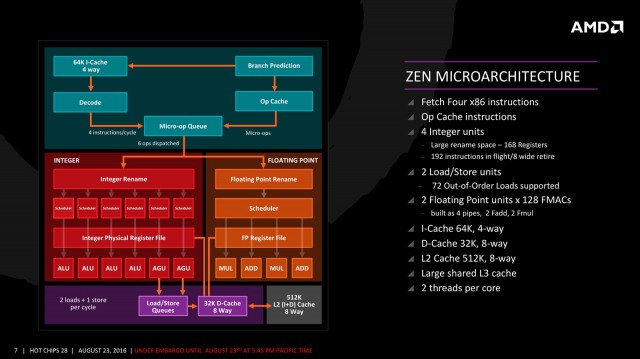
To achieve this, Jim Keller and his team decided to move away from the CMT (Clustered MultiThreading) approach used in AMD Bulldozer and return to the more popular and efficient SMT (Simultaneous Multithreading). Incidentally, SMT is actively used by Intel. Secondly, the developers decided not to repeat the mistakes of the previous structure and equipped each core with all the necessary computational blocks to have competitive performance in both single-threaded and multi-threaded modes.
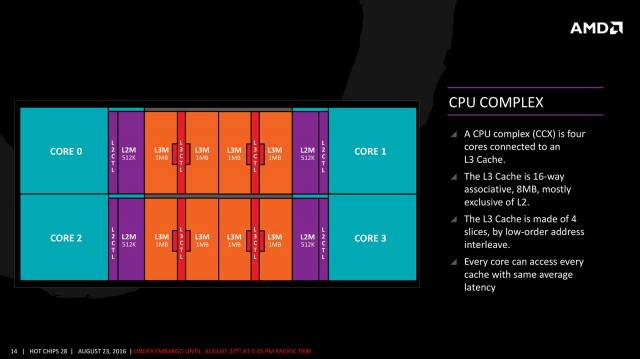
At the heart of any processor with AMD Zen microarchitecture is the CPU Complex (CCX) module. It contains four processor cores, each with 512 KB of L2 cache. In turn, the L3 cache is divided into eight parts (1 MB each), and all cores have access to it. Accordingly, 8-core processors are obtained by integrating two CCX modules in one package, offering 4 MB of L2 cache and 16 MB of L3. 6-core processors also result from combining two CCX modules, but two cores are disabled, so the L2 cache will be only 3 MB, and the L3 remains 16 MB. If 2-core models appear, they will have 1 MB of L2 cache and 8 MB of L3.
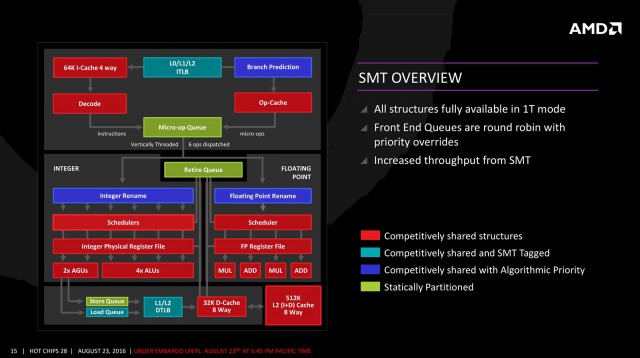
Each processor core can process two data streams, and each CCX module can handle eight streams. Accordingly, we are promised 8-core (16-thread), 6-core (12-thread), 4-core (8-thread), and 4-core (4-thread) models.
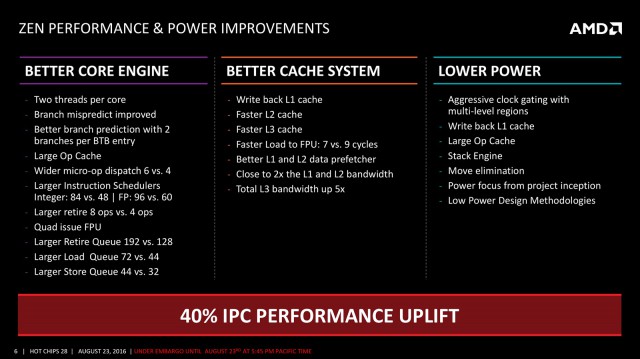
Overall, the AMD Zen microarchitecture promises more than a 40% increase in IPC (Instruction Per Clock). Here is just a small list of improvements that AMD engineers implemented to achieve this indicator:
- Improved branch prediction accuracy.
- Increased operation cache.
- Increased the number of instruction schedulers (for integer calculations from 48 to 84, for floating-point from 60 to 96).
- Enabled L1 cache to work in "Write back" mode instead of "Write-through". In the first case, data is written to the cache and later duplicated in main memory. In the second, the write occurs in main memory with duplication in the cache. "Write back" mode provides higher performance when working with cache.
- Increased L1 instruction cache to 64 KB/core (in AMD Excavator, it is 96 KB per dual-core module).
- Increased L2 cache to 512 KB/core with 8-way associativity.
- The bandwidth of L1 and L2 cache has almost doubled.
- The bandwidth of L3 cache has increased almost 5 times.
- Accelerated loading of information into FPU blocks from 9 to 7 cycles.
- Added a number of new instructions, and much more.
Presentation of AMD Ryzen 7
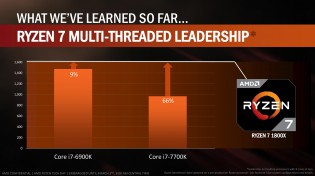

On the eve of the Ryzen 7 series debut, AMD held a special press briefing, where they shared some interesting details worth noting. First and foremost, the emphasis was placed on the excellent multi-threaded performance of the new CPUs. In particular, the flagship of the series, AMD Ryzen 7 1800X, outperformed the Intel Core i7-6900K by 9% and was 66% better than the Intel Core i7-7700K. Currently, multi-threading is actively used in 3D rendering, VR, video processing, virtualization, game streaming, and more.
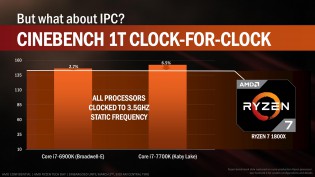
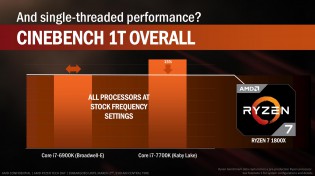
As for single-threaded performance, at the same clock frequency (3.5 GHz), both Intel competitors pull ahead by 2.7% and 6.5%, respectively. When comparing their performance at stock frequencies, the Intel Core i7-6900K is on par with the AMD Ryzen 7 1800X, while the Intel Core i7-7700K pulls ahead by 15%. Interestingly, AMD did not hide such results but played ahead of independent reviews and honestly pointed out the strengths and weaknesses of AMD Ryzen.
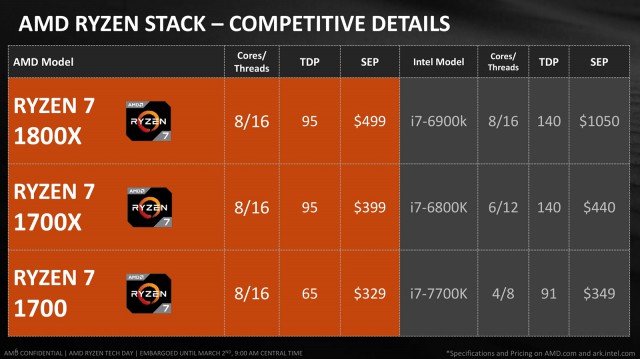
Overall, AMD identified competitors for its first processors: AMD Ryzen 7 1800X ($499) competes against Intel Core i7-6900K ($1089 – 1109), AMD Ryzen 7 1700X ($399) will try to win over buyers from Intel Core i7-6800K ($434 – 441), and AMD Ryzen 7 1700 ($349) will have to battle with Intel Core i7-7700K ($339 – 350).
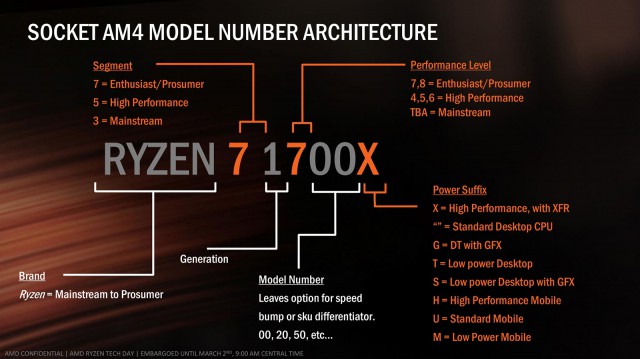
The decoding of the names of AMD Ryzen processors is quite interesting. The first digit after the brand indicates the segment: "7" – solutions for enthusiasts, "5" – high-performance, "3" – mainstream level. The next digit indicates the generation. Thus, the flagship of the next generation could be AMD Ryzen 7 2800X. Then a single digit denotes the performance level: "7" or "8" – chips for enthusiasts, "6", "5" or "4" – high-performance solutions. The mainstream level has not been announced yet, so we will learn their numbers later, but according to preliminary information, these will be "1", "2", and "3". The last two digits allow for the release of additional models that will differ slightly in performance. For example, AMD Ryzen 7 1720X and AMD Ryzen 7 1750X processors may appear, which in terms of performance and price will be between AMD Ryzen 7 1700X and Ryzen 7 1800X. The last letter indicates energy efficiency. For example, "X" denotes high-performance chips, "G" will appear in the name of desktop models with integrated graphics, "T" indicates energy-efficient desktop solutions, and "S" – energy-efficient desktop chips with integrated graphics. For mobile counterparts, suffixes "H" (high-performance), "U" (standard), and "M" (energy-efficient) are provided.
We first encountered AMD SenseMI technology during the AMD New Horizon event in December, but the presentation of the AMD Ryzen 7 series processors could not do without mentioning it. Let us remind you that it includes five components:
- Neural Net Prediction – an artificial intelligence neural network learns to predict the further path of program code based on previous runs, allowing for data optimization and optimal use of the processor's capabilities;
- Smart Prefetch – advanced algorithms study program behavior to predict their future actions and promptly prepare the necessary data;
- Pure Power – more than 100 high-precision built-in sensors provide real-time readings of voltage, temperature, and power to achieve optimal energy efficiency at any given moment;
- Precision Boost – monitors the readings of built-in sensors and instantly optimizes the clock frequency in 25 MHz increments to achieve maximum performance;
- Extended Frequency Range (XFR) – increases the dynamic frequency of Precision Boost to enhance performance if the system uses a cooler with sufficient power reserve.
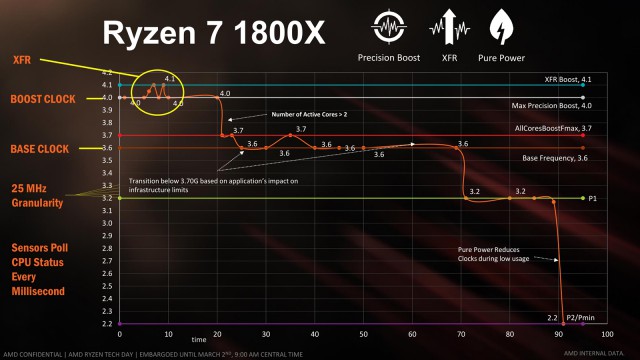
The example of the AMD Ryzen 7 1800X flagship clearly illustrates the impact of AMD SenseMI components on the dynamic change of the processor's clock frequency. Its base speed is 3.6 GHz. In dynamic mode, the frequency of all 8 cores can rise only to 3.7 GHz depending on the load level. More than 2 cores simultaneously (but not all 8) can increase their speed to 4.0 GHz thanks to Precision Boost technology – this is the declared dynamic frequency limit in the specifications of this model. And only one core can briefly increase its speed by another 100 MHz (up to 4.1 GHz) if the cooling system copes with the increased heat dissipation. This is the merit of XFR technology. In turn, the reduction of frequency to improve energy efficiency is the responsibility of Pure Power technology. Since monitoring records the processor's state every millisecond, it allows for quick frequency changes in 25 MHz increments, ensuring maximum CPU resource efficiency.
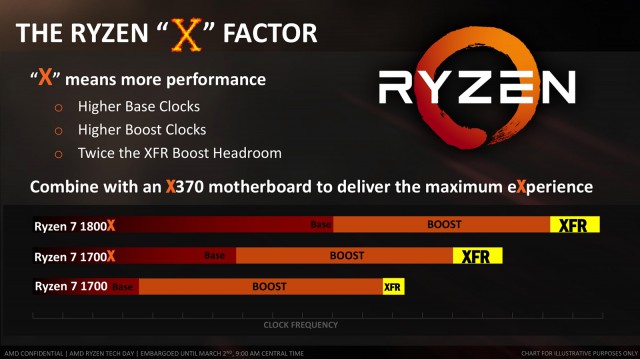
Previously, it was assumed that the presence of the "X" suffix in the processor's name indicated support for XFR technology. However, this is not the case. These models simply have a higher TDP, allowing for an increase in clock frequencies and the thermal corridor for XFR by up to 100 MHz. In turn, the AMD Ryzen 7 1700 model operates at lower speeds, and with the help of XFR, it can increase the frequency of one core by only 50 MHz above the maximum dynamic frequency. This will also be true for other representatives of the AMD Ryzen lineup.
Several slides were dedicated to the new chipsets (AMD X370, AMD B350, AMD A320, AMD X300, and AMD A300). We will discuss the functional differences between them in more detail when reviewing the corresponding motherboards. Here it is worth noting that the overclocking capability of the AMD Ryzen lineup (all processors have an unlocked multiplier) is provided by the AMD X370, AMD B350, and AMD X300 models. The first two are intended for assembling regular desktop systems, while the third is designed specifically for compact PCs (SFF – Small Form Factor).
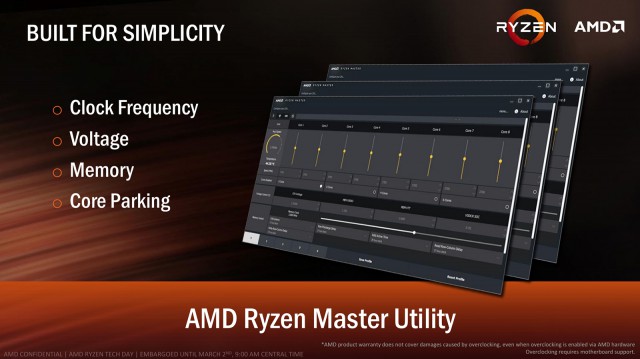
To facilitate CPU overclocking of the AMD Ryzen lineup, a special utility – AMD Ryzen Master Utility – has been created. It allows modifying the frequency of individual cores, voltage, and memory parameters. Several profiles are also provided for storing and quickly activating optimal settings.
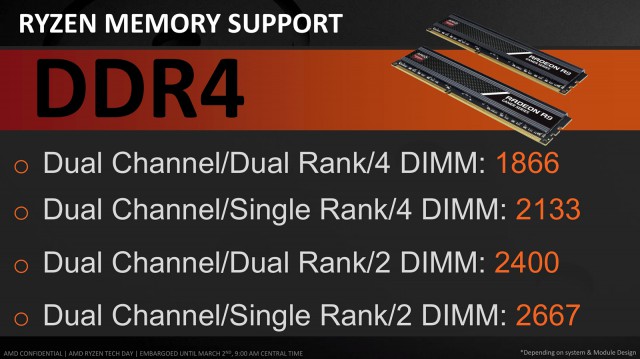
In tandem with the new processors, DDR4 standard memory can be used. When connecting four modules in dual-channel mode, their frequency should not exceed 1866 MHz for dual-rank sticks and 2133 MHz for single-rank ones. If you are only targeting two modules in dual-channel mode, their maximum frequencies can be 2400 and 2667 MHz, respectively.
Some representatives of the AMD Ryzen lineup will be available with AMD Wraith Max, AMD Wraith Spire, and AMD Wraith Stealth coolers. They are intended for processors with TDP of 65 and 95 watts and also boast more comfortable acoustic comfort (from 28 to 38 dBA). Two of them also use a new mounting mechanism.
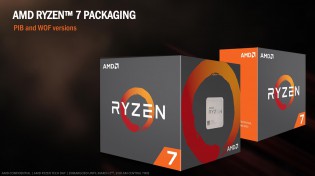
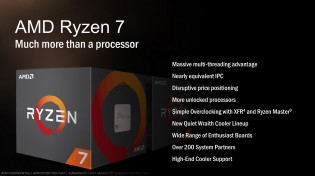
Here is what the packaging design of the new processors looks like. Larger boxes include one of the updated branded cooling systems in the supply package, while more compact versions of the packaging are supplied without it.
At the end of the presentation, AMD demonstrated comparative performance graphs of the AMD Ryzen 7 series CPUs with their competitive counterparts in synthetic and gaming benchmarks. As we can see, the novelties perform excellently in synthetic tests, showing a higher performance/price ratio.
In games, they are almost on par (with variable advantage on either side). At the same time, they are excellent for multitasking, for example, when you need to stream a demanding game in high resolution. Therefore, in terms of effective investment in building a gaming configuration, they are also ahead, according to AMD's internal tests. Let's see if we can achieve similar results with the example of the 8-core AMD Ryzen 7 1700X processor.