Today we will discuss two modifications of the Vinga nettop. It will primarily interest companies for organizing relatively inexpensive workstations for employees. Often, it is impractical to use standard systems in conventional cases for these purposes, as they not only take up a lot of space but also do not look as neat as, for example, a laptop or an all-in-one. A good option is to purchase a mini-PC for installation on the back of a monitor. This also saves space and is cheaper than buying a laptop with comparable performance. However, maximum savings can be achieved with thin clients, which are mainly relevant for large companies with their own server capacities.

Vinga Mini PC V500 is such a versatile solution. It can be used as a regular mini-PC or a thin client. It arrived for testing in two modifications - V500J4105.8240 and V500J5005.8240. They differ only in the model of the installed processor, so we will discuss the case, internal equipment, and more using only one of them as an example. We will talk about the difference in performance in the test results section.
So, the model with the index V500J4105.8240 is equipped with an Intel Celeron J4105, while the more expensive modification V500J5005.8240 comes with an Intel Pentium Silver J5005. The rest of the equipment includes 8 GB of DDR4-2400 MHz RAM and a 240 GB solid-state drive. Let's see what they are capable of in practice.
Specification
|
Model |
Vinga Mini PC V500 (V500J4105.8240) |
Vinga Mini PC V500 (V500J5005.8240) |
|
Processor |
Intel Celeron J4105 (4 / 4 x 1.5 – 2.5 GHz, 4 MB L3, TDP 10 W) |
Intel Pentium Silver J5005 (4 / 4 x 1.5 – 2.8 GHz, 4 MB L3, TDP 10 W) |
|
RAM |
8 GB DDR4-2400 MHz |
|
|
Graphics Adapter |
Intel UHD Graphics 600 (12 @ 250 – 700 MHz) |
Intel UHD Graphics 605 (18 @ 250 – 800 MHz) |
|
Disk Subsystem |
1 x SATA 6 Gbps (GOODRAM CL100, 240 GB) |
|
|
Wi-Fi / Bluetooth |
Wi-Fi 5 (802.11ac) + Bluetooth 4.0 |
|
|
Interfaces |
2 x USB 2.0 |
|
|
Audio Codec |
Realtek ALC269 |
|
|
LAN |
Realtek RTL8111F (10/100/1000 Mbps) |
|
|
Power Supply |
Output parameters: 12 V DC, 2.5 A, 30 W |
|
|
Case Dimensions |
140 x 140 x 45 mm |
|
|
Weight |
0.55 kg |
|
|
Manufacturer's Website |
||
|
Product Page |
||
Packaging and Contents

Vinga Mini PC V500 comes in a small elongated box made of dense cardboard with simple but attractive printing in dark tones. On the top side of the packaging, you can immediately see the design of the device, its name, and the Vinga company logo.

The mini-PC package contents are indicated on a small sticker on one of the sides of the box.

The package includes a set of paper documentation, an external power supply with a replaceable plug, and a VESA bracket with mounting elements.
Appearance, Element Placement

The Vinga Mini PC V500 case is almost entirely made of black matte plastic, which excellently resists fingerprints and dust. Only the ventilation grilles on the top of the case are made of gloss, so the device should retain its pristine appearance for a long time during operation.

The top panel is devoid of significant elements except for the Vinga logo. It can be easily removed for access to the hardware platform. There is a small lever on one side for opening it. The top cover is not held very tightly and has a slight play when touched, although this is not critical for a stationary device.

The bottom cover features ventilation holes, informational stickers, and four small rubber feet on the edges of the case. They improve grip with the surface when placed on a table and dampen possible vibrations if you install a 2.5-inch hard drive inside. There are also mounting holes for the included bracket.

On the top side, there is an elongated LED indicator.
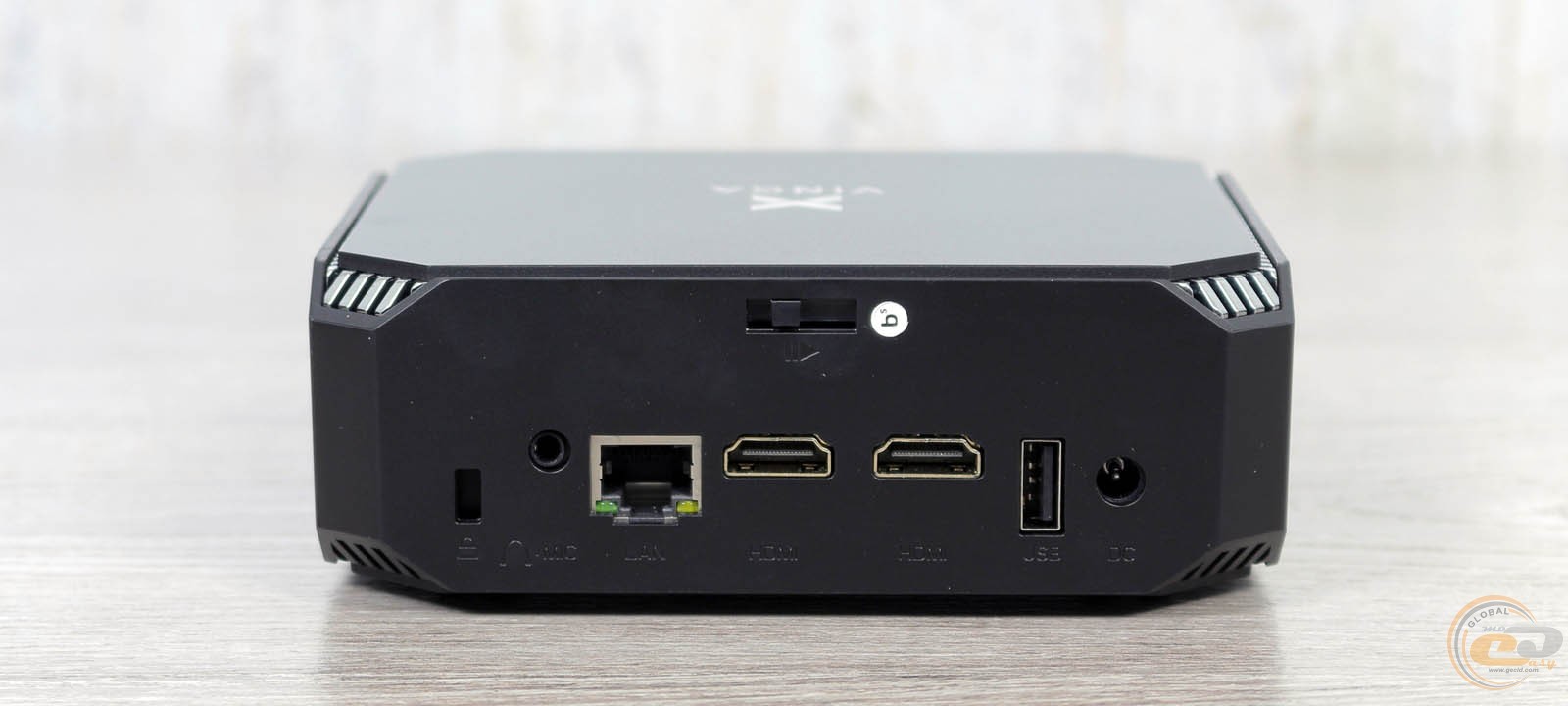
The back side greets us with the aforementioned case opening lever, Kensington lock, audio jack, RJ45 network socket, a pair of HDMI, USB 2.0 port, and power connector.

On the left side, there is a power button, a second USB 2.0 port, two USB 3.0 ports, and a microSD card reader.

The right side is completely devoid of any elements.
Internal Structure and Hardware Platform

Now let's take a look inside the Vinga Mini PC V500. Under the top cover, you will find a slot for a 2.5-inch drive, which in our case is occupied by a GOODRAM CL100 model with a capacity of 240 GB.

The sequential read and write speeds exceed 490 MB/s, which are quite standard results for a model with a SATA 6 Gbps interface.

Under the SSD, there is a DIMM slot and a connector for an M.2 drive. At the same time, the motherboard is covered with a black overlay.

To access the motherboard, you need to first remove the glossy frame with ventilation grilles around the perimeter.
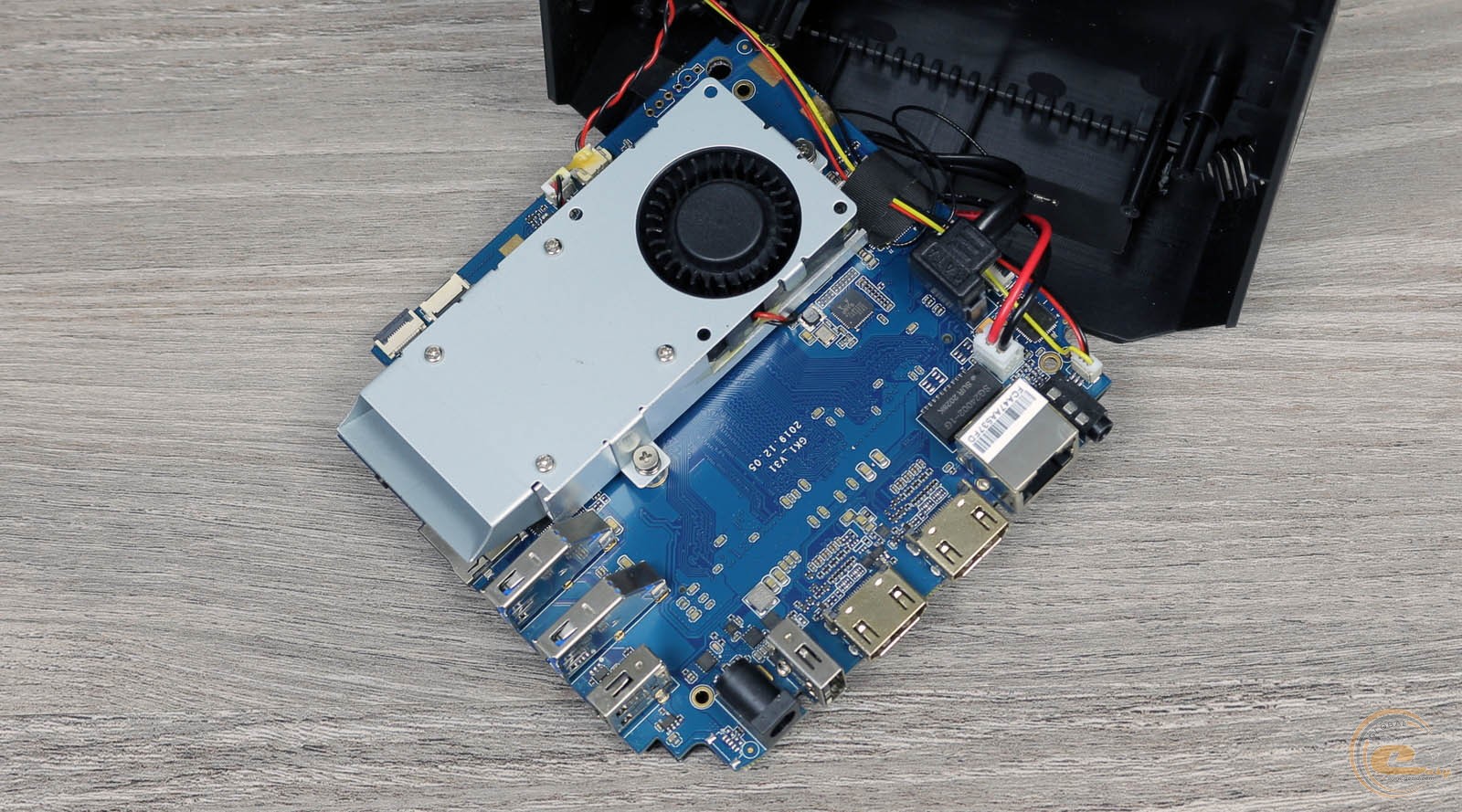
The board itself is notable only for the installed turbine-type CPU cooler in a metal case.

For network connections, a gigabit LAN controller Realtek RTL8111F is used.

The card reader operation is implemented using the Realtek RTS5170 chip.

The power management is handled by the Richtek RT5077A controller.


The Vinga Mini PC V500 (V500J4105.8240) modification is equipped with a 4-core 4-thread Intel Celeron J4105 processor. Its base frequency is 1.5 GHz, and the dynamic frequency reaches 2.5 GHz. The TDP is 10 W.
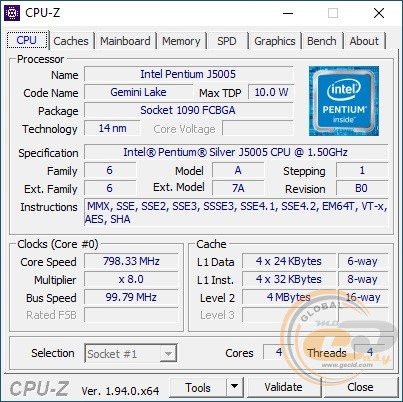

The version with the index V500J5005.8240 is equipped with a 4-core 4-thread Intel Pentium Silver J5005 with a similar base frequency and TDP, but slightly higher dynamic boost up to 2.8 GHz.

Graphics processing in the Intel Celeron J4105 is handled by the integrated Intel UHD Graphics 600 core. It includes 12 execution units with a working frequency of 250-700 MHz. Memory for the graphics subsystem is allocated from the RAM. Since it operates in single-channel mode, we get a 64-bit bus.

The modification with Intel Pentium Silver J5005 is slightly better in this regard, as it has a slightly more powerful integrated Intel UHD Graphics 605 with 18 execution units and a frequency of 250 - 800 MHz.

The RAM subsystem is implemented using a single 8 GB DDR4-2400 MHz module.
Testing
_62.jpg)
_63.jpg)
_77.jpg)
_51.jpg)
_52.jpg)
_53.jpg)
_54.jpg)
_55.jpg)
_56.jpg)
_57.jpg)
_60.jpg)
_61.jpg)
Benchmark results for Vinga Mini PC V500 (V500J4105.8240)
_76.jpg)
_65.jpg)
_66.jpg)
_67.jpg)
_68.jpg)
_69.jpg)
_70.jpg)
_71.jpg)
_72.jpg)
_73.jpg)
_74.jpg)
_75.jpg) Benchmark results for Vinga Mini PC V500 (V500J5005.8240)
Benchmark results for Vinga Mini PC V500 (V500J5005.8240)

For better clarity, instead of the usual table with results, we decided to show the performance difference between the two models using graphs.
Entry-level processors from 2017 cannot provide high performance. Intel Celeron J4105 and Intel Pentium Silver J5005 belong to the Gemini Lake family, which replaced Apollo Lake. They are based on the 14nm Intel Goldmont Plus microarchitecture. The absence of a discrete graphics card and 8 GB of RAM in single-channel mode clearly suggests using the systems as typical typewriters, communication tools, internet browsing, and multimedia playback.
Overall, the performance difference between these two versions reaches 19%. It is especially noticeable in comprehensive benchmarks like RealBench and PCMark. If you want to feel more comfortable in multitasking mode, it's better to look towards the more expensive version with Intel Pentium Silver J5005.
The integrated graphics core in Intel Pentium Silver J5005 is also slightly faster, providing a few extra FPS in undemanding games at minimal settings. However, to achieve stable 30 frames per second, it's advisable to lower the resolution.
Cooling System and Power Supply
The heat dissipation from the processor is handled by an active turbine-type cooling system. The air temperature in the test lab was 24°C at the time of measurements.
At idle, the temperature of the Intel Celeron J4105 processor and the graphics core peaked at 73°C and 60°C, respectively. Throttling was absent.
More powerful Intel Pentium Silver J5005 and its graphics core heated up to 82°C and 61°C, respectively.
During the stress test, the temperature of Intel Celeron J4105 peaked at 81°C, and the GPU at 61°C. In this mode, processor throttling also did not manifest.
As for the system with Intel Pentium Silver J5005, the CPU heated up to 84°C during testing, and the iGPU to 62°C. And in this case, there was no throttling.
Overall, the cooling system handles both processors without any issues and operates quietly even at maximum fan speed. The noise level is below average. The case heating reached 35°C for both models.
The Vinga Mini PC V500 is powered by an external 30-watt Vinga R241-1202000E power supply. The input signal parameters are 100 - 240 V at a current of 0.8 A and a frequency of 50 - 60 Hz. The output is 12 V at 2.5 A.
Power consumption of the mini-PC with Intel Celeron J4105 under different load types:
|
Load |
Power, W |
|
AIDA64 Stress FPU |
18 |
|
AIDA64 Stress GPU |
15 |
|
AIDA64 Stress FPU+ GPU |
16 |
|
Idle* |
8 |
Power consumption of the mini-PC with Intel Pentium Silver J5005 under different load types:
|
Load |
Power, W |
|
AIDA64 Stress FPU |
17 |
|
AIDA64 Stress GPU |
14 |
|
AIDA64 Stress FPU+ GPU |
16 |
|
Idle* |
8 |
The results are practically identical, and the difference can be attributed to measurement error. Overall, in terms of performance per watt, the system with Intel Pentium Silver J5005 looks more preferable.
Conclusion
The nettop Vinga Mini PC V500 in modifications V500J4105.8240 and V500J5005.8240 is an interesting option for several usage scenarios. It is well-suited for offices, business sectors, homes, and educational institutions. It can also be used as a thin client when the PC operates in terminal mode, and all computational load falls on the server.
The main advantages of the Vinga Mini PC V500 include the ability to install two drives, compact dimensions, pleasant design, quick access to the hardware platform, a decent set of ports, support for wireless interfaces, and an efficient cooling system that won't bother you with excessive noise levels. Moreover, it comes pre-installed with a 240 GB SSD and 8 GB of RAM. All that's left is to install the operating system and start working.
Among the drawbacks, we highlight the single slot for RAM and the low overall performance of the processors. Overall, the Vinga Mini PC V500 turned out to be an interesting compact system for solving simple everyday tasks. If you need something more powerful, then pay attention to the Vinga Mini PC V650 with Intel Core U series processors and 32 GB of RAM. However, such a nettop is more expensive.
Advantages:
- energy-efficient Intel Celeron J4105 and Intel Pentium Silver J5005 processors;
- strict design;
- compact dimensions;
- possibility of installing two drives;
- VESA mount included;
- good set of external interfaces;
- ability to work as a thin client;
- efficient and quiet cooling system;
- support for wireless interfaces Wi-Fi 5 and Bluetooth 4.0.
Features:
- basic level of performance;
- only one slot for RAM.
Author: Kostyantyn Shorokhov
Translation: Liliya Masyuk
Link to the review on gecid.com