In recent years, the most enduring trend in the computer components market has been lighting. Virtually any modern system components (motherboards, graphics cards, cooling systems, RAM modules, SSDs, and even power supplies (apparently, only hard drives do not follow this trend)) glow and flash in all the colors of the rainbow. Naturally, to admire these colors, you will need a case with a transparent viewing window or one made entirely of tempered glass, like the recently tested models Vinga Limpid and Vinga Polaris. True, such solutions cannot be called budget-friendly, but Vinga's range includes more affordable options. Such is today's guest in our test lab – Vinga Graphyte.
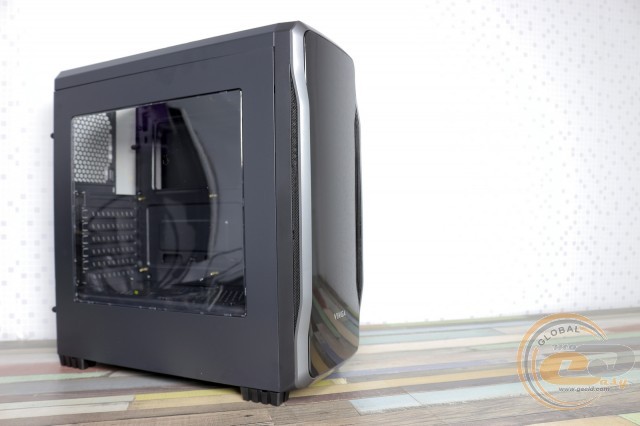
The cost of the novelty is at the level of $33. The user receives a not the largest, but capacious mid-tower with an inset acrylic window. A potentially interesting option for building a budget gaming machine. Let's take a closer look at this chassis.
Specification
|
Model |
Vinga Graphyte |
||
|
Case size |
Middle Tower |
||
|
Supported motherboard form factors |
ATX / microATX / Mini-ITX |
||
|
Color |
Black |
||
|
Bays |
External |
None |
|
|
Internal |
2 x 3.5” 2 x 2.5” |
||
|
Expansion slots |
7 |
||
|
Maximum graphics card length |
378 mm |
||
|
Maximum CPU cooler height |
160 mm |
||
|
Maximum PSU length (non-modular) |
150 mm (175 mm) |
||
|
Cable management space width (non-modular) |
40 mm (15 mm) |
||
|
Ports |
2 x USB 2.0 1 x USB 3.0 2 x audio ports |
||
|
Fan installation capability |
Front panel |
2 x 120-mm |
|
|
Rear panel |
1 x 120-mm |
||
|
Top panel |
1 x 120-mm |
||
|
Internal partition |
2 x 120-mm |
||
|
Liquid cooling installation capability |
Front panel |
120 mm / 240 mm |
|
|
Rear panel |
120 mm |
||
|
Top panel |
120 mm |
||
|
Power supply |
None |
||
|
Materials |
Front panel and side window |
Plastic |
|
|
Chassis |
Steel thickness 0.58 mm |
||
|
Side panels |
Steel thickness 0.56 mm |
||
|
Case dimensions (in brackets – own measurements) |
410 x 180 x 385 mm (449 x 190 x 440 mm) |
||
|
Weight (in brackets – own measurements) |
3.9 kg (3.72 kg) |
||
|
Manufacturer's website |
|||
Packaging and supply kit
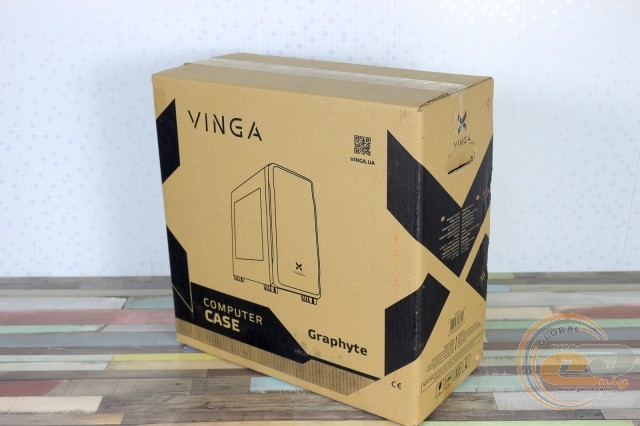
The Vinga Graphyte case is packed in a traditional box made of natural cardboard with a monochrome print. On its sides, you can find not only the model name but also the product specification in English and Ukrainian. For ease of transportation, there are cutouts on the sides.
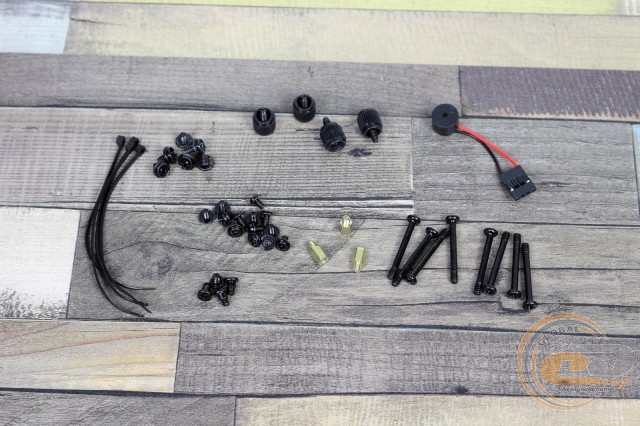
The supply kit includes a decent set of accessories for assembling a computer: a set of standoffs and screws for mounting the motherboard, power supply, fans, drives, and even liquid cooling radiators. In addition, there are several disposable cable ties and a system speaker.
Appearance
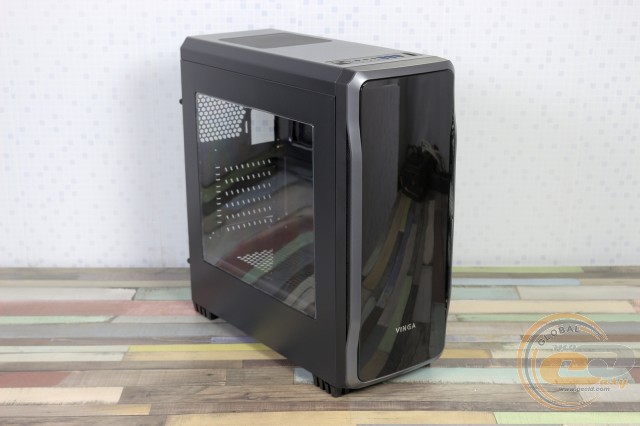
The design of the Vinga Graphyte is quite restrained. Completely graphite-black, with a transparent window on the left side. However, certain elements in the form of slanted sides and a semi-transparent facade with mesh inserts give it an interesting appearance. The chassis is made of 0.58 mm thick steel sheets and complemented with plastic parts.
The central part of the front panel is covered with tinted acrylic featuring the Vinga brand logo at the bottom and a silver plastic border around the contour. It allows you to admire the lighting of the fans, if installed. The surfaces are quite practical, as fingerprints are barely noticeable on them, and those that accumulate are easily removed with handy tools. The edges have inserts with fine mesh, designed to ensure the intake of fresh air into the system.
The panel is attached with a series of conventional latches. After its removal, a view of the chassis and mounting locations for two 120-mm fans opens up. It is also visible that the developer initially provided the possibility of installing external devices, but in this case, it will not be possible to use them due to the features of the facade. We dare to assume that most of our readers have long since stopped using optical drives, and this fact will not upset them much.
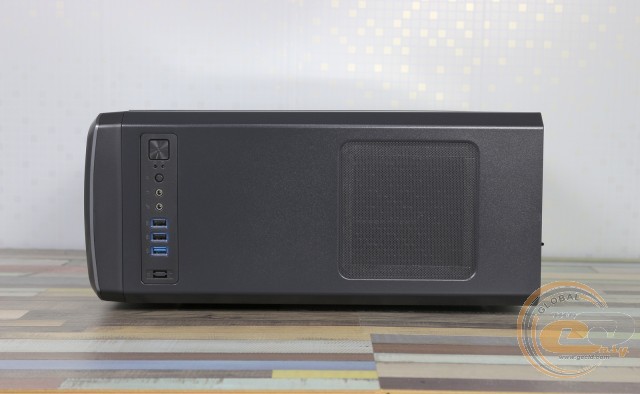
The top panel of the Vinga Graphyte is made of steel. Closer to its rear part are grilles with a mounting location for a 120-mm fan or a liquid cooling radiator, covered with a magnetic metal mesh filter to reduce the speed of dust accumulation inside the PC. The external ports and buttons found their place on the opposite side. The set of elements is quite typical for this segment: a pair of USB 2.0 ports, one USB 3.0, and two 3.5-mm jacks for a microphone and headphones. Next to them are the power and reset buttons, as well as a pair of LED indicators.
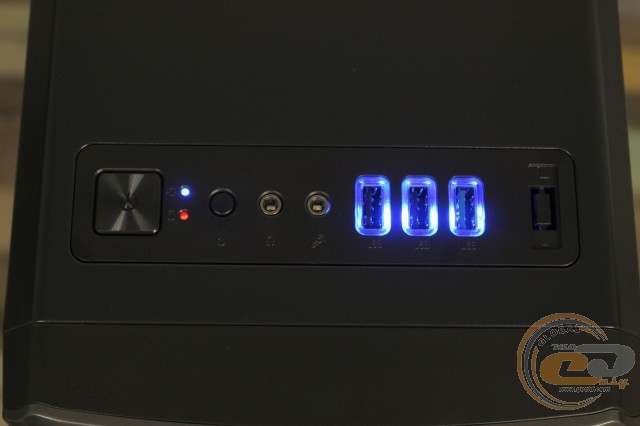
By the way, the USB ports have backlighting around the contour, which will be useful in the dark. It is worth mentioning the unused space for a two-position fan controller, which is found in more expensive solutions, such as in Vinga Volcano.
The back is standard for a configuration with a bottom-mounted power supply. At the top is a cutout for the motherboard's interface panel and a mounting location for a 120-mm exhaust fan. Below them are seven expansion slot covers with a mounting bracket that covers the usual screw mounts.
At the bottom of the case is a ventilation hole with a dust filter, designed to provide cold air access to the PSU. The filter is easily removable, blowable, and washable. There are two pairs of 17 mm high plastic feet with thin rubber pads, which provide good stability on different types of surfaces and sufficient airflow for the power supply.
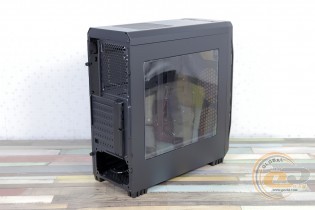
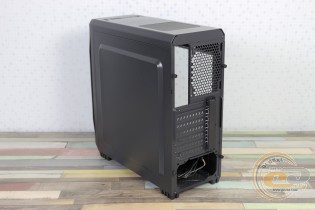
The side panels are attached using screws with shaped heads, which are very convenient to use. As mentioned earlier, the left panel is equipped with a transparent acrylic window, while the right is a solid sheet of metal. Both have stiffening ribs. At the same time, the right side door has embossing that can be used as additional space for cable management. All this makes the panels quite sturdy for a budget model.
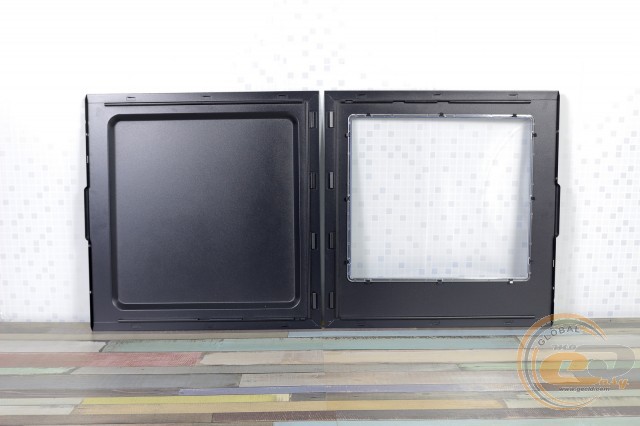
The process of their removal is easy and effortless: just unscrew the screws, slide the panels back, and then pull them towards you.
Internal Structure
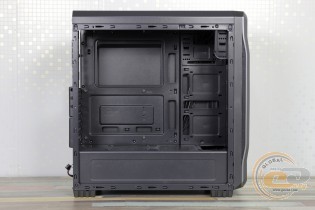
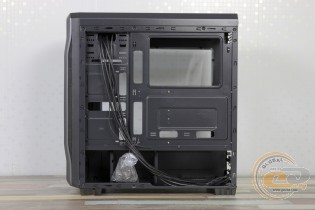
The design of the Vinga Graphyte case uses a dual-chamber design that has become common recently. At the bottom, under the steel cover, is the power supply and drive cage. The motherboard compartment is located at the top. There are no racks in the front part, allowing for the installation of large components and improving the system's ventilation due to the free circulation of air flows. The motherboard tray has a cutout that allows for the installation of CPU cooling systems with a backplate without removing the board itself. There are several holes for cable management without silicone grommets but with tabs to secure the cables.
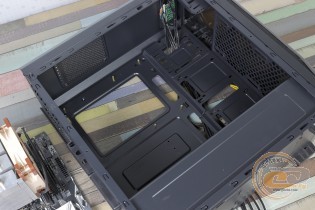
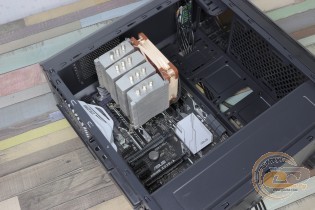
The motherboard is mounted on standard bronze standoffs that the manufacturer pre-installed according to the ATX specification. Smaller solutions in the microATX and Mini-ITX formats will also fit here.
The power supply mounting location is not equipped with anti-vibration pads, and the mounting is done with included screws, with a set featuring a knurled head. According to our measurements, the maximum PSU length is 150 / 175 mm (modular / non-modular), leaving about 40 / 15 mm for cable management. Therefore, our 160-mm test bench Seasonic X-560 Gold with a modular cable design did not fit, and its place was taken by the non-modular 150-mm GIGABYTE GP-P650B.
The Vinga Graphyte provides a total of four mounting locations for SSDs and HDDs: two 3.5-inch in the transverse cage at the bottom of the case (without damping rubber, screw mounting) and a pair of 2.5-inch in the front of the motherboard tray or behind it (screw fixation).
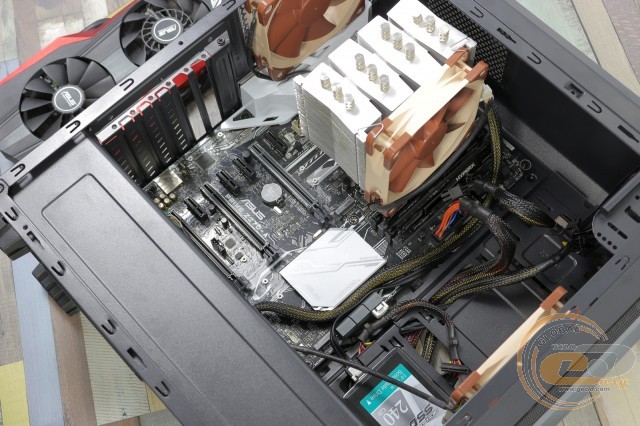
The width of the case allows for the easy installation of CPU coolers up to 160 mm in height. In our case, it was easy to accommodate the 158-mm cooler Scythe Mugen 3.
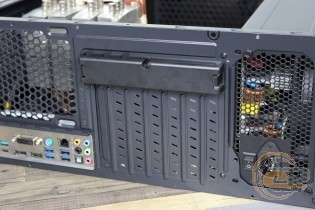
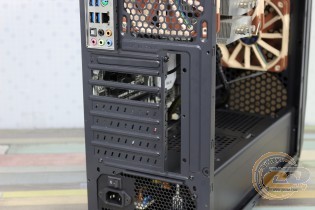
There are seven expansion slot covers: the first is reusable, while the rest will have to be broken out. A plastic block is provided as a mount, which is secured with one screw from the back of the case. If desired, you can opt out of it in favor of regular screws.
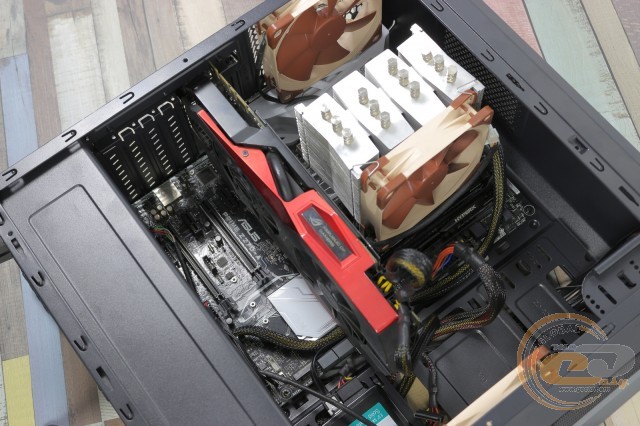
According to our measurements, the case can easily accommodate graphics cards up to 378 mm in length (without a fan or liquid cooling radiator on the front wall). In our case, after installing the standard ASUS ROG Matrix Platinum GTX 980 with a length of 309 mm, there was plenty of free space left.
On the front wall of the Vinga Graphyte, you can install two 120-mm fans. Instead of them, a liquid cooling radiator up to 240 mm in length can be easily placed. There are locations for one 120-mm fan or a similarly sized liquid cooling radiator on the ceiling and the rear wall. On the partition of the unchanged cover, there are grilles where two more 120-mm fans can be installed.
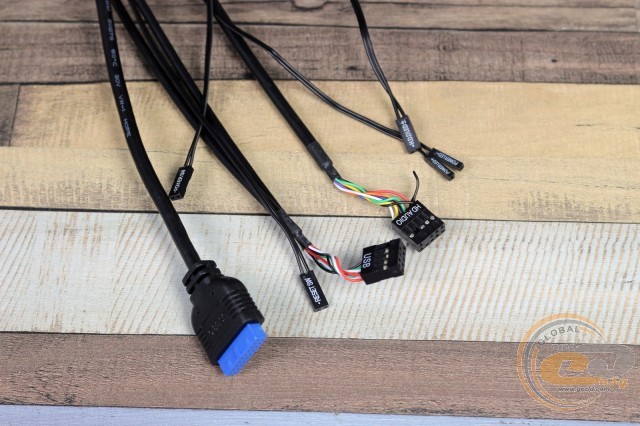
The set of wires for connecting the front panel includes an HD Audio connector (wire length is 65 cm), connectors for connecting buttons and LED indicators (60 cm), as well as cables for connecting a pair of USB 2.0 ports (65 cm long) and one USB 3.0 (70 cm).
Assembling the system inside the Vinga Graphyte should not cause any difficulties. It is worth noting only the necessity of installing the hard drive as the first component if it is planned, because after mounting the PSU, it will be difficult to screw in the screws that hold the drive. In all other respects, there are no remarks. Fans with lighting are just asking to be installed on the front panel, but we didn't have any on hand.
The case itself feels quite solid: the edges are well rolled (even if you want to injure yourself, it is unlikely to happen), there are no distortions or gaps, and the threading is well cut everywhere.
Testing
|
Processor |
Intel Core i7-7700K (Socket LGA1151, 4.2 GHz, L3 8 MB) |
|
Cooler |
Scythe Mugen 3 |
|
Motherboard |
ASUS PRIME Z270-A (ATX, Socket LGA1151) |
|
RAM |
2 x 4 GB DDR4-2400 HyperX Fury (HX424C15FBK2/16) |
|
Video Card |
ASUS GeForce GTX 980 MATRIX PLATINUM 4GB GDDR5 |
|
SSD |
SSD KINGMAX SME35 HYPERLINK |
|
Power Supply |
GIGABYTE GP-P650B |
|
Thermal Paste |
Noctua NT-H1 |
Before reviewing the test results, it is worth noting that a couple of Noctua NF-F12 PWM fans were installed inside the Vinga Graphyte for intake and exhaust (1500 RPM) so that all systems were under equal conditions. As practice shows, using a modern powerful PC without good circulation inside the case can be considered a mistake.
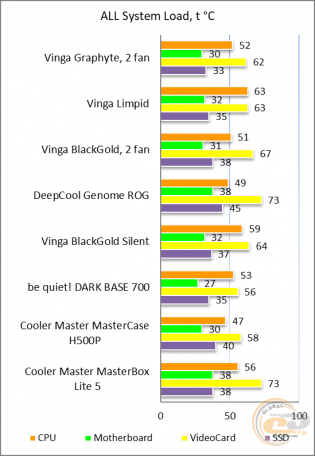
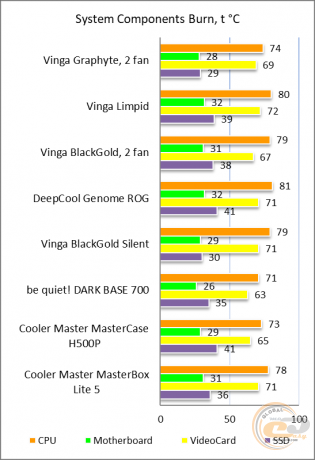
The "All System Load" chart shows the heating of components after 30 minutes of 3DMark Fire Strike in Ultra mode (4K resolution). The "System Component Burn" mode demonstrates temperatures under load with AIDA64 (Stress CPU and FPU) and MSI Kombustor applications for 15 minutes.
Equipped with two fans, the Vinga Graphyte case shows good results: all system components do not overheat, work stably and quietly under any type of load. Incidentally, the novelty surpasses its slightly more expensive counterpart, the Vinga BlackGold, and slightly lags behind renowned rivals, while in some aspects it even looks better.
Conclusions
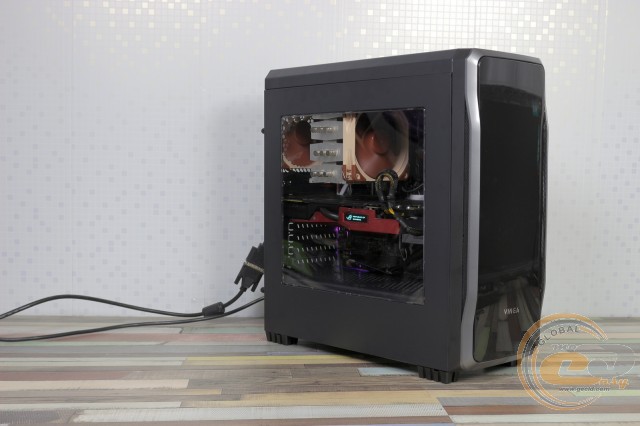
Vinga Graphyte is an example that budget does not mean disadvantage. At an approximate price of $33, the case is quite an attractive option for building a basic or mid-range gaming computer. Its advantages include a pleasant appearance with transparent and semi-transparent inserts, allowing you to show off the system to everyone around. It is also worth mentioning the two-section design with sufficient capacity for modern components and proper cable management capabilities. Thanks to this, the finished machine looks quite neat. Yes, we have an inexpensive solution made from not the thickest metal, but in practice, there is no feeling of fragility or outright cheapness – everything is within the norm.
The design allows for a well-ventilated configuration with a water cooling system. Of course, it should be noted that fans are not included. But this is even better, as many users may already have the necessary fans or simply do not want to overpay for unnecessary ones – everyone can choose the appropriate model at their discretion.
In conclusion, Vinga Graphyte will definitely find its fans among budget-conscious gamers or beginner modding enthusiasts.
Advantages:
- pleasant design;
- presence of transparent and semi-transparent panels;
- good build quality of the chassis, edge processing of panels, and case painting;
- good structural rigidity;
- two-section design;
- possibility to install video cards up to 378 mm long and CPU coolers up to 160 mm high;
- possibility to install up to six additional fans or a water cooling radiator up to 240 mm long;
- decent cable management capabilities;
- adequate temperature and noise indicators;
- affordable price.
Features:
- possibility of simultaneous installation of up to two 3.5-inch and 2.5-inch drives;
- complete absence of external bays on the front panel.
Author: Victor Yefimenko
Translation: Yuriy Koval
We express our gratitude to BRAIN Computers, the official representative of Vinga, for providing the case for testing.
We express our gratitude to ASUS, Intel, Noctua, Sea Sonic Electronics and the brand HyperX for providing the equipment for the test bench.