Perhaps the main advantage of factory All-In-One type water cooling systems is the ease of installation and the lack of maintenance required, except for periodic cleaning of the radiator from dust. Simply put, you install it once and enjoy. Thanks to this, such solutions are very popular among users, and many manufacturers have introduced their variations on this theme. Trying to keep up with trends and not lag behind other brands, Vinga offers two models of AIO on the domestic market - Vinga Sea and Vinga Typhoon with 120mm and 280mm radiators, respectively.
Our laboratory received the younger model priced at 1572 UAH ($57). Let's see what it is capable of and how it compares to competitors. As usual, we will start our review with a detailed examination of the device's specifications.
Specification
|
Model |
Vinga Sea |
|
Supported CPU Sockets |
AMD Socket AM2 / AM2+ / AM3 / AM3+ / AM4 / FM1 / FM2 / FM2+ Intel Socket LGA1156 / LGA1155 / LGA1150 / LGA1151 / LGA1366 / LGA2011 / LGA2011-v3 |
|
Declared CPU TDP, W |
150 (Intel) / 140 (AMD) |
|
Base Material |
Copper |
|
Thermal Interface |
Thermal paste in syringe (1 g) |
|
Radiator |
|
|
Material |
Aluminum |
|
Dimensions, mm |
120 x 154 x 27 |
|
Water Block |
|
|
Power Voltage, V |
12 |
|
Current Consumption, A |
0.25 ± 10% |
|
Power, W |
3 |
|
Pump Speed, RPM |
2200 ± 10% |
|
Power Connector |
3-pin |
|
Dimensions, mm |
84 x 78 x 40 mm |
|
Fan |
|
|
Number of Fans |
1 |
|
Bearing Type |
Hydrodynamic |
|
MTBF, hours |
50,000 |
|
Fan Power Voltage, V |
up to 12 |
|
Current Consumption, A |
0.26 |
|
Power Consumption, W |
3.12 |
|
Rotation Speed, RPM |
900 – 1600 ± 10% |
|
Noise Level, dBA |
17.8 – 34.1 |
|
Max Airflow, m3/h (CFM) |
90.7 (53.4) |
|
Static Pressure, mm H2O |
4.08 |
|
Power Connector |
4-pin |
|
Fan Dimensions, mm |
120 x 120 x 25 |
|
Warranty, months |
12 |
|
Manufacturer's Website |
|
Packaging and Supply Kit
The water cooling system is packed in a relatively small cardboard box with monochrome design. On its sides, you can find not only the model name but also a schematic image of the device and its detailed specifications.
Inside, the cooler is packed in a sturdy tray made of porous cardboard, and some of its parts and all accompanying accessories are wrapped in individual bags.
The Vinga Sea package includes a universal reinforcement plate, two pairs of water block mounts, sets of stands, screws, washers, nuts, studs, and bushings, a syringe of gray thermal paste without identifying marks (1 g), and a step-by-step assembly and installation guide for the cooler.
Appearance and Design
Vinga Sea is a maintenance-free water cooling system with a standard design, where the radiator with a fan is connected by flexible hoses to the water block. At the same time, the compact AIO stands out with a modest weight of 795 g, which is on par with many mid-priced tower coolers.
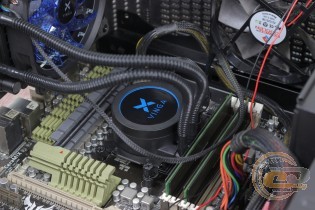
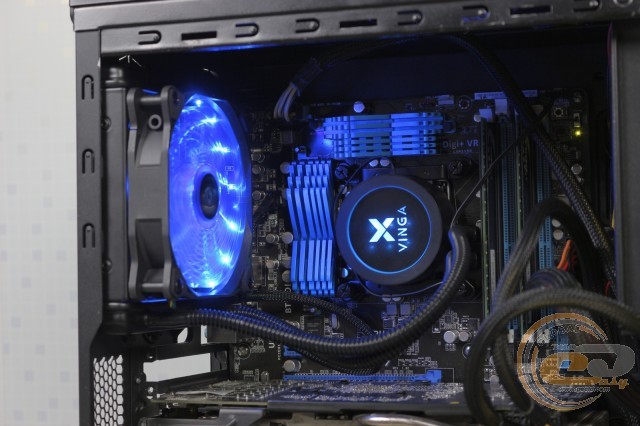
The pump assembly with the water block consists of a plastic housing and a metal base. Its dimensions (84 x 78 x 40 mm) allow for compatibility with massive RAM modules and power subsystem heatsinks of motherboards. The glossy pump cover features the Vinga logo with a calm blue backlight.
A 34-cm 3-pin cable without braiding is used for connection. According to monitoring, the pump rotor speed is 2300 RPM at 12 V, and power consumption does not exceed 3 W. Unfortunately, the operating time of this mechanism, as well as its performance, is not specified.
Two angled fittings on the pump side have a swivel design, which simplifies hose routing inside the case after installing the water block on the processor. At the same time, the corrugated plastic hoses without additional braiding do not kink inside the system unit. Their length is quite standard for "factory water coolers" at 330 mm.
The base of the pump features a copper water block without nickel plating. The 60 x 50 mm soleplate is secured with ten Torx screws and covered with a protective film. It is quite flat and marked with fine traces of rough grinding.
Let's take a closer look at the Vinga Sea cooling system radiator: the dissipating part is made of aluminum, and the mounting frame is steel. Its actual dimensions are 119 x 154 x 28 mm. The design features 14 longitudinal channels for coolant circulation, between which numerous ribbon-type fins are soldered: the partition thickness is 0.35 mm, and the distance between the plates averages 1.2 mm. The fin density (FPI) is 18 per inch. Everything is painted black.
The steel heat exchanger frame has mounting locations for a single 120-mm fan on both sides.
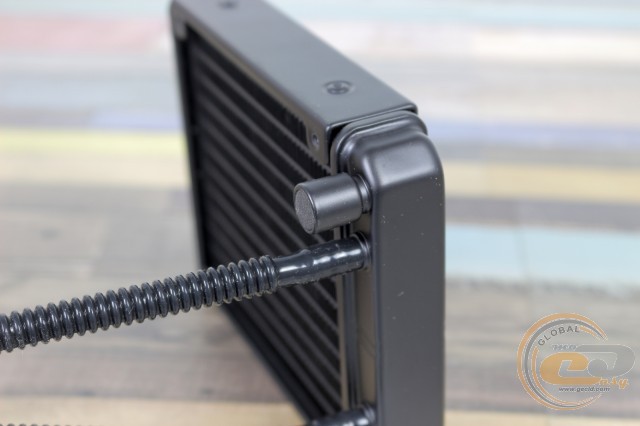
The radiator, like the pump, is equipped with non-removable fittings onto which the hoses are pressed. The filling place is sealed tightly.
The only included 120-mm fan has a four-pin power connection and supports PWM speed control. The braided cord is 44 cm long. According to monitoring, its speed range is 870 – 1630 RPM. At the same time, the maximum airflow is stated at 53.4 CFM (90.7 m3/h), static pressure is 4.08 mm H2O, and noise level should not exceed 34.1 dBA. The nominal voltage is 12 V, and the current consumption is 0.26 A. Thus, the maximum power consumption reaches 3.12 W. A hydrodynamic bearing with a claimed lifespan of 50,000 hours or almost 6 years of continuous operation is used. The impeller consists of nine transparent aerodynamic blades designed to reduce turbulence and, consequently, noise levels. Blue lighting is available.
The fan is mounted to the radiator using long included screws with a crosshead, and anti-vibration inserts are provided at the corners on both sides.
Installation Process
The Vinga Sea cooling system can be installed on any motherboard with a compatible AMD or Intel processor socket: Socket AM2 / AM2+ / AM3 / AM3+ / AM4 / FM1 / FM2 / FM2+ and Socket LGA1156 / LGA1155 / LGA1150 / LGA1151 / LGA1366 / LGA2011 / LGA2011-v3 respectively. Note that the list does not include HEDT platforms AMD Socket TR4 and Intel Socket LGA2066. The procedure itself is detailed in the included user guide and should not cause any problems. We will demonstrate this action using the example of traditional AMD Socket AM3+ and Intel Socket LGA1155 test platforms.
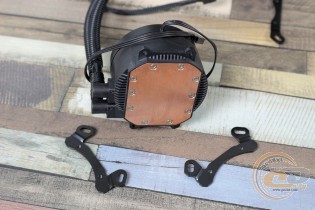
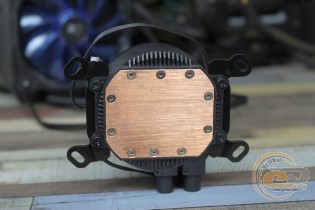
In the first case, you need to select the appropriate water block mount. Next, place both metal plates on the sides of the base and secure each with two screws.
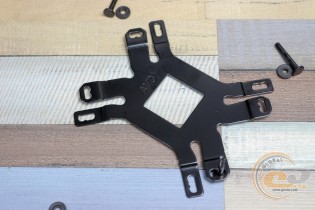
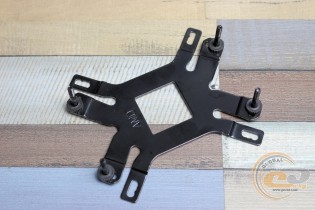
Then take the metal reinforcement plate, turn it towards you with the AMD inscription side, and install the studs in the required holes with fixation, and then thread plastic washers on top.
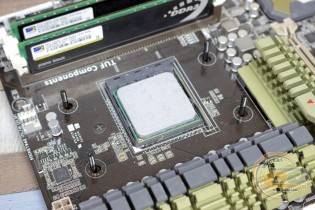
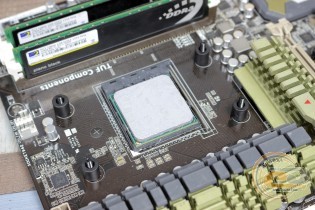
Now mount the resulting structure onto the motherboard. From the front side, thread plastic bushings.
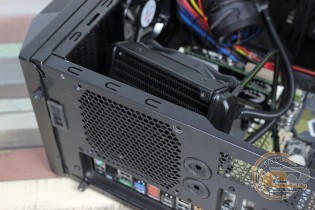
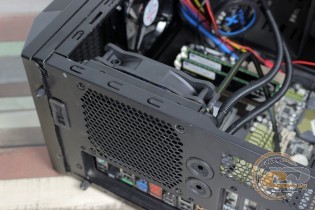
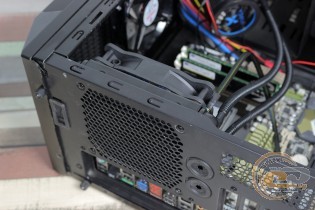
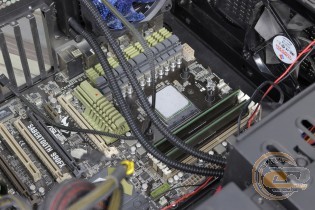
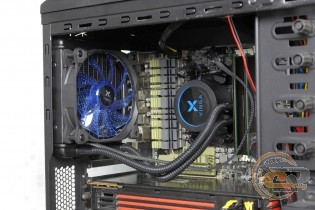
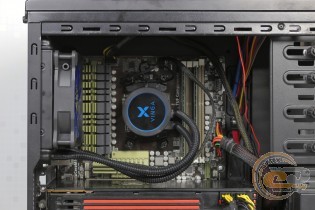
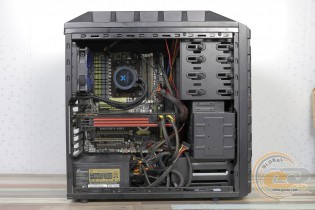
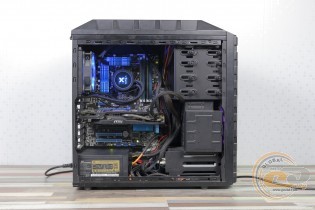
Before installing the water block on the CPU, it is advisable to secure the AIO radiator in the PC case and check if the hose length is sufficient. In our case, the Vinga Sea was easily placed along with the fan on the rear wall of the Enermax Hoplite ECA 3220 case and oriented to exhaust air from the system. For this, we used the screws from the package.
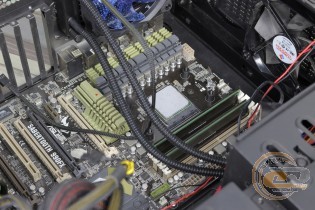
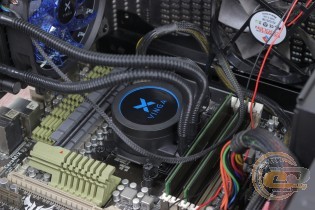
Next, apply a thin layer of thermal paste to the processor lid and place the water block on top, not forgetting to remove the protective film from the base. Then alternately tighten the knurled head nuts crosswise. For a more secure fit, you can use a screwdriver, but be careful not to overdo it.
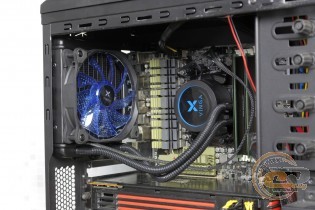
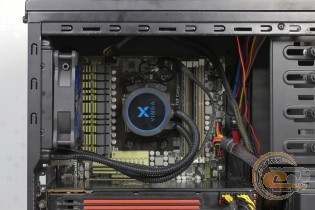
The final step is connecting the fan and pump to the appropriate connectors on the motherboard.
In the case of a platform based on an Intel processor, a similar algorithm is used, but you will need to flip the reinforcement plate mirror-wise and use a different set of water block mounting. You can also change the sequence of operations.
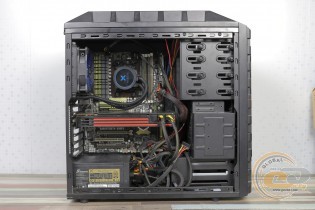
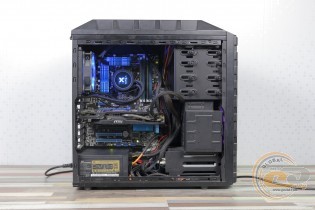
The universal black color and soft blue lighting of Vinga Sea allow the cooler to harmoniously fit into any system and become its decoration.
Testing
The following equipment was used to test the water cooling system:
|
Processors |
AMD Phenom II X6 1100T @ 4.0 GHz, 1.4 V (Socket AM3+, 3.3 GHz, L3 6 MB) Intel Core i5-2500K @ 4.5 GHz, 1.44 V (Socket LGA1155, 3.3 GHz, L3 6 MB) |
|
Motherboards |
ASUS SABERTOOTH 990FX (AMD 990FX, Socket AM3+, DDR3, ATX) ASUS P8P67 (Intel P67, Socket LGA1155, DDR3, ATX) |
|
RAM |
2 x 1024 MB DDR3-1333 TwinMOS 9DRTBKZ8-TATP |
|
Graphics Card |
AMD Radeon HD 6950 (2 GB GDDR5) |
|
Hard Drive |
Samsung HD080HJ (80 GB, 7200 RPM, 8 MB, SATA 3 Gbit/s) |
|
Power Supply |
Seasonic X-760 (SS-760KM), 120mm fan |
|
Case |
be quiet! Dark Base Pro 900, (2 x 140mm and 1 x 120mm fans) |
|
Thermal Paste |
akasa AK-460 pro-grade (3.3 W/m·K, -45…+200°C) |
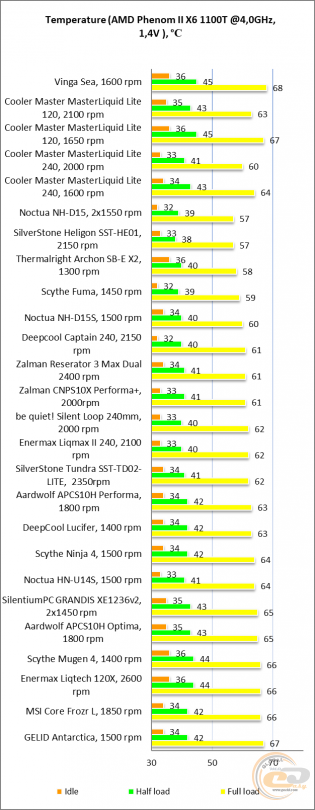
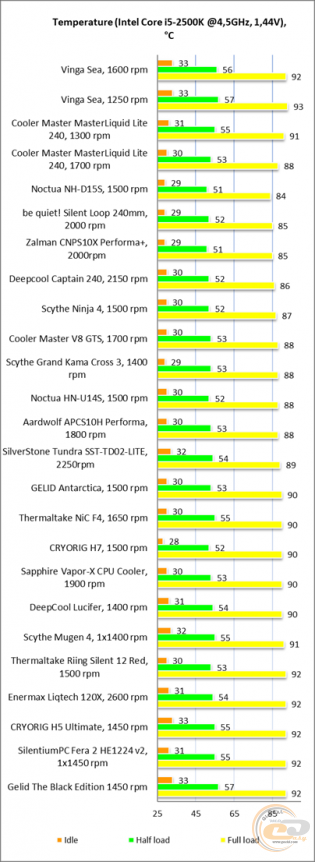
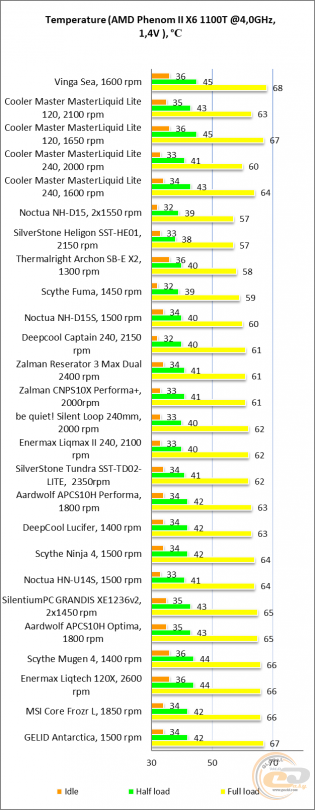
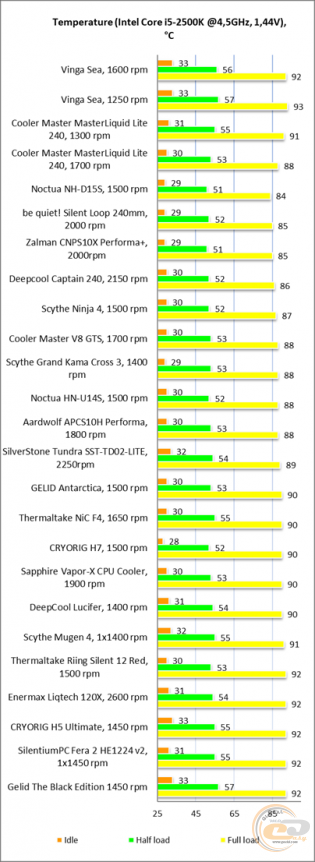
Despite its compact size, Vinga Sea handles heat dissipation from overclocked multi-core processors up to 4 - 4.5GHz. In terms of efficiency, it is quite comparable to tower coolers like GELID Antarctica or MSI Core Frozr L, as well as AIOs like Enermax Liqtech 120X and Cooler Master MASTERLIQUID LITE 120. Cooler Master's creation takes the lead solely due to a faster stock fan.
Remember that the full load mode implies maximum utilization of all processor cores. Therefore, in real conditions where the load is variable (for example, in games), you can safely expect lower temperature readings.
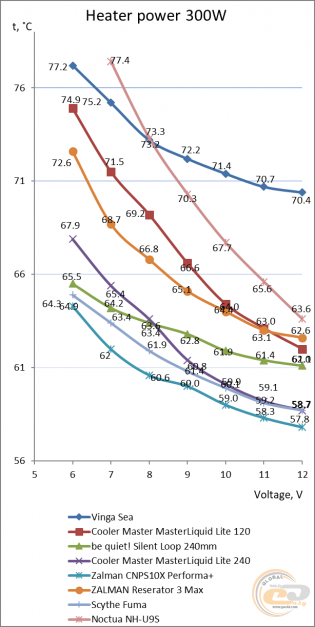
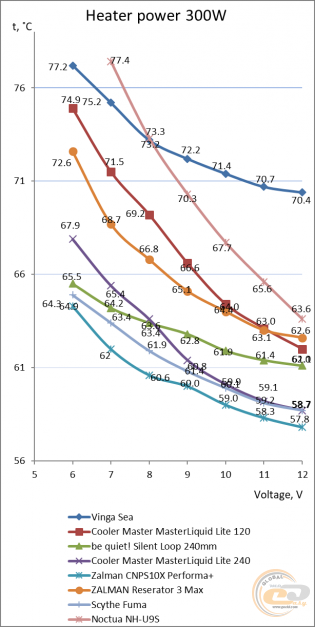
Testing the Vinga Sea on a 300W heating stand shows a near-linear dependency, which is due to the small heat dissipation area of the radiator. Therefore, using the fan even at a low speed will effectively dissipate heat from the processor.
|
Supply Voltage, V |
Blade Rotation Speed, RPM |
Noise Level |
|
5 |
870 |
Silent |
|
6 |
1040 |
Silent |
|
7 |
1170 |
Almost silent |
|
8 |
1280 |
Very quiet |
|
9 |
1390 |
Quiet |
|
10 |
1480 |
Quiet |
|
11 |
1560 |
Below average, slightly noticeable |
|
12 |
1630 |
Below average |
It is also worth noting that despite the constant operation of the pump at 12 V, it remains almost silent in operation. This means that even in a quiet environment, it does not distract from what is happening on the screen. The same applies to the noise level of the fan, which remains quite comfortable for continuous use even at maximum speed. To achieve near-complete silence, it is enough to stay in the range of 1390-1560 RPM, without sacrificing maximum overclocking.
Conclusions
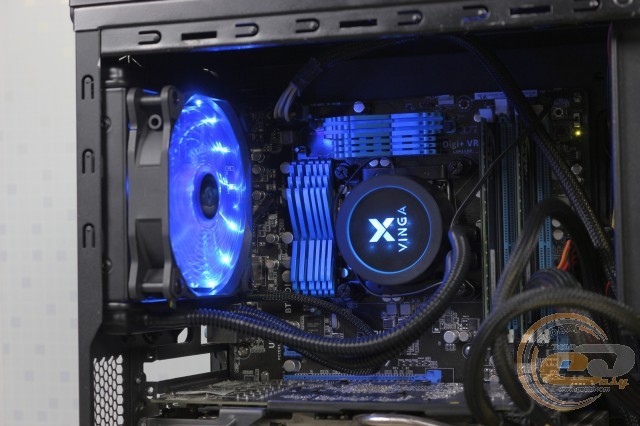
Our introduction to the Vinga Sea maintenance-free water cooling system has come to an end. To begin with, it is worth saying that the "first pancake" turned out far from lumpy. Consider this: at a price of 1572 грн ($57) − it is one of the most affordable water cooling systems on our market at the moment. At the same time, it offers compact dimensions, an attractive appearance with blue lighting, high build quality and durable components, a quiet and fairly efficient stock fan with wide-range PWM control, as well as good compatibility with popular platforms and ease of installation.
Yes, in terms of efficiency, the "Sea" lags behind air bestsellers with 120mm fans, but it can compete on equal terms with more expensive single-section water coolers from renowned manufacturers. In practice, the cooler will handle well-overclocked mainstream 4-6 core processors from AMD and Intel, with a very quiet acoustic background. And thanks to its modest size and weight, it offers excellent compatibility with most standard cases, including even some HTPCs that have at least one mounting spot for a 120mm fan.
Simply put, if the task is to provide adequate cooling in limited space conditions or you just want to decorate your system and at the same time try an inexpensive "water" solution, Vinga Sea looks like a good purchase.
Advantages:
- pleasant appearance;
- good efficiency even at reduced operating speeds;
- compatibility with most current and some outdated platforms;
- use of a quality fan with a wide range of operating speeds and blue lighting;
- good compatibility with large components in the system;
- ease of installation;
- affordable price.
Features:
- the cooler is not compatible with AMD Socket TR4 and Intel Socket LGA2066 HEDT platforms.
Author: Viktor Yefimenko
Translation: Yuriy Koval
We express our gratitude to AMD, ASUS, Enermax, Noctua, Sea Sonic Electronics, and TwinMOS Technologies for providing the equipment for the test bench.