Have you become acquainted with the 500-watt PSU Vinga VPS-500B priced around $50? If the answer is affirmative, then you already know a lot about its 600-watt counterpart Vinga VPS-600B.
Before us is a similarly affordable solution (which is $5-6 more expensive) with an 80 PLUS Bronze certificate and the ability to operate in networks with a voltage from 115 to 230 V. We also have a solid list of protections (OPP, OVP, UVP, SCP, SIP), a single powerful +12V line, and a three-year warranty that inspires confidence in the device's operation for at least this period. You can call us optimists or pessimists, but we consider ourselves realists. So let's proceed to the review and thorough testing of the device - starting with examining the box and ending with testing on a real configuration. Just the way you like it.
Specification
|
Model |
Vinga VPS-600B |
|
|
Type |
ATX12V v2.3 |
|
|
Rated Power, W |
600 |
|
|
Power on +12V channel, W |
588 |
|
|
Power on +3.3V and +5V lines, W |
97 |
|
|
Number of +12V lines |
1 |
|
|
Outputs, A |
+3.3V |
18 |
|
+5V |
18 |
|
|
+12V |
49 |
|
|
-12V |
0.3 |
|
|
+5Vsb (standby power line) |
2.5 |
|
|
Input Voltage, V |
115 − 230 |
|
|
Frequency, Hz |
50 – 60 |
|
|
Input Current, A |
6 |
|
|
Efficiency, % |
≤85 |
|
|
80 PLUS Certified |
Bronze |
|
|
Power Factor Correction Method |
Active |
|
|
Power Factor (PF), % |
>90 |
|
|
PCIe Connectors |
2 (6+2-pin) |
|
|
Modular |
No |
|
|
Fan Dimensions, mm |
120 x 120 x 25 |
|
|
Protections |
OPP, OVP, UVP, SCP, SIP |
|
|
Warranty, years |
3 |
|
|
Manufacturer's Website |
||
Packaging and Supply Kit
The box turned out to be bright and informative - even better than in more expensive solutions. And it also has a convenient handle for transportation.
The supply kit fully corresponds to the price segment: a power cable, mounting screws, and a pair of cable ties.
Appearance
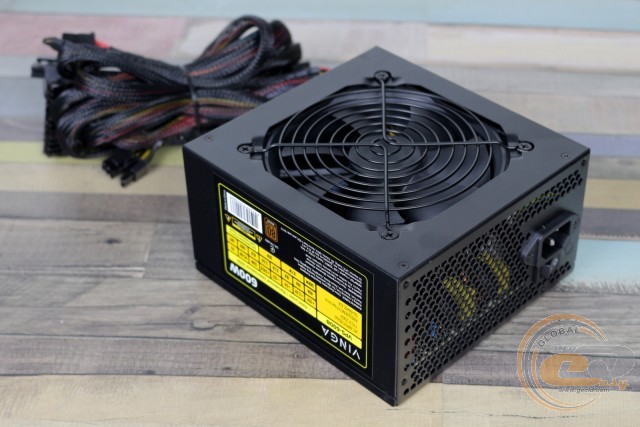
Before us is an ordinary-looking power supply that will fit into any average case. The ordinary black color will help it blend into the ecosystem of a modern system unit like the Vinga VPS-600B.
The 120 mm diameter fan is made in a similar color and covered with a removable grille.
The exhaust of heated air is handled by honeycomb-shaped holes on the rear part of the case, which are adjacent to the input power connector and the power switch. As you have already understood, in terms of design, we have an ordinary representative of the genre, whose manufacturer cannot be identified without looking at the label.
For number enthusiasts, there is a sticker with specifications. The maximum load on the device can reach 600 W, and 98% of it can be provided by the most demanded +12V line. The +5V and +3.3V channels have almost 100 W of power at their disposal - slightly more than in the case of the 500-watt unit. In other respects, there are no differences.
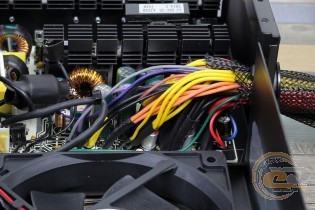
At first glance at the price of the tested PSU, it is very easy to guess that all cables are directly routed from the case. They are dressed in nylon braid, which in turn is fixed at the edges with heat shrink. No savings were made on the wire gauge - we have 18 AWG (1.02 mm in diameter with a cross-sectional area of 0.82 mm2). However, the length of all conductors, except for PCIe, turned out to be 10 cm shorter than stated. To be fair, such values should be sufficient for using the device in a Middle Tower case with a bottom-mounted PSU.
The full cable system configuration looks like this:
|
Connector Types |
Quantity |
Wire Length to Connector(s), cm |
|
20+4-pin ATX |
1 |
50 |
|
4+4-pin ATX12V |
1 |
60 |
|
two 6+2-pin PCIe |
1 |
50-65 |
|
three SATA |
2 |
50-65-80 |
|
three PATA + one FDD |
1 |
50-65-80-95 |
The main connectors are represented by a 20+4-pin ATX and a 4+4-pin ATX12V. Almost any video card can be connected using two 6+2-pin PCIe connectors, and six SATA (on two separate wires) and three PATA with FDD are provided for peripheral power.
Internal Structure
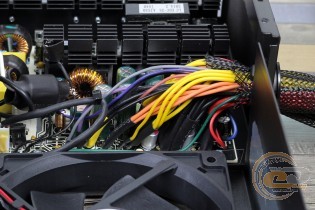
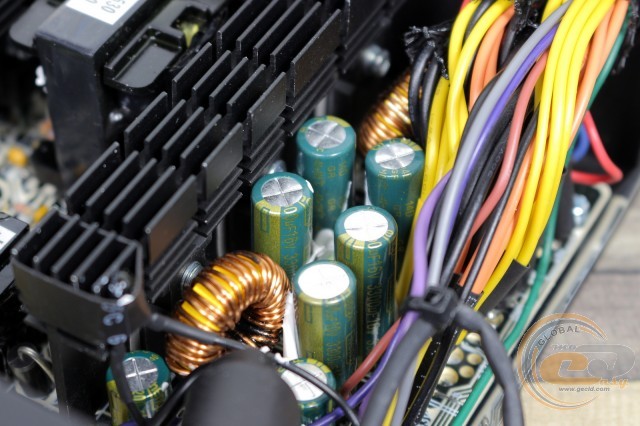
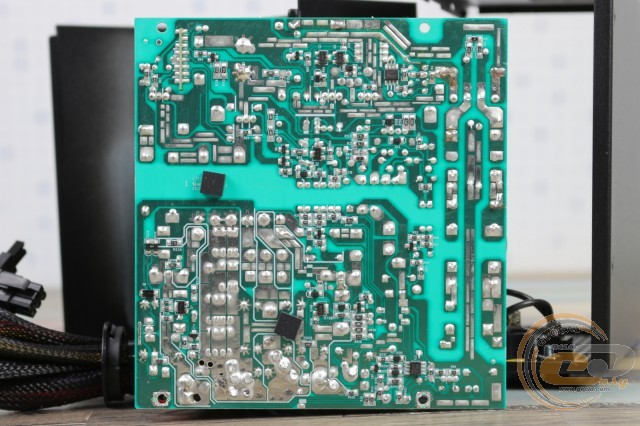
Armed with a Phillips screwdriver and unscrewing 4 screws (one of which is likely covered by a warranty seal, which should be considered), we can access the internal components of the PSU. Here, as in the 500-watt unit, there are two heatsinks with a fairly large heat dissipation area.
The successful active cooling is ensured by the same 120mm fan Aobos AAM1225S1AN (12 V, 0.16 A, 1.92 W). Given the presence of the letter "S" in the name, it is obviously based on a sleeve bearing.
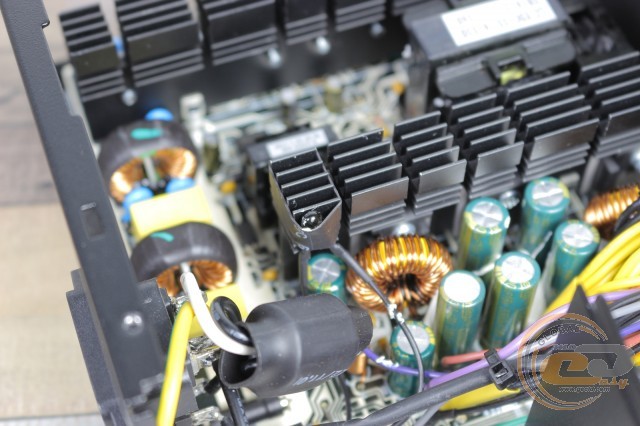
Let's move on to the circuitry. The EMI filter here consists of four Y and two X capacitors, a pair of coils, and a ferrite bead near the input connector, while protection is provided by a fuse and a varistor (model STE-14D561K). Overall, the electromagnetic filter is well-executed and boasts a proper number of components.
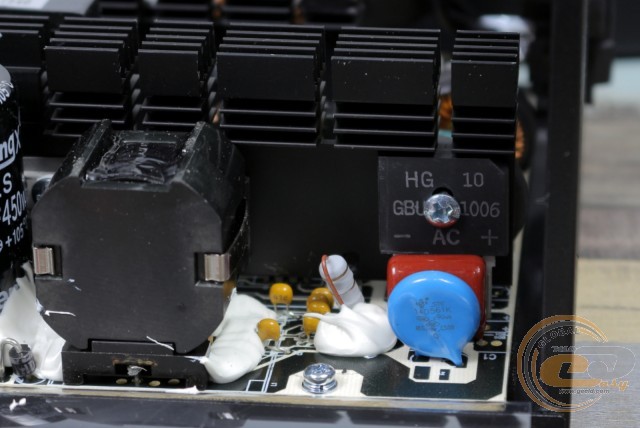
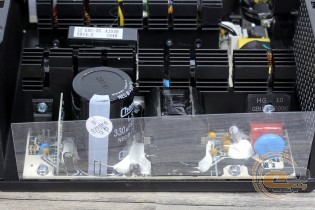
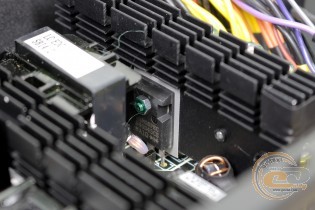
Voltage rectification is performed by the diode bridge GBU1006, rated for a current of up to 10 A. Since this element is attached to the main heatsink, we do not worry about its heating and preservation.
Nearby are the power elements of the PFC unit, including a pair of transistors SIF18N50C. The latter have an on-resistance of 280 mOhm, which is a relatively low value, positively affecting the overall energy efficiency of the source.
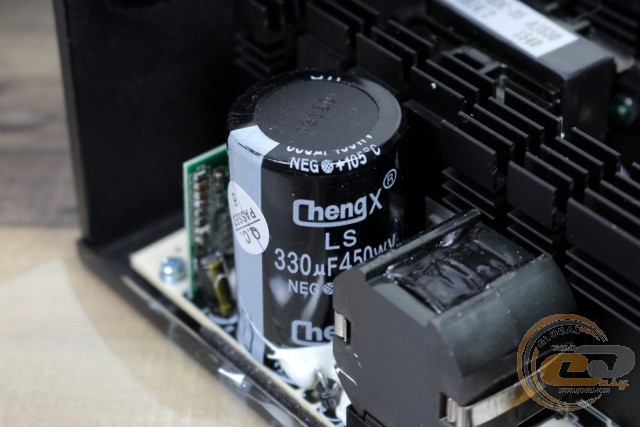
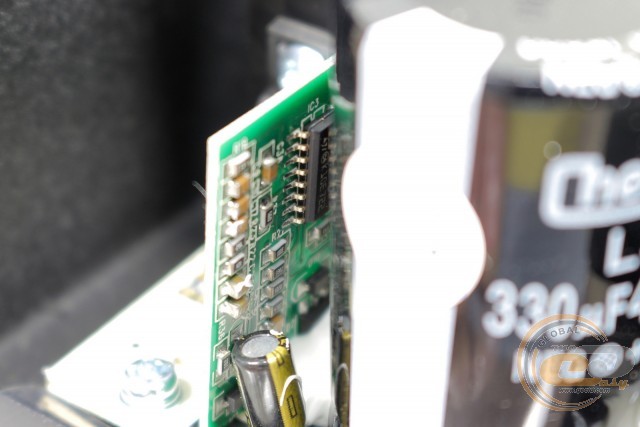
The input electrolytic capacitor is represented by a creation of ChengX (330 µF x 450 V). Its capacity is one and a half times higher than that used inside the 500-watt unit - this is already a good indicator. Among the advantages is also its belonging to the high-temperature series. It's just a pity that the reputation of this manufacturer, unfortunately, is not the best.
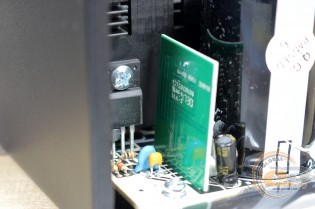
The operation of the source is controlled by the PWM controller ST L6599, specifically designed for use in PSUs with a half-bridge topology.
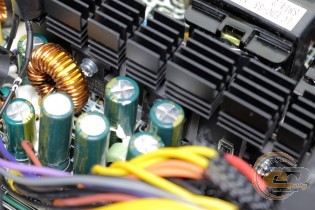
The thermosensor is fixed to the second heatsink using heat shrink. Thus, the fan speed will depend on its readings. The cooler, in turn, is designed to dissipate heat from the Schottky diodes, which are presented here in the amount of 4 pieces: a pair for the +12 V line and one each for smaller ratings.
The label indicates the maximum current for each channel. How accurate are the stated data? Let's calculate.
The maximum current is calculated using the formula I/(1 - D), where D is the duty cycle used (we assume 30%, i.e., 0.3), and I is the maximum current supported by the rectifying diode.
+12V Line
The average rectified current of the Schottky diode MOSP S40D45CS is 20 A. Since we have two diodes connected in parallel, the total current is 40 A. Substitute into the formula: 40 A/(1-0.3)=57.1 A.
Multiply by the channel's rating to get the allowable power: 57.1 A * 12 V = 685.7 W. An excellent value, even higher than stated!
Also note the low maximum voltage drop across the diode - only 0.55 V, which positively affects the heating and energy efficiency of the device as a whole.
+5V Line
The average rectified current of the Schottky diode MOSP S30D45CS is 15 A. Substitute into the formula: 15 A / (1 - 0.3) = 21.4 A.
Multiply by the channel's rating to get the allowable power: 21.4 A * 5 V = 107 W. Higher than the stated indicator, so it's a pass!
The maximum voltage drop here is the same proper 0.55 V.
+3.3V Line
Unfortunately, it was not possible to fully examine the markings on the transistor.
However, overall the obtained indicators pleased with being noticeably higher than stated. This, in turn, suggests the possibility of the Vinga VPS-600B operating even under overload, which we will definitely test.
Voltage stabilization is carried out on a group principle. We have two coils that must withstand quite a large load.
The filtration node also includes ChengX capacitors and at least a pair of reliable polymers.
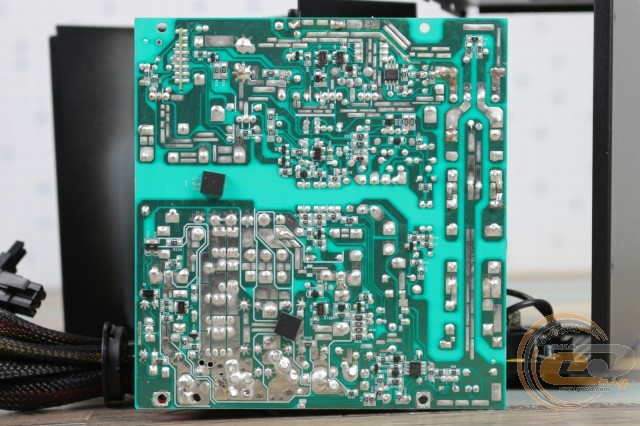
Besides circuitry, we are also interested in the safety of the device. The packaging indicates the presence of five different protections designed to preserve expensive components in case of such unforeseen situations:
- overvoltage protection (OVP);
- undervoltage protection (UVP);
- short circuit protection (SCP);
- overpower protection (OPP);
- inrush current protection (SIP).
Cross-load characteristics
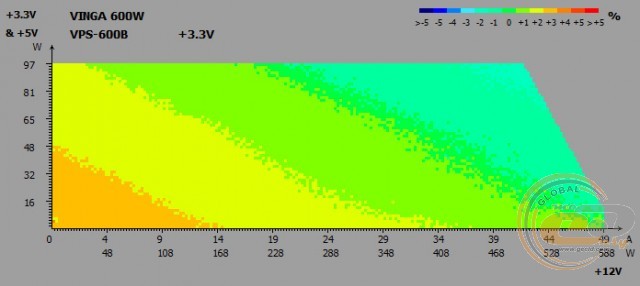
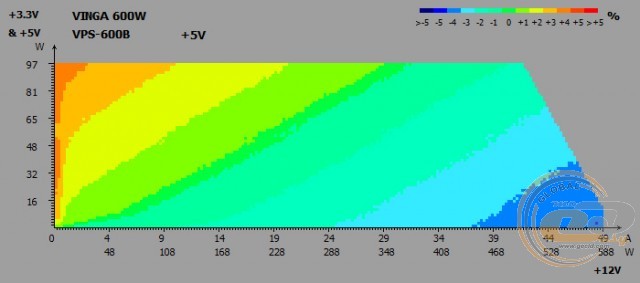
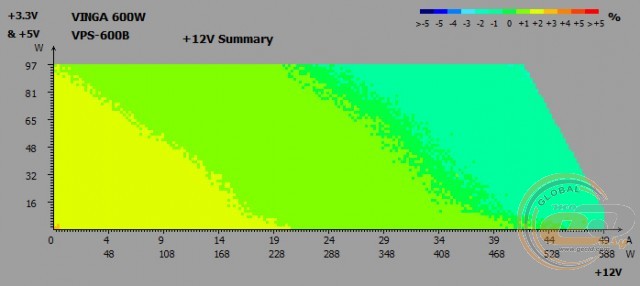
According to the ATX12V standard, the allowable range of voltage deviations for all power lines is ±5% of their nominal value.
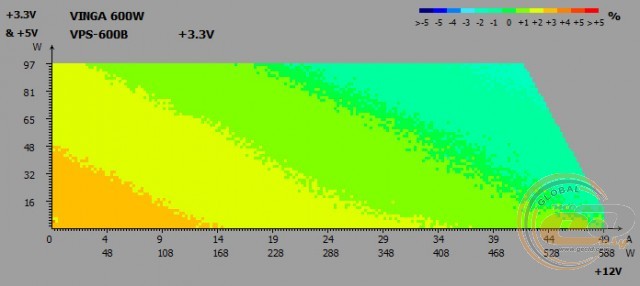
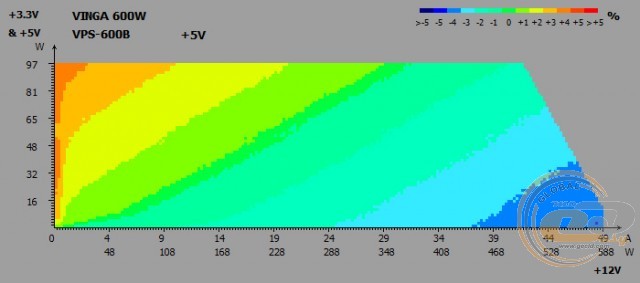
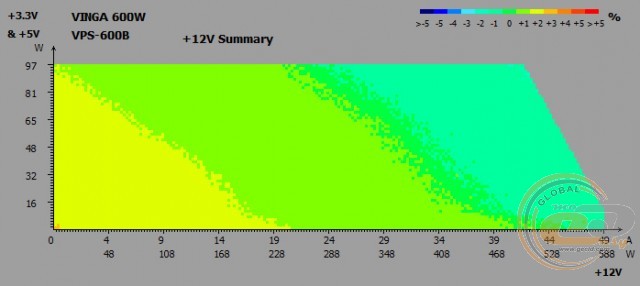
During cross-load tests on the main power lines of the Vinga VPS-600B, the following voltage deviations were recorded:
- +3.3V line: from -1% to +3%;
- +5V line: from -4% to +3%;
- +12V line: from -1% to +2%.
What can be said here - voltage stabilization turned out to be at an appropriate level. Deviations on all three lines did not even think of exceeding the allowable norms.
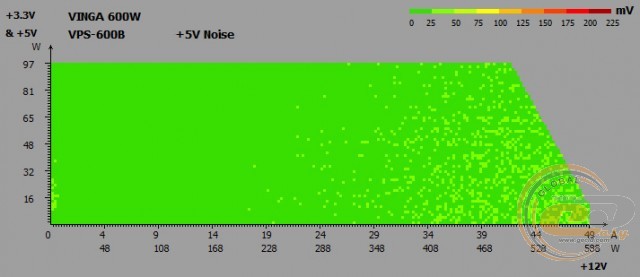
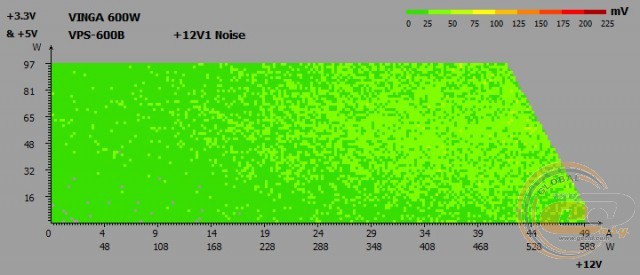
Noise and ripple across the entire voltage range
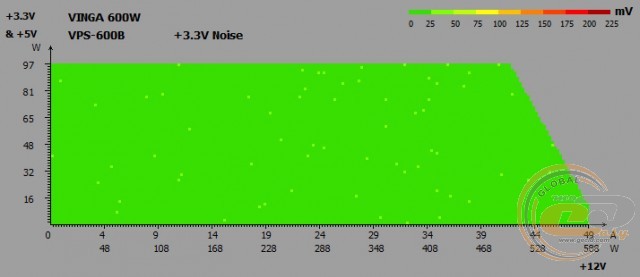
For the ATX12V standard, the following allowable norms regarding ripple level (peak-to-peak) are provided:
- +3.3V and +5V lines: 50 mV;
- +12V line: 120 mV.
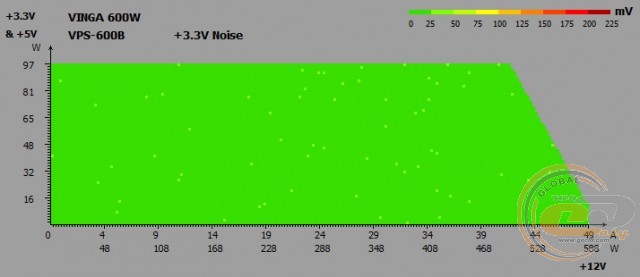
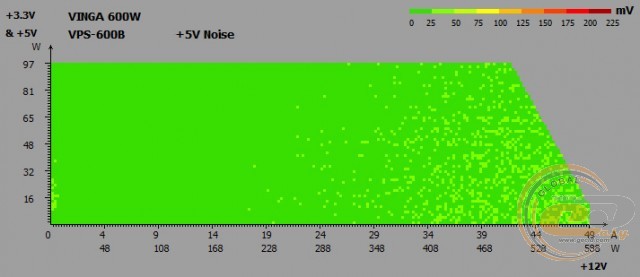
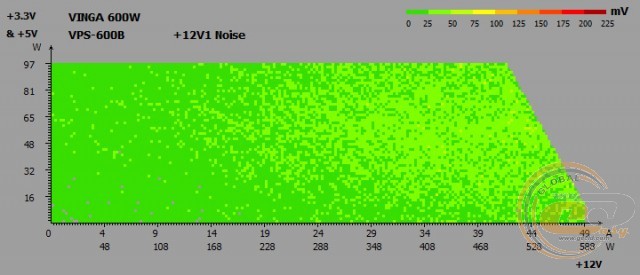
Ripple also does not cause any remarks: up to 50 mV on the lower lines and up to 75 mV on the upper one - even less than required by the ATX specification.
Standby power line +5VSB
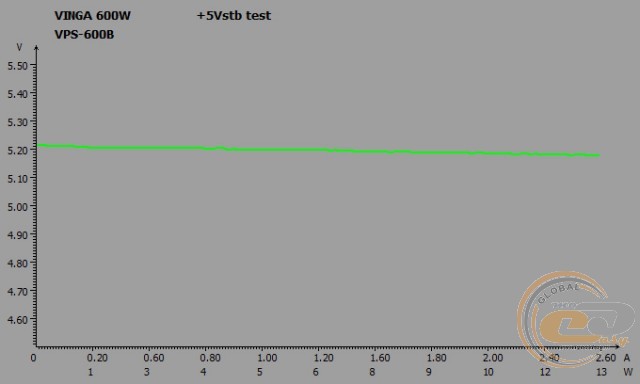
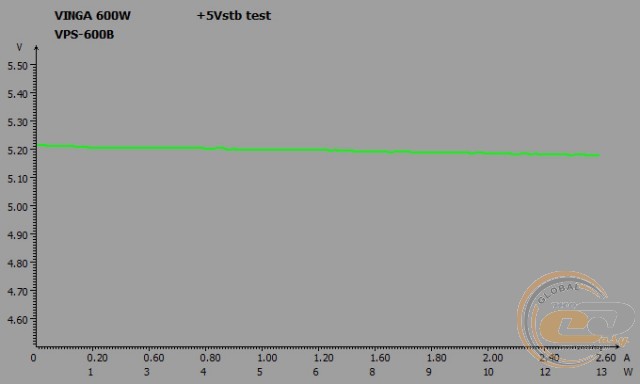
The voltage on the standby power line changes within acceptable limits depending on the load: from 5.22 to 5.17 V, not exceeding ±5%.
PFC
Table showing the change in PFC depending on the power supply load:
|
Load, W |
60 |
120 |
200 |
250 |
300 |
380 |
450 |
500 |
600 |
|
Load, % |
10 |
20 |
33 |
42 |
50 |
63 |
75 |
83 |
100 |
|
PFC |
0.8 |
0.91 |
0.96 |
0.97 |
0.98 |
0.98 |
0.99 |
0.99 |
0.99 |
Load* − load as a percentage of the power supply's nominal power.
In addition to good voltage conditions, we have a high PFC coefficient. Already at 120 W consumption, it reached 0.91, with the maximum value of 0.99 recorded at a load of 450 W and above.
Efficiency
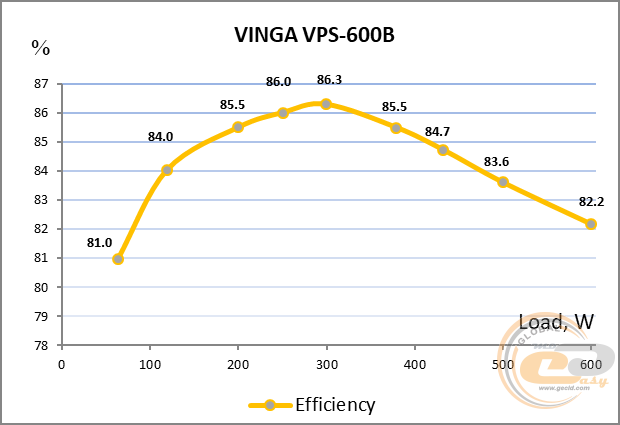
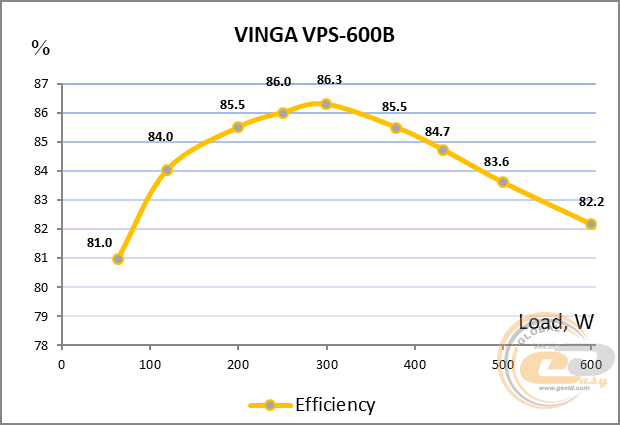
In such an inexpensive solution as the Vinga VPS-600B, it is pleasant to see full compliance with the 80 PLUS Bronze standard. The source was most efficient at half load of 300 W, which is close to the power consumption of a system based on a 95-watt processor and an NVIDIA GeForce GTX 1070 level graphics card. In this mode, the fan will have to dissipate 41 W of heat, while at nominal load (600 W) this figure will already reach 107 W.
Cooling system and temperature mode
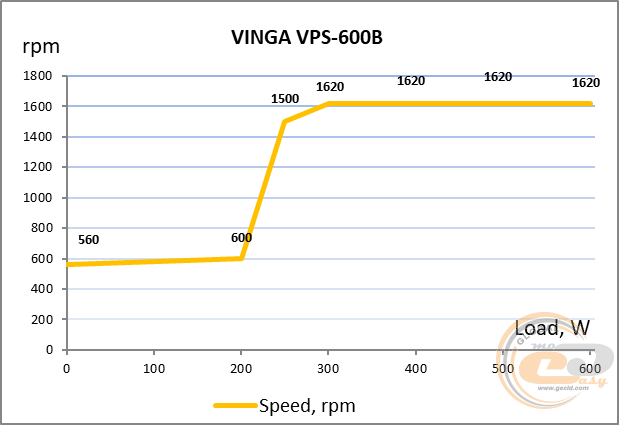
The noise level of the device can be indirectly assessed by the fan speed at different load levels. The interval after which the fan speed was measured and the subsequent power increase was about twenty minutes. The measurement results are marked with points on the graph. At the same time, the ambient temperature for the power supply was approximately 27°C. It should be noted that the air inside the computer case can be much hotter, with a temperature of 40°C being quite acceptable. Meanwhile, the load created by the computer system is variable, which facilitates the temperature regime of the power supply.
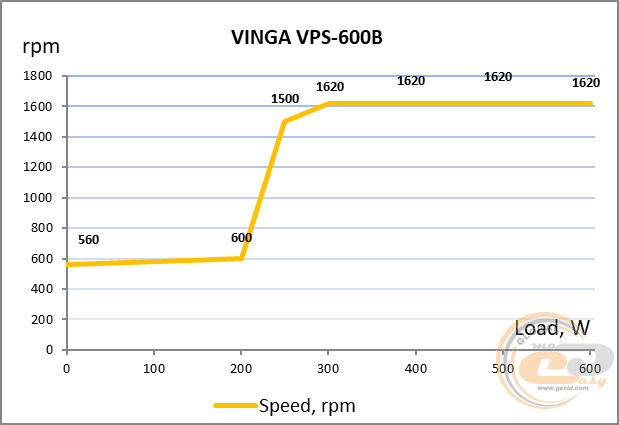
The fan inside the Vinga VPS-600B PSU mainly operates in one of two modes. The first is at a load of up to 200 W, where it spins very quietly at a speed of 560-600 RPM, and the second is a range from 250 to 600 W, where the fan reaches a nominal speed of 1500-1620 RPM. In the second case, the noise level remains very comfortable, below average.
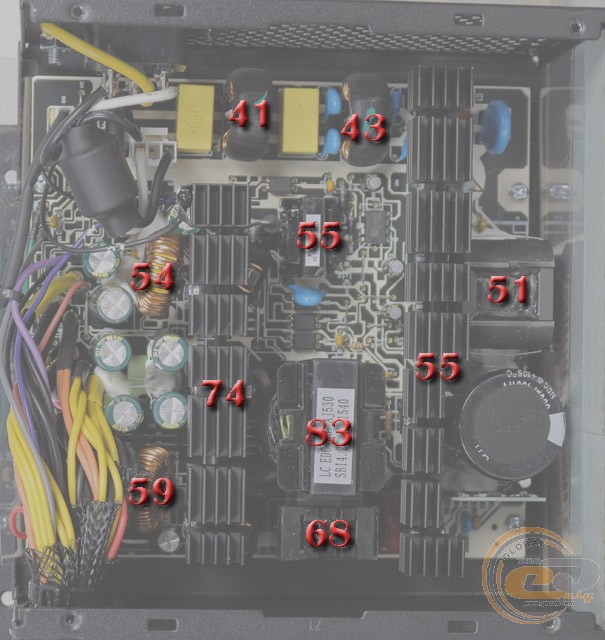
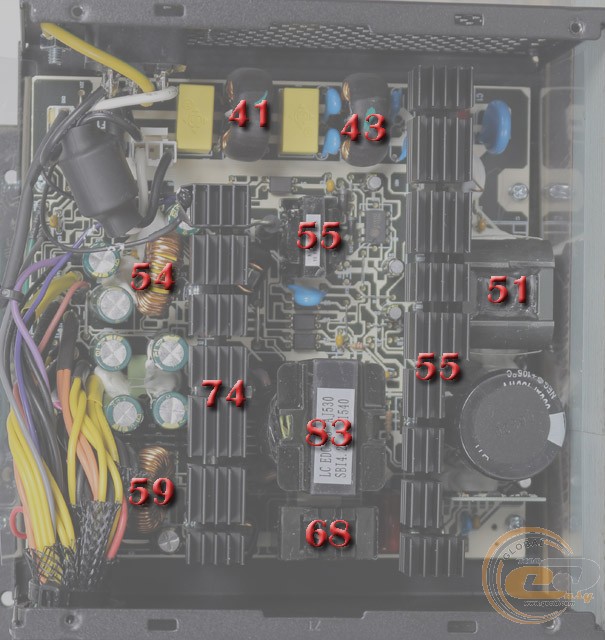
At nominal load, there is no need to fear overheating. The highest temperature was observed at the main transformer - 83°C, and this value is still far from critical. Let us remind you that these indicators were obtained under prolonged constant load, while in real conditions they will be lower.
External noises during the operation of the power supply unit
As practice has shown, across the entire range of nominal power, the Vinga VPS-600B does not produce additional noises in the form of annoying coil whine or characteristic transformer hum.
OverLOAD
The load on the tested model was increased to 700 W (+16% to nominal), at which the voltage on the +3.3V line already exceeded the permissible values. Until this point, the source showed good results within ±5%.
Practical tests on a real configuration
To build a real computer system, a powerful 6-core processor Intel Core i7-4960X operating in nominal mode was used. As a video accelerator, we used a quite powerful model ZOTAC GeForce GTX 480 AMP! with factory overclocking. It should be noted that the purpose of this experiment is to reproduce real loads of a high-performance PC and to check how the power supply unit works in practice.
|
Motherboard |
ASUS P9X79 PRO (Socket LGA2011, Intel X79 Express) |
|
Processor |
Intel Core i7-4960X (Socket LGA2011, 3.6 GHz, L3 12 MB) |
|
Cooler |
Thermalright TRUE Spirit 120M |
|
RAM |
4 x 4096 MB DDR3-1333 Transcend PC3-10600 |
|
Video card |
ZOTAC GeForce GTX 480 AMP! |
|
Hard drive |
WD Caviar Blue 1 TB (WD10EALX) |
|
Case |
Spire SwordFin SP9007B with two 120mm fans |
|
Wattmeter |
Seasonic PowerAngel |
|
Multimeter |
MASTECH MY64 |
Measurements were taken in two modes: "Idle" and "Maximum load," which was created using Linpack and FurMark 1.10.4 utilities. During testing, the total power consumption of the system was measured using a Seasonic PowerAngel device, and the voltage on the +12V, +5V, and +3.3V power lines was recorded using a MASTECH MY64 multimeter.
As a result of measuring the power supply voltage on the output lines, the following values were obtained:
|
|
Vinga VPS-600B |
|||||
|
Mode |
Value, V |
Deviation, % |
Value, V |
Deviation, % |
Value, V |
Deviation, % |
|
+12V |
||||||
|
Idle |
12.14 |
+1.2 |
12.27 |
+2.3 |
12.22 |
+1.8 |
|
Burn |
12.18 |
+1.5 |
12.23 |
+1.9 |
12.16 |
+1.3 |
|
+5V |
||||||
|
Idle |
5.17 |
+3.4 |
5.19 |
+3.8 |
5.11 |
+2.2 |
|
Burn |
5.19 |
+3.8 |
5.20 |
+4.0 |
5.05 |
+1.0 |
|
+3.3V |
||||||
|
Idle |
3.43 |
+3.9 |
3.39 |
+2.7 |
3.39 |
+2.7 |
|
Burn |
3.45 |
+4.5 |
3.38 |
+2.4 |
3.34 |
+1.2 |
|
Input Power Consumption, W |
||||||
|
Idle |
92 |
93 |
90 |
|||
|
Burn |
500 |
532 |
500 |
|||
The output voltages of the Vinga VPS-600B always remain in the "plus," not exceeding the permissible 5% deviation. Therefore, under load (Burn mode) and when the system is idle (Idle mode), the components will receive the necessary power for their stable operation, and the difference between the two modes will be a maximum of 0.04V.
As seen from the table, the +3.3V line indicators closely approach the maximum permissible mark of 3.47V. But they exceed it, as we noted above, only when operating in overload mode.
Power Consumption in Idle and Power Off States
|
Power Supply Unit |
Power Consumption in Mode, W |
|
|
Sleep |
Power Off |
|
|
Vinga VPS-600B |
7 |
3 |
|
CHIEFTEC PROTON BDF-500S |
8 |
3 |
|
Vinga VPS-550G |
8 |
3 |
The power consumption of the tested power supply unit in the computer's power-off state and in sleep mode matches the indicators of other power sources of similar capacity that have been in our test lab.
Conclusions
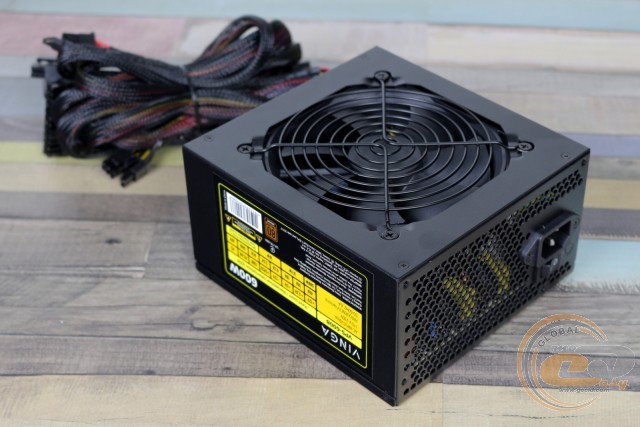
Budget does not mean "bad." The Vinga VPS-600B power supply unit won't burden your wallet, yet it will deliver the output indicators claimed by the manufacturer. Moreover, the novelty boasts high-quality power supply—forget about voltage drops below nominal! All this is complemented by high efficiency (80 PLUS Bronze), quiet cooling system operation, a range of protections, and thick power cables in the necessary quantity.
Of course, in such an affordable price category, the manufacturer made certain sacrifices. The most obvious one is the use of capacitors from a company with not the best reputation. The fan is also evidently based on a budget sleeve bearing, so its noise level will increase somewhat over time.
So, if the above-mentioned is not crucial for you, you will be satisfied with the Vinga VPS-600B power supply unit. Or find an additional $15 in your wallet to purchase the 550-watt Vinga VPS-550G—a more substantial, yet noticeably more sophisticated "golden" solution with high-quality Japanese components.
Advantages:
- good efficiency level for its price range (80 PLUS Bronze certification);
- availability of a large power reserve (up to +15%);
- good voltage condition on power lines;
- small voltage deviations when changing load without drops below nominal;
- presence of a full EMI filter;
- low ripple;
- availability of a range of protections;
- ability to operate in a wide range of network voltages;
- low power consumption in sleep mode and when the computer is off;
- use of sufficiently long wires in nylon braid;
- fairly quiet cooling system;
- active power factor correction method.
Features:
- use of capacitors with not the best reputation.
Author: Oles Paholok
Translation: Liliya Masyuk
We express our gratitude to the companies ASUS, Intel, Thermalright, Transcend, Western Digital and ZOTAC for the equipment provided for the test bench.